150. Índice.

Es un Índice, simplemente tienes que hacer Click en el Posts que sea de tu interés y directamente entrarás en el contenido.

1.-¿Qué es la ecografía?

2. Clasificación de los Ultrasonidos.

3. La Onda Ultrasónica. Características.

4. Magnitudes de la Onda Ultrasónica. La Frecuencia.

5. Magnitudes de la Onda. Otras Magnitudes.

6. Interacción del haz ultrasónico y la materia.

7. Las Interfases y sus efectos.

8. La Piezoelectricidad.

9. El haz ultrasónico.

10. El Transductor, su componentes.

11. Tipos de transductores.

12. La imagen. Modos de representarla.

13. Parámetros técnicos.

14. Parámetros técnicos. Los modos de trabajo.

15. La Ganancia General.

16. La Ganancia Parcial.

17. Freezer y Cine.

18. La Profundidad.

19. El foco.

20. Medidas.

21. La Frecuencia.

22. Los Armónicos.

23. El Rango Dinámico.

24. La Potencia de Transmisión.

25. Otros Ajustes o Parámetros.

26. Autoevaluación.

27. Efectos biomecánicos del ultrasonido.

28. La Calidad de la Imagen. La Resolución.

29. La Semiología Ecográfica. La Ecogenicidad.

30. La Homogeneidad y la Heterogenicidad de la Imagen.

31. Los Artefactos.Artefactos Beneficiosos.

32. Artefactos Nocivos.

33. La Imagen.Características y Planos de corte.

34. Protocolos. Consideraciones.

35. Protocolo de Tiroides. Consideraciones básicas.

36. Protocolo de Tiroides. Los Cortes.

37.Protocolo de Tiroides.Las imágenes.

38.Protocolo de Tiroides.La Semiología.

39.Protocolo de Tiroides.La Patología.

40. Protocolo de Abdomen. Consideraciones generales.

41. Protocolo de Abdomen.El Páncreas.

42. Protocolo de Abdomen. El Páncreas. Patología.

43. Protocolo de Abdomen. Ramas Izquierdas Portales.

44. Protocolo de Abdomen. Cava y Aorta.

45. Protocolo de Abdomen. Suprahepáticas.

46. Protocolo de Abdomen. La Vesícula y Vías biliares.

47. Protocolo de Abdomen. La Porta Transcostal.

48. Protocolo de Abdomen. Lóbulo Hepático Derecho.

48. Protocolo de Abdomen. Lóbulo Hepático Derecho.

50. El Hígado. Patología más habitual.

51. Protocolo de Abdomen. Riñón Derecho.

52. Protocolo de Abdomen. El Bazo.

53. Protocolo de Abdomen. Patología del Bazo.

54. Protocolo de Abdomen. El Riñón Izquierdo.

55. Protocolo de Abdomen. Patología Renal.

56. Protocolo de Abdomen. Aorta y Cava.

57. Protocolo de Abdomen. La Vejiga. Patología más habitual.

58. Protocolo de Abdomen. La Próstata.

59. Protocolo de Abdomen. El Útero y los Ovarios.

60. Protocolo de Mama. Exploración y tejido normal.

61. Protocolo de Mama.Signos patológicos habituales.

62. Protocolo de Estudio Escrotal.

63. Patología escrotal habitual.

64. Test.

65. Protocolo Hombro. Consideraciones.

66. Semiología Eco MSK.

67. Protocolo de Hombro. Tendón del Bíceps.

68. Protocolo de Hombro. Tendón del Subescapular.

69. Protocolo de Hombro.Tendón del Supraespinoso.

70. Protocolo de Hombro.Articulación Acromion-Clavicular.

71. Protocolo de Hombro. Tendón del Infraespinoso.

72. Protocolo de hombro. Patología básica.

73. Protocolo de Codo. Consideraciones.

74. Protocolo de Codo. Cara anterior.

75. Protocolo de Codo. Cara Lateral.

76. Protocolo de Codo.Cara Medial.

77. Protocolo de Codo.Cara Posterior.

78. Protocolo de Codo. Canal Cubital.

79. Protocolo de Codo.Patología básica.

80. Protocolo de Muñeca. Consideraciones.

81. Protocolo de Muñeca. Región Extensora.

82. Protocolo de Muñeca. Región Flexora.

83. Protocolo de Muñeca. Patología habitual.

84. Flexores de los dedos de la mano.

85. Patología de la región flexora de la mano.

86. Región Ungueal.

87. Muslo. Cara Anterior.

88. Patología Habitual Muslo Anterior.

89. Cara Posterior Muslo. Nervio Ciático.

90. Muslo Posterior. Isquiotibiales.

91. Aparato Expensor de la Rodilla. El Rotuliano.

92. El Hueco Poplíteo. Quiste de Baker.

93. Exploración ecográfica de la Pierna Posterior.

94. La Pata de Ganso.

95. Tendones Peroneos Laterales.

96. El Tendón de Aquiles.

97. Tendón Tibial Anterior y Posterior.

98. Patología Tendón TA y TP.

99. Fascia Plantar. Exploración y patología.

100. Estudio para búsqueda de Neuroma de Morton

101. Ecografía de Partes Blandas.

102. El Doppler.Nociones Básicas. Doppler Color.

103. El Doppler Pulsado.

104. Doppler TSA.

105. Protocolo MMII.

106. Pared Abdominal.

107. Ecografía Pediátrica. Consideraciones.

108. Ecografía de Caderas neonatal

109. Ecografía de Abdomen Pediátrica.

110. Hidronefrosis.

111. Pielonefritis.

112 Megauréteres.

113. Suprarrenales o Adrenales.

114. Litiasis.

115. Nefrocalcinosis.

116. Riñón en Herradura

117. Estenosis hipertrófica de píloro.

118. Invaginación intestinal.

119. Reflujo Gastroesofágico.

120. Apendicitis.

121. SNC en Pediatría.Consideraciones.

122. Ecografía Transfontanelar. Cortes Coronales.

123. Ecografía Transfontanelar. Cortes Sagitales.

124 Ecografía Transfontanelar. Estudio Vascular básico.

125. Ecografía Transfontanelar,otros accesos.

126. Ecografía Transfontanelar. Patología básica.

127. SNC. Canal Medular.

128.SNC.Canal Medular.Patología básica.

129. Punto y aparte.

130. Doppler Venoso Profundo MMSS. Consideraciones Generales.

131. MMSS II

132. Contraste Ecográfico. Consideraciones básicas.

133. El Contraste en Ecografía. El Nódulo hepático.

134. Fibromatosis Colli

135. El Tórax.

136. Los Ganglios.

137. El Bazo errante.

138. Ecocardiografía. Consideraciones generales

139. Ecocardiografía. Estudio Paraesternal Eje Largo.

140. Paraesternal Eje Corto.

141. Mediciones de los planos paraesternales.

142. Ecocardiografía.Plano Apical 4 cámaras

143. Ecocardiografía.Plano Apical 5 Cámaras.

144. Ecocardiografía.Plano Apical 2 Cámaras.

145. Ecocardiografía.Plano Apical 3 Cámaras.

146. Ecocardiografía.Segmentación y territorios vasculares.

147. Ecocardiografía. Planos Subcostales.

148. Ecocardiografía. Planos Supraesternal y Paraesternal derecho.

149. Gracias, Ecocardiografía.

150. Índice.

151. Denervación Muscular. Caso clínico.

153. El Timo.

154. La Mama Lactante.

155. Ecografía en Pediatría.Protocolos habituales,repaso.

156. Eco Fast.

158. Lipoma Gigante

159. Elastografía. Conceptos básicos.

160. La imagen ecográfica. Semiología y repaso.

161. Hilio Hepático

162. Los Riñones, un abordaje diferente.

163. Artefactos de Electricidad.

164. Tumor Glómico.

165. Dispositivos Subdérmicos.

166. Ergonomía y otras cosas…

167. Lesión ósea.

168. Urotelioma en Divertículo vesical.

169. La tormenta de Nieve. Siliconomas.

170. Rotura Muscular Antigua.

171. Doppler: Tipos y usos en Tendinopatías.

172. Apéndice Xifoides.

173. Adenoma de Paratiroides

174. Implante metastásico subcutáneo.

175. Ectopia Renal Cruzada.

176. Tofo Gotoso.

177. Pared Abdominal. Hernia.

178. ¿Dilatación Renal o Quistes Renales?

179. Lesión subcutánea

180. Inserción Biceps, cabeza de Radio, acceso posterior.

181. Riñones en IRC severa.

182. La enfermedad de Osgood-Schlatter

183. Trombosis parcial de la vena Safena Interna.

184. Litiasis renales. Rx, TC y Ecografía.

185. Rx Portátil. Técnica del “arrastrón”.

186 Entesopatía y estudio de la inserción proximal del recto anterior del muslo.

187. Neuroma de Morton. Maniobra de movilización.

188. Cola de Páncreas. Técnica del vaso de agua.

189. Hiperplasia Nodular Focal.

190. Patología maligna del Testículo. Semiología habitual.

191. Rotura de Tendón Supraespinoso. Tipos y Semiología.

192. Divertículo esofágico de Killiam-Jamieson.

193. Edema y Absceso en ecografía. Semiología habitual.

194. El Hamartoma.

195. Rotura de la placa plantar.

196. Patología cutánea.

197. El Doppler y su evolución.

198. Psudoaneurisma renal con hematoma y angiomilipoma.

199. Nódulo de la hermana Mary Joseph.

200. Tumor Phyllodes.

201. Manejo de equipos y ajustes básicos en ecografía

202. Ectasia ductal y Papiloma intraductal.

203. El Infierno tiroideo.

204. Quiste de Nuck.

205. Semiología y tumoración renal.

206. Calcificaciones distróficas + Síndrome de Haglund.

207. Panoramic View.

208. Clasificación Ti-Rads. Nódulos tiroideos.

209. El Seroma

210. Sartorio, rotura fibrilar

211. La Vesícula.

212. Hemiagenesia tiroidea.

213. Hemorragia neonatal. Clasificación – Grados.

214. Lesiones Testiculares.

215. “Quistes” mamarios.

216. Calcificaciones migradas.

217. Calcificación inserción del tendón pectoral.

218. Protocolo básico Ecografía Doppler Renal.

219. Mastopatía diabética.

220. Luxación Tendón Bíceps

221. La Vejiga. Preparación.

222. Paraganglioma de cordón espermático.

223. Endometriosis

224. Tiroidectomía.

225. Epitelioma calcificado de Malherbe o Pilomatrixoma.

226. Lipomas.

227. Quiste epidermoide.

228. Liposarcoma

229. Fractura cabeza de radio.

230. Tumor de Células Gigantes

231. Pseudoaneurisma de vaso superficial.

232. Impingement del Hombro

233. Artefactos que “emborronan” la imagen.

234. Quiste ovárico ¿Hemorrágico?

235. Candidiasis cerebral neonatal.

236. Quiste parameniscal.

237. Neuropatía del Nervio Radial.

238. Síndrome de Zinner

239. Fractura falange distal

240. Curso de Ecografía para TSIDMN

241. Rotura del Extensor Largo del Pulgar. Tercer Compartimento.

242. La Vesícula, Adenomiomatosis y Gorro Frigio

243. Quiste del Uraco

244. Absceso Muscular por Staphilococo

245. INTERACCIÓN DEL HAZ DE US CON LA MATERIA.

246. Segunda Edición Del Curso de Ecografía para TSIDyMN NIVEL 1.

247. El Caballero Blanco.

248. Clasificación Bi-Rads.

249. Atrofia grasa de los Rectos Abdominales.

250. Ecografía de Tórax, Líneas A y B.

251. Triple Patología Vesicular.

252. Mastitis.

253. Helix Calcificado.

254. Muñeca de bebé. Enfermedad de De Quervain

255. Sarcoidosis Esplénica

256. Lipoma Intramuscular del Músculo Romboides.

257 El Síndrome del Cascanueces.

258. I Congreso Nacional de Ecografía para TSID. Octubre 2022.

259. Mastectomía bilateral. Lesión pectoral.

260. Deflux.

261. Prótesis Testicular.

262. Quiste Hidatídico Calcificado.Clasificación de Gharbi.

263. La Columna de Bertin.

264. El Músculo Digástrico.

265. Espina de Palmera.

266. Hemorragia Suprarrenal Neonatal Izquierda


149. Gracias, Ecocardiografía.

«Hasta aquí llega esta serie de post sobre ecocardiografía, que sin duda alguna es un mundo apasionante. Aprovecho para dar las gracias a Antonio Lanzas por su magnífico blog que ha conseguido poner sencillez y sensatez en una técnica compleja como es la eco. Me consta que hay personas que han “sentido la llamada del ultrasonido” gracias a esta colección. Y también dar las gracias a la sección de cardiología no invasiva del Hospital Gregorio Marañón (Madrid, España) por darme la oportunidad de aprender ecografía cardiaca para, ahora, unos cuantos años después (no diré cuántos por no dar pistas de mi edad), pueda sentarme a escribir esta serie de ecocardio para todos los interesados que estáis leyendo esto. Mi reconocimiento desde aquí a Miguel A. García Fernández, que copió en su momento la forma de trabajar de los cardiólogos ecocardiografistas americanos y llevó ese modelo a España; gracias a él, podemos trabajar codo con codo los cardiólogos, enfermeras y técnicos para ofrecer a los pacientes la mejor atención, que no debemos olvidar que son el centro de nuestro trabajo.»

Javier Álvarez.

Hay personas que te hacen la vida fácil, muy muy pocas, personas que sin saber muy bien porqué están ahí siempre.Personas que no es que te ayuden cuando les necesitas, sino que  siempre están, y este tipo de personas es Javier Álvarez González, un excelente profesional y un excelente amigo.

Él es el autor de todos los Posts sobre Ecocardiografía, el que escribe ahora sólo es el conector, el intermediario de la información que os ha llegado en el Blog y que espero que os sea de provecho porque tiene un altísimo valor.

Quería dejar aquí escrito, mi agradecimiento eterno por los Posts, por las fotos y los clips, por su capacidad de trabajo enorme, por completar el Blog y hacerlo una aventura intensa, costosa, pero absolutamente maravillosa, he tenido la suerte de poder rodearme de Javier y no me quiero olvidar de Alejandro, que es el autor y especialista de los Posts de Doppler.

Antonio Lanzas.

148. Ecocardiografía. Planos Supraesternal y Paraesternal derecho.

Vamos llegando al final de nuestro protocolo de screening y lo hacemos con el abordaje supraesternal, que en algunos sitios no entra dentro del protocolo estándar y en otro sí.

Con este plano vamos a tener una visión del arco aórtico y si el paciente es de pequeño tamaño, también podremos ver desde aquí la aorta ascendente proximal, que ya teníamos estudiada tanto en el paraesternal eje largo, como en el apical 5 cámaras, apical 3 cámaras y, posiblemente, en el subcostal 5 cámaras.

Entonces, si ya estaba tan bien estudiada la aorta ascendente, ¿para qué más? ¿No será una pérdida de tiempo? Bueno, como decía al principio este plano no es estándar en todos los servicios. Desde luego sí será obligatorio en caso de:

  1. Dilatación de la aorta ascendente vista en los otros planos: En este caso debemos explorar toda la aorta que podamos hasta que vuelva a tener un calibre normal. Hipotéticamente, si nuestras imágenes son concluyentes, se podría prescindir de un TAC con contraste posterior (radiación + yodo). Además, podemos evaluar la luz verdadera con el Doppler color en caso de aneurisma.
  2. Insuficiencia aórtica severa: Será severa, pero muy severa, si la regurgitación aórtica es capaz de “arrastrar hacia atrás” el flujo desde el cayado aórtico o incluso la aorta descendente torácica. Es fácilmente visible con el Doppler color y con el Doppler espectral.
We are coming to the end of our screening protocol and we do it with the suprasternal approach, which in some places does not fit into the standard protocol and in another it does.
With this plane we will have a view of the aortic arch and if the patient is of small size, we can also see from here the proximal ascending aorta, which we had already studied both in the parasternal long axis, and in the apical 5 chambers, apical 3 chambers and, possibly, in the subcostal 5 chambers.
So, if the ascending aorta was already well studied, why else? Is not it a waste of time? Well, as I said at the beginning, this plan is not standard in all services. Of course it will be mandatory in case of:
  1. Dilation of the ascending aorta seen in the other planes: In this case we should explore all the aorta that we can until it has a normal caliber again. Hypothetically, if our images are conclusive, we could do without a CT with posterior contrast (radiation + iodine). In addition, we can evaluate true light with color Doppler in case of aneurysm.
  2. Severe aortic insufficiency: It will be severe, but very severe, if the aortic regurgitation is able to «drag back» the flow from the aortic arch or even the thoracic descending aorta. It is easily visible with color Doppler and with spectral Doppler.

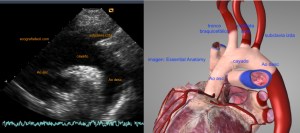
Para conseguir la imagen que te presento (clip 20) hay que apoyar la sonda en el manubrio esternal y dirigir el haz de ultrasonidos hacia caudal y posterior y con ligera rotación que coincida con la oblicuidad posteroanterior de la aorta. Hay que ir jugando con angulación y rotación hasta conseguir el clip que te presento. En la figura 32 tienes el esquema de las estructuras anatómicas visualizadas.

To obtain the image that I present to you (clip 20), the probe should be supported on the sternal handle and the ultrasound beam directed towards the caudal and posterior and with a slight rotation that coincides with the posteroanterior obliquity of the aorta. You have to go playing with angulation and rotation until you get the clip that I present to you. In figure 32 you have the diagram of the anatomical structures visualized. 


Fig 32.

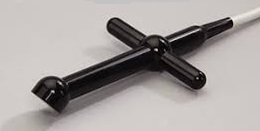
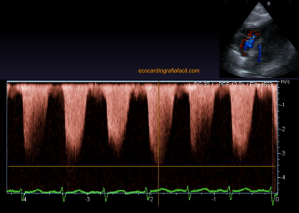
Como planos complementarios a nuestro estudio también podemos estudiar la aorta abdominal (cuya calidad de imagen será muy “paciente-dependiente”) y también existen los planos paraesternales derechos, donde el paciente se tumba sobre su costado derecho y trataremos de evaluar la velocidad máxima aórtica en caso de estenosis severa. En muchas ocasiones, para este último abordaje vamos a cambiar nuestra sonda y emplearemos una sonda “ciega”, que es una con aspecto de lapicero, de pequeño tamaño (figura 33) y que sólo nos va a dar Doppler espectral continuo no habrá imagen. Hay que ir “escuchando” los flujos hasta que encontremos una curva de calidad sobre la que mediremos los gradientes máximo y medio y con ellos, calcular el área de la válvula aórtica. Como nuestra sonda ciega está en el tórax anterior derecho, y la aorta ascendente proximal viene desde la parte izquierda del tórax del paciente, la curva que veremos será positiva en vez de negativa como hemos estado viendo hasta ahora. Eso significa que habrá que poner la línea basal del espectro en una posición inferior, como ves en la figura 33.

As complementary planes to our study we can also study the abdominal aorta (whose image quality will be very «patient-dependent») and there are also the right parasternal planes, where the patient lies on his right side and we will try to evaluate the maximum aortic velocity in case of severe stenosis. In many occasions, for this last approach we are going to change our probe and we will use a «blind» probe, which is a pencil-like probe, of small size (figure 33) and that will only give us continuous spectral Doppler  there will be no image. You have to go «listening» to the flows until we find a quality curve on which we will measure the maximum and average gradients and with them, calculate the area of ​​the aortic valve. Since our blind catheter is in the right anterior thorax, and the proximal ascending aorta comes from the left side of the patient’s chest, the curve we will see will be positive rather than negative as we have been seeing so far. That means that you have to put the baseline of the spectrum in a lower position, as you see in Figure 33.

Fig 33


147. Ecocardiografía. Planos Subcostales.

La siguiente parada en nuestro protocolo será el abordaje subcostal. Pediremos al paciente que se coloque en supino. Situaremos la sonda en el epigastrio, ligeramente desplazada hacia la derecha y con una dirección anteroposterior, caudocraneal y derecha-izquierda. Casi siempre habrá que presionar con firmeza y os aseguro que no es agradable para el paciente.

Podremos ver el corazón a través de parte del hígado. Normalmente tendremos que aumentar la profundidad y en consecuencia, bajar la frecuencia.

Pero este abordaje tiene sus ventajas y es que cuando tenemos mala ventana por paraesternal y por apical (el ejemplo típico es un paciente con EPOC), el abordaje subcostal nos va a salvar los muebles.

The next stop in our protocol will be the subcostal approach. We will ask the patient to be placed in supine. We will place the probe in the epigastrium, slightly displaced to the right and with an anteroposterior direction, caudocraneal and right-left. It will almost always be necessary to press firmly and I assure you that it is not pleasant for the patient.
We can see the heart through part of the liver. Normally we will have to increase the depth and, consequently, lower the frequency.
But this approach has its advantages and that is that when we have bad view by parasternal and apical (the typical example is a patient with COPD), the subcostal approach will help us

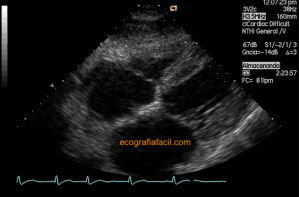
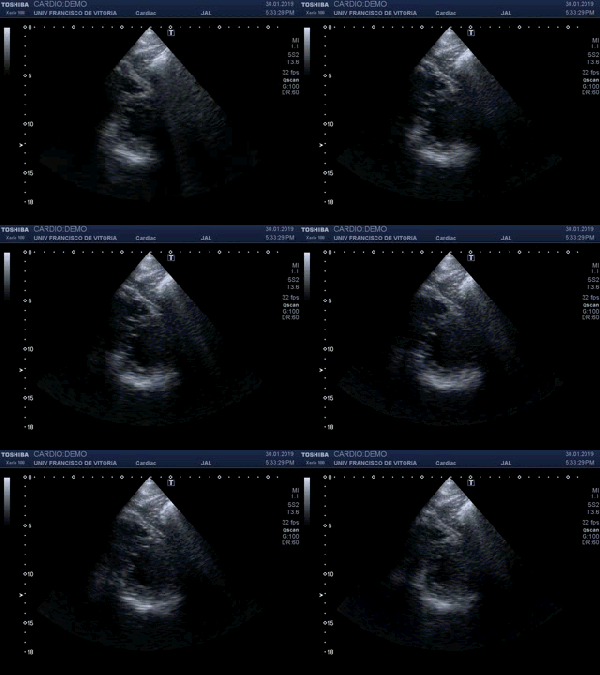
La primera imagen que vamos a obtener será un cuatro cámaras (figura 29) así que el análisis de la contracción, el tamaño de las cavidades y el grosor del miocardio es similar al apical 4 cámaras. Si angulamos un poco más, incluso podremos desplegar la aorta en el centro del corazón y tenemos un 5 cámaras donde podemos poner también un Doppler espectral para hacer mediciones de gradientes. También es posible valorar el llenado mitral, y girando adecuadamente la sonda, obtener una buena alineación de la barra de muestra Doppler continuo con una insuficiencia mitral para, posteriormente, calcular la Presión Sistólica Pulmonar (PSAP) (figura 30).

The first image that we will obtain will be a four chambers (figure 29) so the analysis of the contraction, the size of the cavities and the thickness of the myocardium is similar to the apical 4 chambers. If we angulate a little more, we can even deploy the aorta in the center of the heart and we have a 5 chambers view where we can also put a spectral Doppler to make measurements of gradients. It is also possible to assess mitral filling, and by appropriately rotating the probe, obtain a good alignment of the continuous Doppler sample bar with mitral insufficiency to subsequently calculate the Pulmonary Systolic Pressure (PSAP) (Figure 30).

Fig 29.

Fig 30

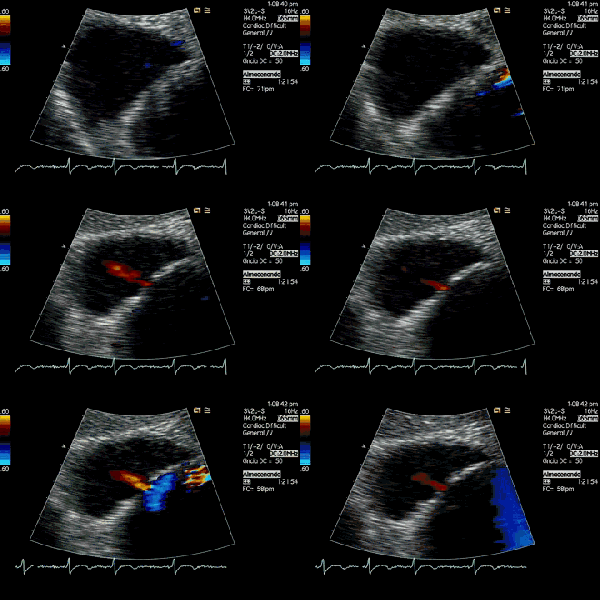
Pero sin duda, hay dos patologías “protagonistas” de este plano en este abordaje. La primera es la visualización de comunicaciones interauriculares (ya sea por CIA verdadera o por foramen oval permeable), como puedes ver en el clip 16.

But undoubtedly, there are two pathologies «protagonists» of this plane in this approach. The first is the visualization of interatrial communications (either by true CIA or permeable foramen ovale), as you can see in clip 16.

Clip 16

La segunda es la visualización de derrame pericárdico, que cuando es severo se observa en otros planos, pero que en caso de ser de menor cuantía, puede no ser visible en ningún otro abordaje (clip 17). No es el caso de este ejemplo, ya que se trata de un derrame pericárdico severo que produce un “swing-heart”, pero le tengo cariño a este clip por ser mi primera experiencia con los derrames.

The second is the visualization of pericardial effusion, which when severe is observed in other planes, but which, if it is of lesser quantity, may not be visible in any other approach (clip 17). It is not the case of this example, since it is a severe pericardial effusion that produces a «swing-heart», but I am fond of this clip because it is my first experience with spills.

Clip 17.Además, se puede valorar indicentalmente la presencia de derrame pulmonar en diversos grados de evolución. Existe otro protocolo de estudio ecográfico de pulmón, pero lo dejamos para otro post.

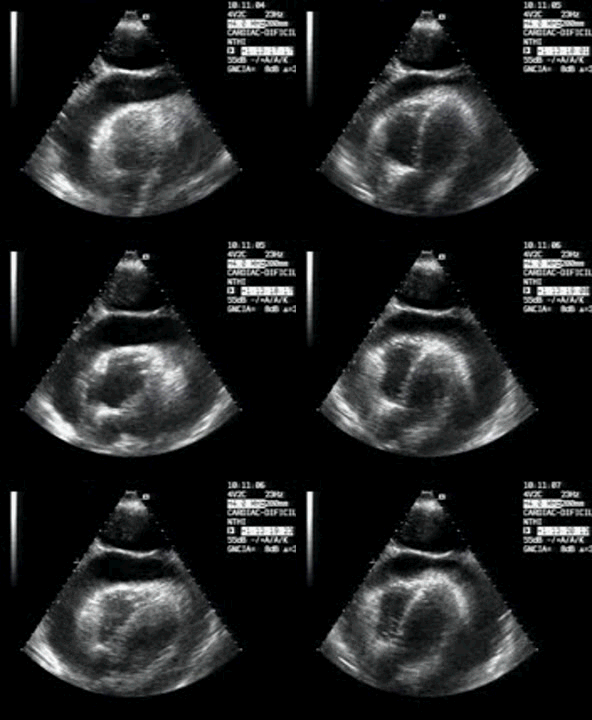
Bien, además del plano 4 cámaras podemos hacer una rotación de la sonda, como siempre, de 90º en sentido horario (ojo, en esta ocasión es en sentido horario) para obtener un “eje corto”. Al igual que en el eje corto paraesternal, podemos ir angulando la sonda para barrer todo el ventrículo y analizar la contracción segmentaria (clip 18). A la hora de describir los segmentos y paredes con movilidad alterada hay que tener cuidado: lo que en el paraesternal es la cara anterior, en el subcostal es la cara inferior o lateralinferior. Pensad dónde se coloca la sonda y desde donde estamos apuntando al corazón.

In addition, the presence of pulmonary effusion in various degrees of evolution can be evaluated indicentally. There is another lung ultrasound study protocol, but we leave it for another post.
Well, in addition to the 4 chambers plane we can rotate the probe, as always, from 90º in a clockwise direction (eye, this time in a clockwise direction) to obtain a «short axis». As in the parasternal short axis, we can angulate the probe to sweep the whole ventricle and analyze the segmental contraction (clip 18). At the time of describing the segments and walls with altered mobility, care must be taken: what in the parasternal is the anterior face, in the subcostal is the inferior or lateral inferior side. Think about where the probe is placed and where we are pointing to the heart

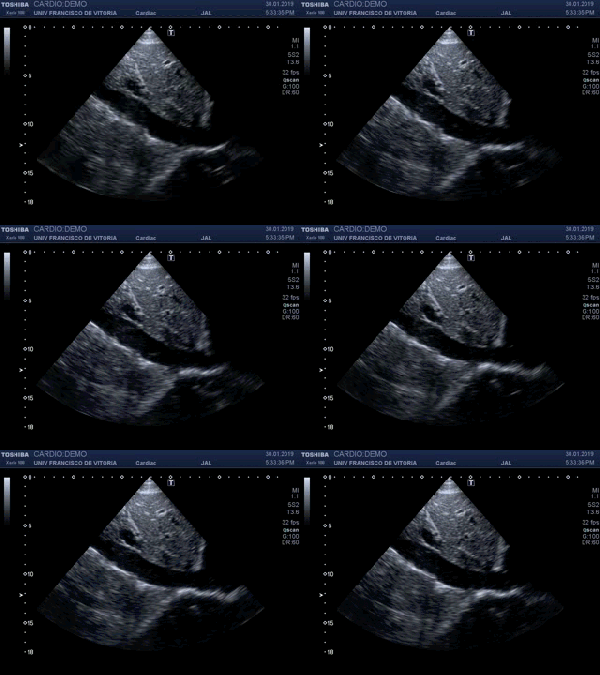
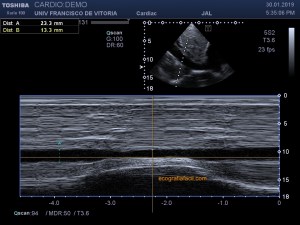
Por último en este abordaje vamos a evaluar la vena cava inferior. ¿Para qué? Nos gusta saber qué calibre tiene y cómo se comporta frente a la inspiración. Pensad que las venas sufren continuamente compresiones extrínsecas que ayudan al avance de la sangre. En las piernas son los gemelos al caminar; en el abdomen es el diafragma al respirar. Lo ideal es encontrar una vena cava que no sea demasiado gruesa y que se colapse más del 50% con la respiración fisiológica. Si está dilatada y/o se colapsa menos del 50% es un dato que apunta a hiperpresión pulmonar. Si lo ponemos en contexto con la velocidad máxima de la insuficiencia tricúspide y con un tiempo de aceleración acortado en la arteria pulmonar, tenemos todos los datos para valorar de forma no invasiva la PSAP. La vena cava inferior puede valorarse cerca de su desembocadura en la aurícula derecha, ya sea en modo 2D (clip 19) o bien en modo M (figura 31), que particularmente, es el que prefiero.

Finally, in this approach, we will evaluate the inferior vena cava. For what? We like to know what caliber he has and how he behaves in the face of inspiration. Think that the veins continually suffer extrinsic compressions that help the advance of the blood. In the legs are the twins when walking; in the abdomen is the diaphragm when breathing. The ideal is to find a vena cava that is not too thick and that collapses more than 50% with physiological breathing. If it is dilated and / or collapses less than 50% is a finding that points to pulmonary hyperpressure. If we put it in context with the maximum velocity of tricuspid insufficiency and with a shortened acceleration time in the pulmonary artery, we have all the data to evaluate non-invasively the PSAP. The inferior vena cava can be assessed close to its mouth in the right atrium, either in 2D mode (clip 19) or in M ​​mode (figure 31), which is particularly preferred.

Clip 19.

Fig 31.

146. Ecocardiografía.Segmentación y territorios vasculares.


Hemos estado hablando de la Fracción de eyección del VI y de la contracción global y segmentaria. Pero, ¿qué es eso de “segmentaria”?

Como todos los órganos, el miocardio tiene una vascularización múltiple y en caso de estenosis coronaria, no tenemos “todos los huevos en la misma cesta” y existe mayor probabilidad de seguir con la función global, aunque uno de los apartados entre en disfunción.

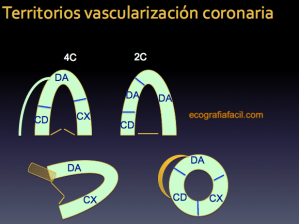
De esta manera, existen varias arterias coronarias que van a irrigar diferentes partes del músculo cardiaco. En la fig. 27 puedes ver la distribución coronaria. La gente que hace estudios hemodinámicos tiene bien controlado este apartado.

We have been talking about the LV ejection fraction and the global and segmental contraction. But, what is that of «segmentary»?
Like all organs, the myocardium has a multiple vascularization and in case of coronary stenosis, we do not have «all the eggs in the same basket» and there is a greater probability of continuing with the global function, although one of the sections goes into dysfunction.
In this way, there are several coronary arteries that will irrigate different parts of the heart muscle. In fig. 27 you can see the coronary distribution. People who do hemodynamic studies have this section well controlled.

Fig 27.

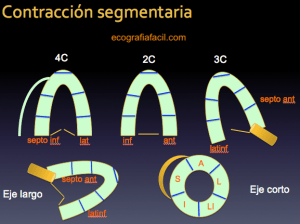
Y para llevar esa vascularización a cada zona muscular particular, se ha dividido cara pared del VI en 3 segmentos: basal, medio y apical. De manera que en total, y sólo para el VI tenemos 16 segmentos: cara anterior, lateral, lateralinferior, inferior y septo son 5 caras, que por 3 segmentos cada una suman un total de 15 segmentos. El segmento número 16 es la puntita. La parte más distal del ápex. Si estás en nivel avanzado, también puedes decir que el septo interventricular se divide a su vez en 2: septo inferior (el que ves en el eje largo) y septo anterior (el que ves en el 4 y 5 cámaras).

La fig. 28 es un esquema de los planos ecocardiográficos y su segmentación. En ella puedes ver el nombre de cada pared y sus tres segmentos.

Cada segmento pertenece más o menos a una coronaria. Si ha habido un infarto, la parte correspondiente dejará de contraerse. El reto clínico es revascularizar precozmente ese sector (ceteterismo) y hacer gimnasia (rehabilitación cardiaca) para que el músculo vuelva a tener función y todo quede en un susto. En caso de que no exista viabilidad para una pared en concreto, esta se verá adelgazada e hiperecóica, ya que prevalecerá el tejido conectivo por encima del tejido contráctil, al igual que en las cicatrices fibrosas musculares que podemos ver con ecografía en los músculos esqueléticos.

And to bring this vascularization to each particular muscular zone, the LV wall has been divided into 3 segments: basal, middle and apical. So that in total, and only for the VI we have 16 segments: anterior face, lateral, inferior side, inferior and septum are 5 faces, that for 3 segments each add a total of 15 segments. Segment number 16 is the tip. The most distal part of the apex. If you are at an advanced level, you can also say that the interventricular septum is divided into 2: lower septum (the one you see on the long axis) and anterior septum (the one you see in the 4 and 5 chambers).
Fig. 28 is a diagram of the echocardiographic planes and their segmentation. In it you can see the name of each wall and its three segments.
Each segment belongs more or less to a coronary. If there has been a heart attack, the corresponding part will stop contracting. The clinical challenge is to revascularize that sector early and to do gymnastic (cardiac rehabilitation) so that the muscle has a function again and everything remains in a fright. In case there is no viability for a concrete wall, it will be thinned and hyperechoic, since the connective tissue will prevail over the contractile tissue, as in the muscular fibrous scars that we can see with ultrasound in the skeletal muscles.

Fig 28

145. Ecocardiografía.Plano Apical 3 Cámaras.

Ya vamos terminando con los planos apicales. Sólo nos falta el tres cámaras.

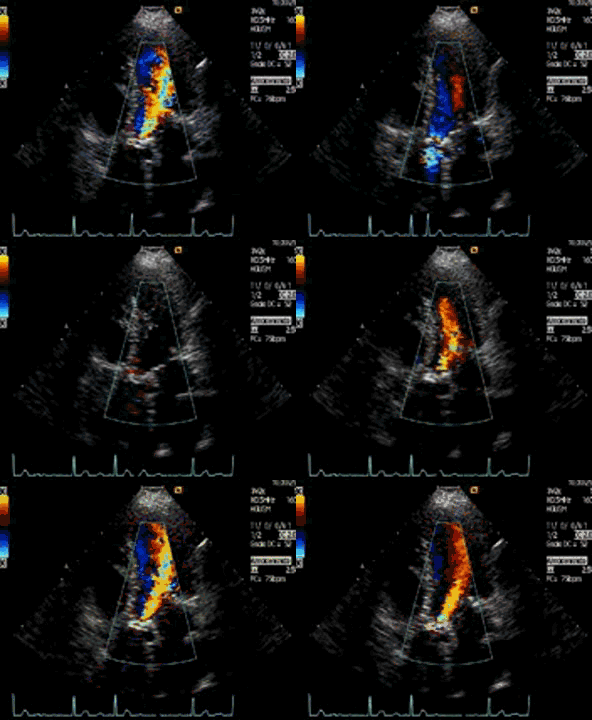
Para conseguirlo (clip 14) partimos del 2 cámaras e imprimimos un poco más de rotación antihoraria a la sonda, hasta que la válvula aórtica asome por el lateral derecho del monitor.

We are already finishing with the apical planes. We only need the three cameras. To achieve this (clip 14) we start from the 2 chambers view and print a little more anti-clockwise rotation to the probe, until the aortic valve appears on the right side of the monitor.

Clip 14

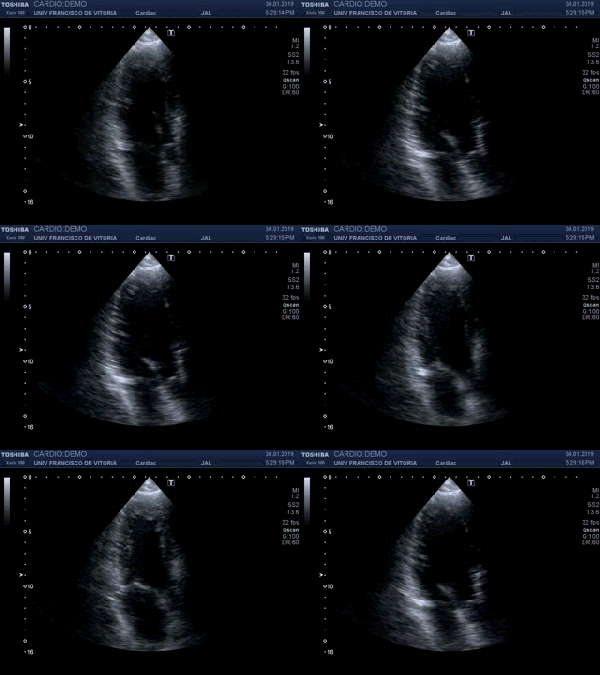
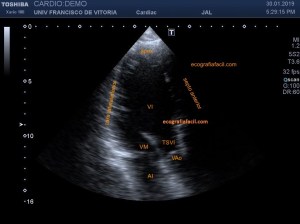
La utilidad de este plano es observar otras paredes del VI para objetivar otros segmentos de las paredes del VI y poder describir las alteraciones en la contracción segmentaria además de la contracción global (fig. 26). En el próximo post explicaremos la segmentación de las diferentes paredes y los territorios vasculares coronarios.

The usefulness of this plane is to observe other LV walls to objectify other segments of the LV walls and to be able to describe the alterations in the segmental contraction as well as the global contraction (Figure 26). In the next post we will explain the segmentation of the different walls and coronary vascular territories.

Fig 26.

Además del estudio muscular, en este plano (que se parece al eje largo, pero con el corazón puesto de pie) se valora bien la patología de la válvula mitral que cursa con prolapso de la misma. Por este motivo hay que cuidar bien los parámetros para obtener una imagen de calidad y, llegado el caso, hacer un zoom selectivo sobre la válvula. Los prolapsos suelan dar insuficiencia con jet de pared que pueden escaparse e infravalorarse si no vamos a buscarlos específicamente.

Aquí también pondremos el color para ver esa insuficiencia (clip 15). Y en este plano también pueden verse insuficiencias aórticas con jets excéntricos. Si ese es el caso, realizaremos las mismas maniobras que hicimos en el 5 cámaras.

Also the muscular study, in this plane (which resembles the long axis, but with the heart standing), the pathology of the mitral valve with prolapse of the mitral valve is well evaluated. For this reason, we must take good care of the parameters to obtain a quality image and, if necessary, selectively zoom in on the valve. Prolapses tend to give insufficiency with a wall jet that can escape and be underestimated if we do not specifically look for them.
Here we will also put the color to see that insufficiency (clip 15). And in this plane you can also see aortic insufficiencies with eccentric jets. If that is the case, we will perform the same maneuvers that we did in the 5 chambers view.

Clip 15.

144. Ecocardiografía.Plano Apical 2 Cámaras.

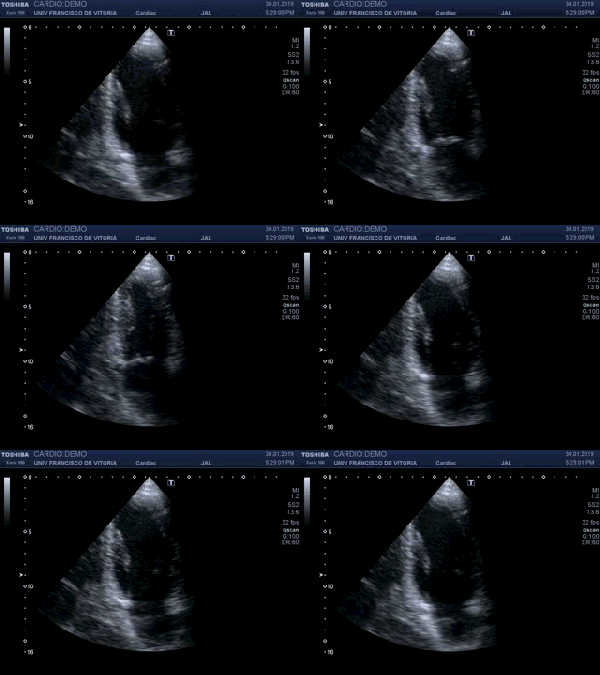
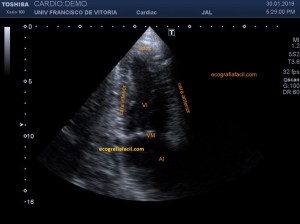
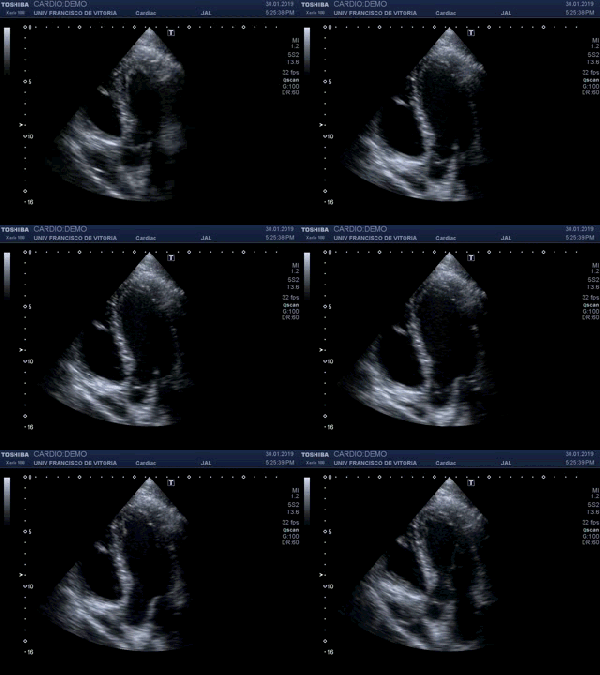
En esta ocasión vamos a estudiar únicamente las cavidades izquierdas: ventrículo y aurícula izquierdos. Para encontrar este plano (clip 13) debes partir del 4 cámaras para realizar una rotación de 90º en sentido antihorario. Si lo haces adecuadamente obtendrás la figura 24, donde te enseño las paredes que vamos a estudiar.

On this occasion we will study only the left cavities: left ventricle and atrium. To find this plane (clip 13) you must start from 4 chambers to make a rotation of 90º counterclockwise. If you do it properly you will get figure 24, where I show you the walls that we are going to study.

Clip 13.

Fig 24.

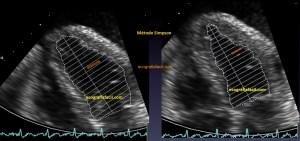
Para la valoración de la FEVI (fracción de eyección del VI) tenemos 3 métodos: el primero de ellos es cualitativo y consiste en sacar una impresión general de la contracción global. Recuerda que por debajo del 50% ya hablamos de FEVI deprimida. El segundo es el método Teichold, consistente en hacer una resta entre el diámetro del VI en diástole y sístole en el paraesternal eje largo y que ya vimos en un post anterior. El tercero es el método Simpson biplano, para el que necesitamos obtener el área del VI en el 4 cámaras y en el 2 cámaras (figura 25). El equipo hará sus cuentas para ofrecernos una valoración numérica. Todos los datos que obtengamos de los 3 métodos no deben ser discrepantes entre sí aunque haya ligeras variaciones. Si obtenemos una FEVI visual y por Teich del 65% y el método Simpson nos habla de 30%, evidentemente algo está mal.

For the assessment of LVEF (ejection fraction of the LV) we have 3 methods: the first one is qualitative and consists of taking a general impression of the global contraction. Remember that below 50% we already talked about depressed LVEF. The second is the Teichold method, consisting of subtracting the diameter of the LV in diastole and systole in the parasternal long axis, which we saw in a previous post. The third is the Simpson biplane method, for which we need to obtain the VI area in the 4 chambers view and in the 2 chambers view (figure 25). The team will make their accounts to offer us a numerical valuation. All the data we obtain from the 3 methods should not be discrepant with each other although there are slight variations. If we obtain a visual LVEF and Teich 65% and the Simpson method tells us 30%, obviously something is wrong.

Al igual que en el 4 cámaras, la morfología del VI debe ser afilada hacia el ápex y no redondeada, lo que podría explicarse por un abordaje demasiado alto.

Y como también vemos la válvula mitral en este plano, pondremos una caja de Doppler color para valorar insuficiencias. En este caso, vamos a valorar bien las insuficiencias con “jet de pared”, que pueden ser difíciles de visualizar con otros planos.

As in the 4 chambers view, the LV morphology should be sharpened towards the apex and not rounded, which could be explained by a too high approach. And as we also see the mitral valve in this plane, we will put a color Doppler box to assess insufficiencies. In this case, we will assess the inadequacies with «wall jet», which can be difficult to visualize with other plans.

143. Ecocardiografía.Plano Apical 5 Cámaras.

Desde el plano anterior basta con angular algo más cranealmente la sonda hasta que aparezca en el centro de la imagen (en la confluencia de las 4 cámaras) la válvula aórtica y la aorta ascendente proximal (clip 11).

From the anterior plane, the probe is angled somewhat more cranially until it appears in the center of the image (at the confluence of the 4 chambers) the aortic valve and the proximal ascending aorta (clip 11).

Clip 11

El interés de este plano es valorar la válvula aórtica y fundamentalmente su funcionalidad mediante el Doppler color y las mediciones que vamos a obtener mediante el Doppler espectral pulsado y continuo.

Así que lo primero será poner la caja de color para valorar aceleraciones extrañas e insuficiencias.

En el clip 12 puedes ver una insuficiencia de esta válvula. Para cuantificarla, además de la impresión que tengamos por la cantidad del chorro de color retrógrado, podemos ir “interrogando” al ventrículo izquierdo en situaciones cada vez más apicales para ver mediante el espectro pulsado hasta dónde llega la regurgitación. También es posible valorar la pendiente de esa regurgitación en el Doppler continuo. Y por último, si la insuficiencia es severa, tendremos que valorar también con Doppler espectral en los planos supraesternales.

Clip 12.

The interest of this plane is to assess the aortic valve and fundamentally its functionality through color Doppler and the measurements that we will obtain by means of pulsed and continuous spectral Doppler. So the first thing is to put the color box to assess strange accelerations and inadequacies. In clip 12 you can see an insufficiency of this valve. To quantify it, in addition to the impression we have for the amount of retrograde color jet, we can «interrogate» the left ventricle in increasingly apical situations to see through the pulse spectrum how far the regurgitation arrives. It is also possible to assess the slope of this regurgitation in continuous Doppler. And finally, if the insufficiency is severe, we will also have to evaluate with spectral Doppler in the suprasternal planes.

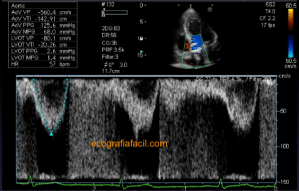
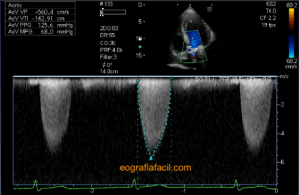
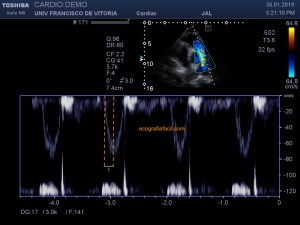
Otra medida que vamos a hacer en este plano será el cálculo del área valvular para lo que nos basamos en la “ecuación de continuidad”. Para ello necesitamos sacar la integral velocidad-tiempo en el tracto de salida del VI (TSVI) con Doppler pulsado (figura 22) y los gradientes máximo y medio transvalvulares aórticos con Doppler continuo (figura 23). Mediante estas dos mediciones y la que ya teníamos antes del diámetro del TSVI, que habíamos medido en el paraesternal eje largo, podremos calcular el área y cuantificar el grado de severidad en caso de estenosis.

En este link tienes los parámetros normales y la cuantificación de las valvulopatías. https://ecocardio.com/documentos/valores-referencia.html

Another measure that we are going to do in this plane will be the calculation of the valvular area for what we rely on in the «continuity equation». For this, we need to take the velocity-time integral in the LV outflow tract (LVOT) with pulsed Doppler (figure 22) and the aortic transvalvular maximum and middle gradients with continuous Doppler (figure 23). By means of these two measurements and the one that we had before the diameter of the LVOT, which we had in the parasternal long axis, we can calculate the area and quantify the degree of severity in case of stenosis. 

Fig 22

Fig 23

142. Ecocardiografía.Plano Apical 4 cámaras

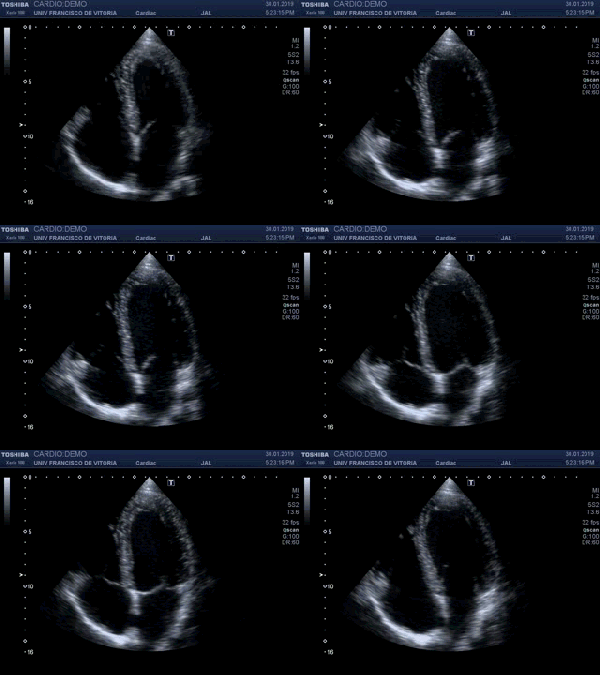
Recordaréis que para obtener los planos apicales, el paciente se coloca en posición OPI, con el brazo izquierdo elevado para poder abrir los espacios intercostales y situamos la sonda entre dos costillas, dirigida hacia el hombro contrario. Debes obtener algo parecido al clip 9.  Como ves, el ápex cardiaco se encuentra situado en la parte alta del monitor mientras que el techo de las aurículas se sitúa en la profundidad. En algunos centros hacen una inversión especular arriba-abajo para tener una representación anatómica más anatómica, pero en cuanto hagas media docena de pacientes te acostumbrarás a ver el corazón del revés.  La angulación de la sonda debe ser tal que el corazón no aparezca redondeado; eso significará que debes bajar un espacio intercostal. Si por el contrario, tienes demasiada angulación, aparecerá la aorta en el centro de las 4 cámaras y habrás obtenido el plano 5 cámaras, que no es el que ocupa este post. Otro truco si no te sale bien a la primera es jugar con la respiración del paciente. Algunos se benefician de mantener una apnea inspiratoria y otros en espiración. Prueba por ti mismo para descubrir qué es lo que necesita tu paciente para ofrecerte toda la calidad de su corazón. 

Remember that to obtain the apical planes, the patient is placed in the OPI position, with the left arm raised to open the intercostal spaces and place the probe between two ribs, directed towards the opposite shoulder. You should get something similar to the clip 9. As you can see, the cardiac apex is located at the top of the monitor while the atrium roof is located at the depth. In some centers they make a top-down mirror inversion to have a more anatomical anatomical representation, but as soon as you make around six  patients you will get used to seeing the heart upside down. The angulation of the probe should be such that the heart does not appear rounded; that will mean that you have to lower an intercostal space. If, on the other hand, you have too much angulation, the aorta will appear in the center of the 4 chambers and you will have obtained the 5 chambers map, which is not the one that occupies this post. Another trick if you do not get it right the first time is to play with the patient’s breathing. Some benefit from maintaining inspiratory apnea and others from expiration. Test yourself to discover what your patient needs to offer you all the quality of your heart.

Clip 9

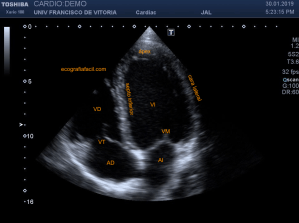
 La figura 17 te indica la anatomía ecográfica de este plano. Debes valorar el tamaño de las aurículas y de los ventrículos, la movilidad, flexibilidad y ecogenicidad de las válvulas mitral y tricúspide así como sus anillos y por último valorar la contracción segmentaria de las paredes que se ven en este plano y que te conducirán al cálculo de la fracción de eyección 

Figure 17 shows you the ultrasound anatomy of this plane. You must assess the size of the atria and ventricles, the mobility, flexibility and echogenicity of the mitral and tricuspid valves as well as their rings and finally assess the segmental contraction of the walls that are seen in this plane and that will lead you to the calculation of the ejection fraction.

Fig 17

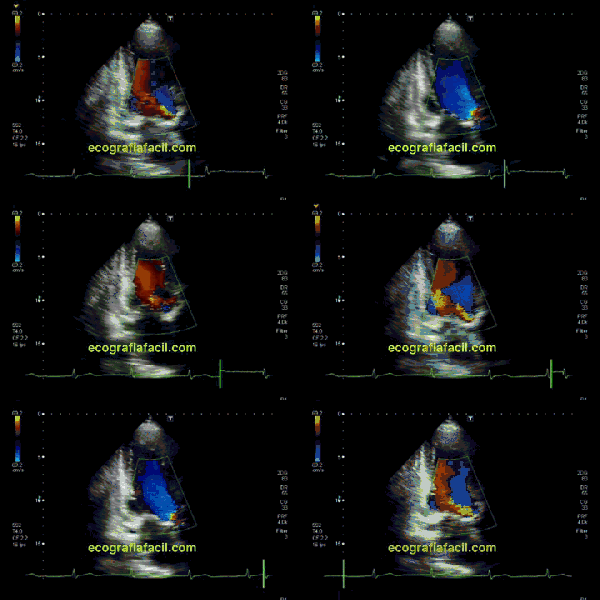
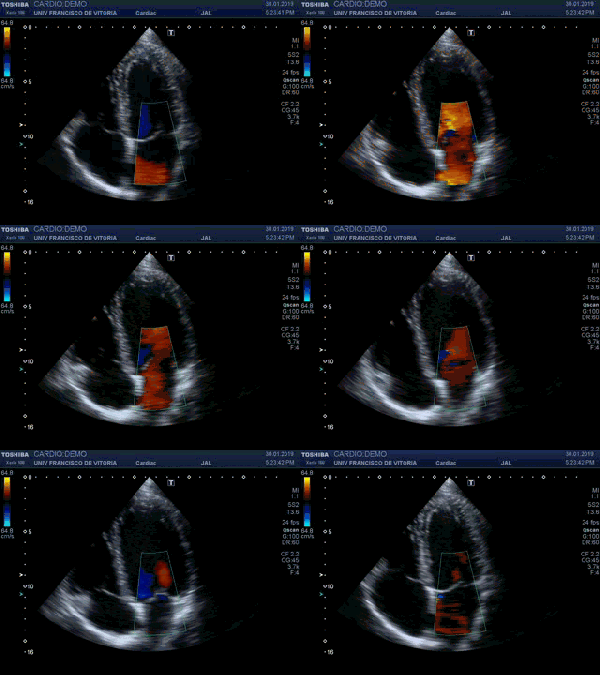
Una vez realizado el estudio 2D pasamos al estudio mediante Doppler-color. En primer lugar colocaremos una caja de color sobre la válvula mitral donde nos haremos una idea si existe regurgitación o no (insuficiencia valvular), una aceleración excesiva de la sangre en este lugar (estenosis) coincidiendo con un defecto de apertura sospechado en el 2D, o por el contrario, todo parece normal. El clip 10 muestra un llenado transmitral normal por Doppler color. 

Once the 2D study was done, we went to the Doppler-color study. First we will place a colored box on the mitral valve where we will have an idea if there is regurgitation or not (valvular insufficiency), an excessive acceleration of the blood in this place (stenosis) coinciding with an opening defect suspected in the 2D, or on the contrary, everything seems normal. Clip 10 shows normal transmitral filling by color Doppler.

clip 10

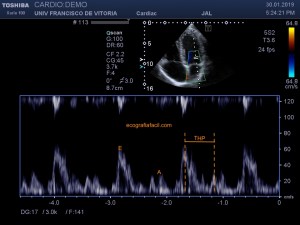
A continuación, pondremos un volumen de muestra a nivel del final de los velos mitrales en el momento de su apertura total para obtener un Doppler espectral que nos permita medir la velocidad de llenado transmitral y el tiempo de hemipresión, parámetros que nos ayudarán a valorar el tipo de ritmo cardiaco (sinusal, fibrilación auricular, alteración de la relajación…) y el área de la válvula (figura 18). Si la velocidad máxima supera 1.5 m/s sugiere que hay estenosis y entonces el Doppler espectral deberá ser contínuo y no pulsado. También usaremos el continuo en casos de prótesis valvular. 

Next, we will put a sample volume at the end of the mitral leaflets at the moment of its total opening to obtain a spectral Doppler that allows us to measure the transmitral filling speed and the hemipression time, parameters that will help us to evaluate the type of heart rate (sinus, atrial fibrillation, relaxation disturbance …) and the area of ​​the valve (figure 18). If the maximum velocity exceeds 1.5 m / s, it suggests that there is stenosis and then the spectral Doppler should be continuous and not pulsed. We will also use the continuum in cases of valvular prostheses.

fig 18

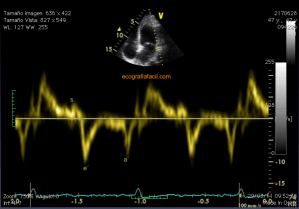
Una vez valorado el flujo transmitral, vamos a por un Doppler tisular espectral en el anillo lateral mitral (figura 19). La relación que encontremos entre los valores de la onda E (sangre) y la onda e´(anillo) me ayudará a establecer la función diastólica. 

Once the transmitral flow is assessed, we go for a spectral tissue Doppler in the lateral mitral ring (Figure 19). The relationship that we find between the values ​​of the wave E (blood) and the wave e'(ring) will help me to establish the diastolic function.

fig 19

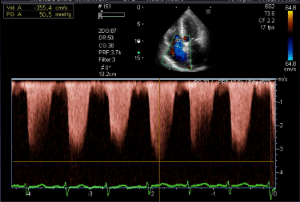
 Una vez finalizado el estudio de las cavidades izquierdas, vamos a poner el Doppler color sobre la válvula tricúspide. En este caso no nos interesa tanto el llenado transvalvular como la insuficiencia que pudiera existir porque gracias a ella vamos a calcular la PSAP (Presión sistólica en arteria pulmonar) de manera no invasiva. Si observamos una regurgitación con el Doppler color, hay que alinear la barra de muestra del Doppler continuo con la dirección de la misma para obtener una buena medida de la velocidad máxima de regurgitación (figura 20). Con la fórmula PSAP = (Vmax2 x4) + RAP, pasaremos de tener una velocidad a una presión en mmHg, que de ser superior a 50 mmHg, nos hará pensar en HTP. Este punto hay que relacionarlo con la morfología de la curva espectral que obtuvimos en la válvula pulmonar (eje corto grandes vasos) y, por supuesto, con la clínica del paciente. 

After completing the study of the left cavities, we will put the color Doppler on the tricuspid valve. In this case we are not interested in transvalvular filling as much as in the insufficiency that could exist because thanks to it we are going to calculate the PSAP (pulmonary artery systolic pressure) in a non-invasive way. If we observe a regurgitation with the color Doppler, it is necessary to align the sample bar of the continuous Doppler with the direction of the same to obtain a good measure of the maximum regurgitation velocity (figure 20). With the formula PSAP = (Vmax2 x4) + RAP, we will go from having a velocity to a pressure in mmHg, which if it is higher than 50 mmHg, will make us think of HTP. This point has to be related to the morphology of the spectral curve that we obtained in the pulmonary valve (short axis large vessels) and, of course, to the patient’s clinic.

fig 20

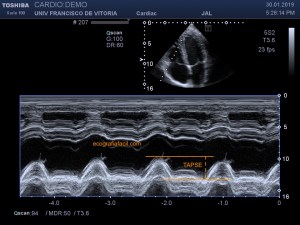
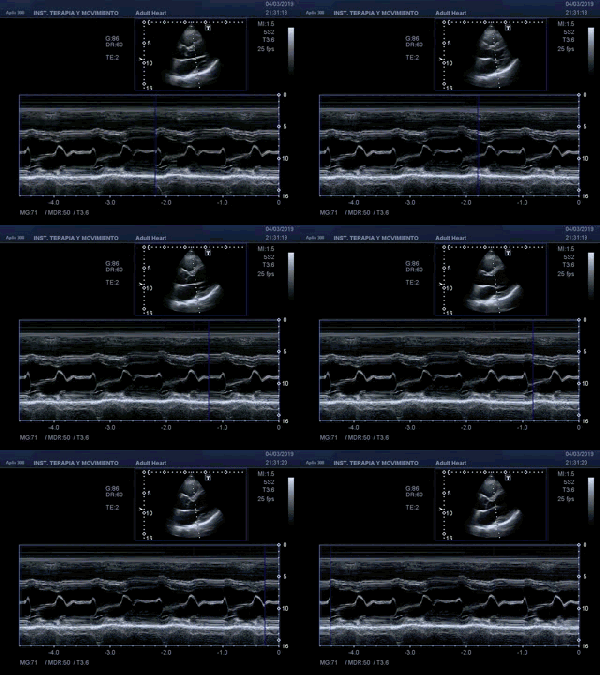
 Por último, vamos a usar el modo M para valorar la cantidad de movimiento longitudinal (o vertical, según se mire) del anillo tricúspide, y que me da una idea de la función sistólica del ventrículo derecho. En la figura 21 puedes ver el modo M que debe arrojar un valor por encima de 15 mm en condiciones normales. 

Finally, we will use the M mode to assess the amount of longitudinal (or vertical, as viewed) movement of the tricuspid annulus, and that gives me an idea of ​​the systolic function of the right ventricle. In Figure 21 you can see the M mode that should throw a value above 15 mm under normal conditions.

fig 21

141. Mediciones de los planos paraesternales.

No paramos en este lluvioso y gris jueves de se Semana Santa, donde el verano parece no existir, donde el susurro del mar y la calidez de la arena de la playa y el sol me llaman…Me acompaña «con las ganas» de Zahara…no digo más…

Para establecer un diagnóstico sobre la ecografía cardiaca no basta con ver las alteraciones morfológicas y funcionales. Es importante realizar algunas mediciones estandarizadas para poder CUANTIFICAR el grado de las lesiones si existen.

Para ello se han publicado diversas guías que dicen lo que está bien y lo que no; los límites inferiores y superiores de cada medida. A todo ello hay que añadirle el resto de ingredientes para que el resultado final sea óptimo. Estos elementos son la anamnesis, la exploración física, la auscultación y, en estos momentos de práctica de la medicina basada en la evidencia son también importantes las preferencias del paciente; es decir, que el paciente debe involucrarse en todo lo que respecta a su enfermedad, a su vida, a su cuerpo…

To establish a diagnosis on cardiac ultrasound, it is not enough to see the morphological and functional alterations. It is important to perform some standardized measurements to be able to quantify the extent of the injuries if they exist.
For this, several guides have been published that say what is good and what is not; the lower and upper limits of each measure. To all this we must add the rest of the ingredients so that the final result is optimal. These elements are the anamnesis, the physical examination, the auscultation and, in these moments of practice of the medicine based on the evidence, the preferences of the patient are also important; that is, that the patient must be involved in everything related to the own illness, the own life, the own body …
You can see the normal echocardiographic values ​​and their alterations in these publications:

Puedes ver los valores ecocardiográficos normales y sus alteraciones en estas publicaciones:

http://www.scielo.br/scielo.php?script=sci_arttext&pid=S0066-782X2000000800003

https://www.echopedia.org/wiki/Normal_Values

https://ecocardio.com/documentos/valores-referencia.html

Lo que vamos a enseñarte a continuación es cómo debes obtener estas mediciones. Vayamos por partes (como decía Jack el destripador)…

Paraesternal eje largo:

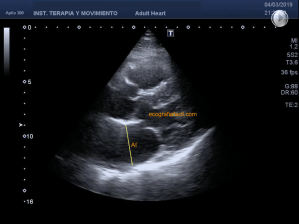
Aquí podemos medir el diámetro de la Aurícula Izquierda (AI), que lo haremos cuando esté lo más dilatada posible; es decir, al final de la sístole, como puedes ver en la figura 11Este momento coincide con el punto de mayor vaciado del Ventrículo Izquierdo (VI), así que aprovechamos para medir este diámetro también.
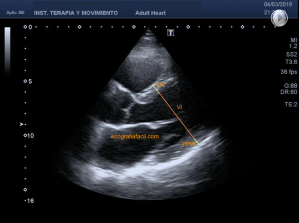
Here we can measure the diameter of the Left Atrium (LA), which we will do when it is as wide as possible; that is, at the end of the systole, as you can see in figure 11. This moment coincides with the point of greatest emptying of the left ventricle (LV), so we took advantage of this diameter to measure it too.

Fig 11

Un poco más allá en el tiempo, veremos que el diámetro del VI es máximo al final de la diástole, así que aquí volveremos a medir el diámetro del VI en el mismo punto anatómico que lo hicimos anteriormente. Además, podemos medir el espesor del septo interventricular y de la cara lateral-inferior del VI (fig 12). 

A little further in time, we will see that the diameter of the LV is maximum at the end of diastole, so here we will again measure the diameter of the LV at the same anatomic point as we did previously. In addition, we can measure the thickness of the interventricular septum and the lateral-inferior aspect of the LV (fig 12).

Fig 12. Muak.

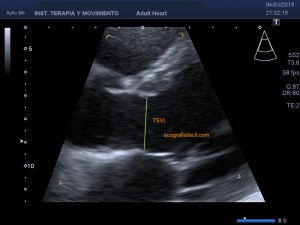
Este punto temporal coincide con una imagen donde vemos completamente abiertos los velos de la válvula mitral (VM) y por ello es posible medir también el Tracto de Salida del VI (TSVI), que podemos llegar a necesitar para cuantificar posteriormente una estenosis de la Válvula Aórtica (EAo). Lo más cómodo es hacer un zoom sobre esta región para mayor comodidad y fiabilidad en la medición (fig 13).

This temporal point coincides with an image where the veils of the mitral valve (VM) are completely open and it is therefore possible to measure the LV Exit Tract (LVOT), which we may need to subsequently quantify a stenosis of the Valve Aortic (EAo). It is most convenient to zoom in on this region for greater convenience and reliability in the measurement (fig 13).

Fig 13.

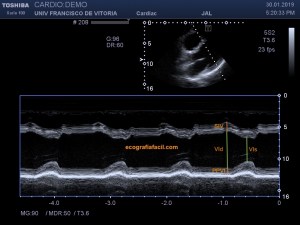
Es posible pasar un modo M tanto por la AI como por la VM y por el centro del VI (clip 8 y figura 14)En todos estos casos podemos medir los diámetros anteriormente citados, aunque es necesario que la línea de corte que me va a enseñar el modo M esté perpendicular al eje largo del VI, porque si no, podemos infra o sobreestimar las mediciones. La ventaja del modo M sobre el modo 2D reside en su excelente resolución temporal y resolución axial.

It is possible to pass an M mode both by the AI ​​and by the VM and in the middle of the LV (clip 8 and figure 14). In all these cases we can measure the aforementioned diameters, although it is necessary that the cut line that will teach me the M mode is perpendicular to the long axis of the LV, we must be carefull in this moment, is possible that we can underestimate or overestimate the measurements. The advantage of M mode over 2D mode lies in its excellent temporal resolution and axial resolution.

Fig 14. 

Clip 8.

Paraesternal eje corto:

Aquí vamos a realizar nuestras primeras mediciones con el Doppler espectral.

Pondremos el cursor de muestra inmediatamente antes de la válvula pulmonar y pasaremos a ese nivel un PW, que nos informará de la velocidad máxima de la sangre en ese punto, y lo más importante aquí, el tiempo de desaceleración de la sangre, como puedes ver en la figura 15.

Here we are going to make our first measurements with the spectral Doppler.
We will put the sample cursor immediately before the pulmonary valve and we will pass to that level a PW, which will inform us of the maximum velocity of the blood at that point, and most importantly, the time of deceleration of the blood, as you can see in figure 15.

Fig 15. 

También podemos poner el color sobre la válvula tricúspide y, en caso de observar una regurgitación, pasar el Doppler espectral continuo (recuerda que el CW es algo casi exclusivo de la cardio) para medir la velocidad máxima de la regurgitación. Esta medida será importante para cuantificar después si existe o no hipertensión pulmonar.

Cuando estemos en el eje corto sobre la válvula mitral pondremos nuestra caja de color. De esta manera podemos ver también si existe o no una insuficiencia valvular que genera una regurgitación (esto también es posible realizarlo sobre la válvula aórtica en el plano de los grandes vasos, que antes se me pasó comentarlo).

Después, cuando estemos en la mitad del VI podemos parar el movimiento del corazón (¡por favor, sólo el clip adquirido, no el corazón real del paciente!) en el momento  final de la diástole; o sea, cuando las paredes son más delgadas, para hacer mediciones de los espesores parietales del VI (figura 16).

We can also put the color on the tricuspid valve and, in case of observing a regurgitation, pass the continuous spectral Doppler (remember that the CW is something almost exclusive of cardio) to measure the maximum speed of regurgitation. This measure will be important to quantify later whether or not pulmonary hypertension exists.
When we are on the short axis on the mitral valve we will put our color box. In this way we can also see if there is or not a valvular insufficiency that generates a regurgitation (this is also possible to realize it on the aortic valve in the plane of the great vessels, which before I was told about it).
Then, when we are in the middle of the LV, we can stop the movement of the heart (please, only the acquired clip, not the real heart of the patient!) At the end of the diastole; that is, when the walls are thinner, to make measurements of the parietal thicknesses of the LV (Figure 16).

Fig 16

No es una medida que hagamos siempre, pero es posible realizarla si no vimos bien las paredes en el eje largo anterior.

It is not a measure that we always do, but it is possible to do it if we did not see the walls in the previous long axis

Nos vemos en el próximo post, donde nos adentraremos en las imágenes apicales. Ve cogiendo fuerzas!

See you in the next post, where we enter the apical images. Get your strength!