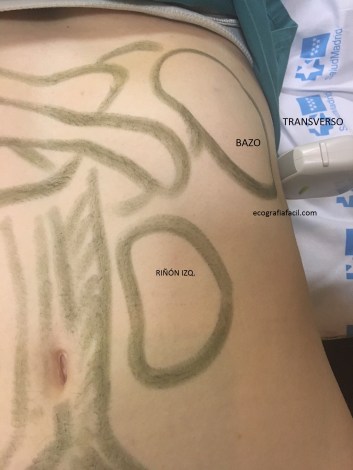
Después del Riñón derecho, nos vamos hacia el lado izquierdo, concretamente al Hipocondrio Izquierdo, allí encontramos el Bazo.
Es un órgano intraperitoneal.
Está en continuidad con el diafragma. Contacta con el riñón izdo. Inferiormente y con el estómago y la cola del páncreas medialmente.
La arteria esplénica se origina en el tronco celiaco.
La vena esplénica sale del bazo en el hilio y confluye con la vena mesentérica superior y forma la vena porta.
El Bazo es un órgano difícil de estudiar, cuando uno comienza a formarse en ecografía cuesta mucho ubicarlo, capturarlo, aunque sepamos su localización.Pero ¿porqué?
Hay varias razones, a saber, es un órgano subcostal, en ocasiones puede ser muy pequeño y está rodeado de mucho aire, concretamente del ángulo esplénico colónico. Si todos estos agentes se alinean en nuestra contra, encontrarlo y estudiarlo es difícil, pero se combate, como digo siempre, con técnica.
Nosotros, cuando tenemos Técnicos o Residentes de Radiología que empiezan a formarse con nuestro equipo y al principio se frustran por no poder con esta estructura, decimos siempre que al principio el Bazo es una estructura que nunca encontramos, pero que cuando lo veamos por primera vez sin ayuda, nuestra mano siempre lo va a «encontrar»…y eso, no es ni más ni menos que técnica.
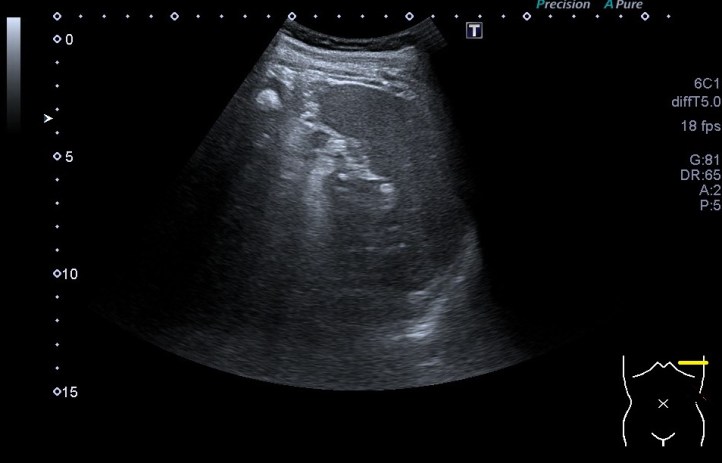
Partiremos de la posición en longitudinal en línea axilar media izquierda a la altura de la 9-10 costilla y ahí buscaremos el órgano según anatomías. Hacemos cortes transverso y longitudinal.
Punto de partida. Corte Longitudinal.Cortes.Posiciones de Sonda.
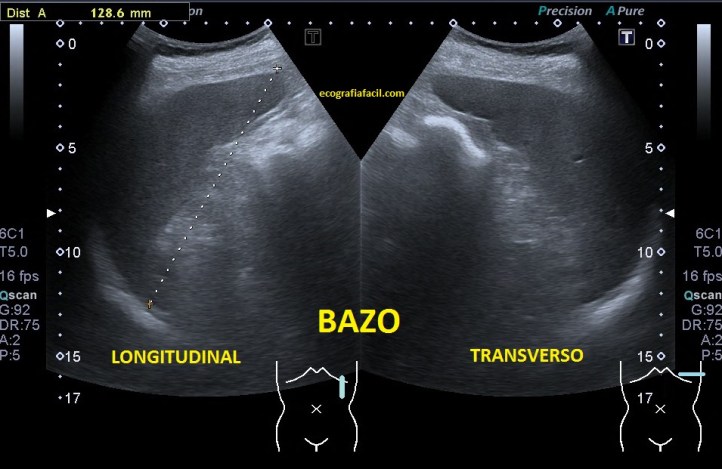
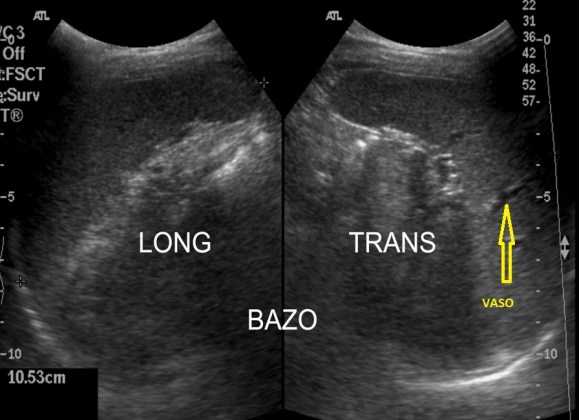
Ecográficamente es una estructura voluminosa, hiperecogénica y homogénea que no debe medir en adultos más de 12 cms. Los vasos de la estructura se verán anecoicos.
Semiología ecográfica.Detalle del vaso.
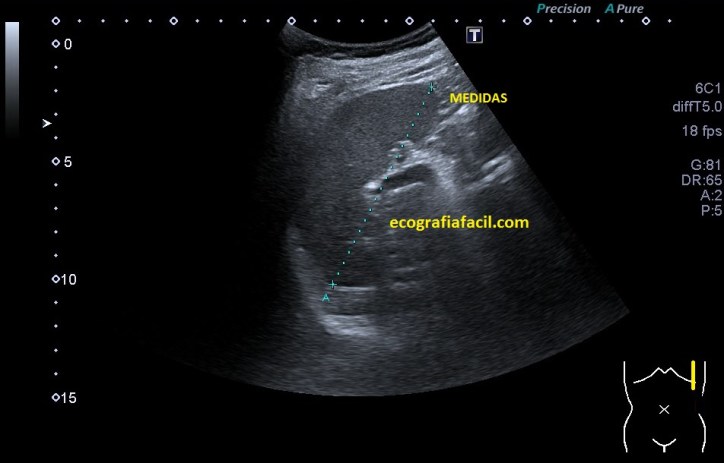
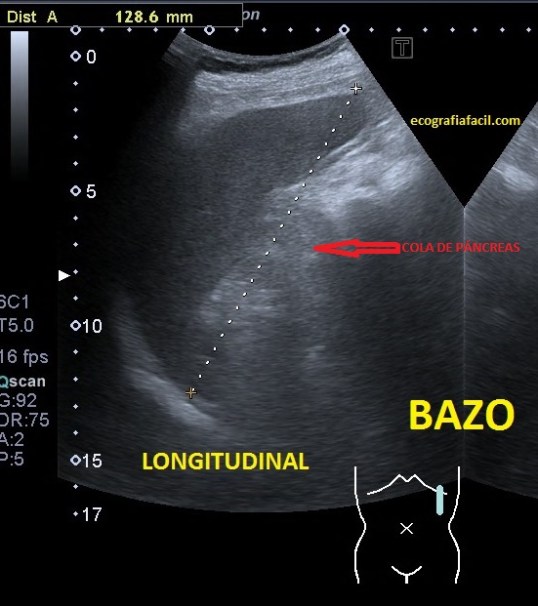
El objetivo principalmente es observar el órgano, demostrar que no tenga patología y hacerle medidas en el corte longitudinal al menos.
Longitudinal con medidas. Observe el lector el pictograma.Transverso. Detalle del pictograma en amarillo.
El o la paciente se debe encontrar en decúbito supino o decúbito lateral derecho, recomiendo exploración del órgano en ambas posiciones y escoger la mejor para hacer las fotos y medidas.
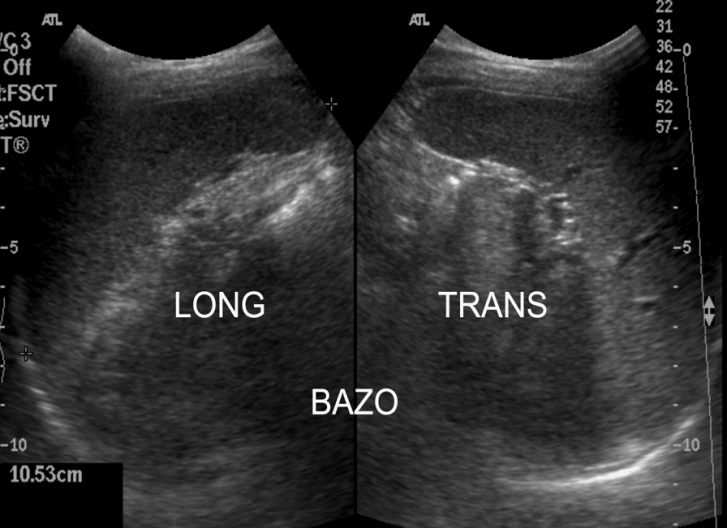
La estructura del Bazo hace que tanto en transverso como en longitudinal el Bazo aparece ecográficamente como una estructura que estuviese reflejada en un espejo. Mira:
En Long y en Trans como si la estructura estuviese reflejada.
La sonda en adultos será de baja frecuencia, en pediatría, depende del tamaño de la/el paciente. En neonatos y menores de 4 años más o menos, siempre podremos usar frecuencia altas.
No es un órgano al que no afecta gran cantidad de patología, pero una gran parte de esta patología que le afecta es infecciosa o de origen hematológico y puede provocar esplenomegalia, que trataremos en el siguiente post.
Para terminar os voy a comentar que estas proyecciones son útiles para estudiar posibles lesiones de la cola de Páncreas y tenemos la experiencia contrastada de hallazgos patológicos en dicha localización desde este acceso no vistos en el acceso por vía normal para el estudio del Páncreas. En estas proyecciones el la cola pancreática se ve ligeramente hiperecogénica junto al borde interno del Bazo, cerca de su hilio. En la siguiente foto te lo marco en Rojo. Esta visualización de la cola pancreática requiere más experiencia y estar habituado a la técnica.
Localización cola pancreática.
A mis alumnos Cristina y Mario, este Post, es un poco de ellos también.
El Hígado es un órgano que sufre cantidad de patología, además es muy importante su estudio porque es una estructura «diana» de metástasis de tumores de otros órganos y por eso diversos marcadores analíticos pueden indicar revisión o estudio ecográfico.
Vamos a repasar los principales signos ecográficos de la patología más habitual hepática y biliar para que tengas una base de estudio y conocimiento, pero este Blog no tiene como objetivo que aprendas patologías, aunque obviamente necesitamos saber y conocer sus signos ecográficos principales.
Diferenciamos entre patología hepática y vesicular.
Hígado. En el Hígado tenemos gran cantidad de patología. Tumoral, benigna y maligna, infecciosa, inflamatoria, etc. La ecografía abdominal es una técnica inocua, barata y de gran valor diagnóstico en la patología abdominal y hepática.
Empezamos:
Quistes.
Son las lesiones focales más frecuentes. Es tremendamente habitual ver este tipo de patología.
Ecográficamente se comportan así:
Lesiones anecoicas.
Presentan refuerzo Posterior.
La pared posterior está bien definida.
Los quistes se denominan complejos si tienen ecos en su interior, pared gruesa, septos numerosos o gruesos, elementos sólidos o calcificaciones.
El hígado se afecta en un 40 ó 50% de los casos de enfermedad poliquística dominante y una gran parte del tejido es sustituido por quistes. No afectando a la función hepática.
Tienen este aspecto en la imagen:
The liver is an organ that suffers a lot of pathology, in addition it is very important to study it because it is a "target" structure of metastasis of tumors of other organs and that is why various analytical markers can indicate revision or echographic study.

We are going to review the main echographic signs of the most common liver and biliary pathology so that you have a base of study and knowledge, but this Blog does not have as objective that you learn pathologies, although obviously we need to know and know its main sonographic signs.

We differentiate between hepatic and vesicular pathology.

Liver. In the Liver we have a lot of pathology. Tumor, benign and malignant, infectious, inflammatory, etc. Abdominal ultrasound is a safe, inexpensive technique of great diagnostic value in abdominal and hepatic pathology.

We start:

You are crying

They are the most frequent focal lesions. It is extremely common to see this type of pathology.

Ecographically they behave like this:

Anechoic lesions
Present Posterior reinforcement.
The back wall is well defined.
Cysts are called complex if they have echoes inside, thick walls, numerous or thick septa, solid elements or calcifications.
The liver is affected in 40 to 50% of the cases of dominant polycystic disease and a large part of the tissue is replaced by cysts. Not affecting the liver function.
They have this aspect in the image:
Hemangiomas.
Son los tumores benignos más frecuentes.
Los signos ecográficos son:
Masa homogénea, menor de 3 cm. hiperecogénica.
Los bordes son lisos y finos.
Pueden ser redondeados o ligeramente ovalados.
Hemangiomas

They are the most frequent benign tumors.
The echographic signs are:
Homogeneous mass, less than 3 cm. hyperechoic
The edges are smooth and thin.
They can be rounded or slightly oval
Un porcentaje significativo de angiomas atípicos tienen periferia hiperecogénica y centro hipoecogénico o también llamado imagen en diana.
Típico Hemangioma Atípico.
Metástasis.
Son los tumores malignos del hígado que se presentan con mayor frecuencia.
La ecografía muestra una o diversas lesiones circunscritas, más o menos esféricas, de tamaño y ecoestructura variables y que pueden ser hipo, iso o hiperecogénicas. Pueden ser en poco número o que rellenen todo el parénquima.
Metastasis.

They are malignant liver tumors that occur more frequently.
The ultrasound shows one or several circumscribed lesions,
more or less spherical, of variable size and echoestructure and that can be hypo, iso or hyperechoic.
They can be in small numbers or fill the whole parenchyma.
Forma de bolas de algondón.
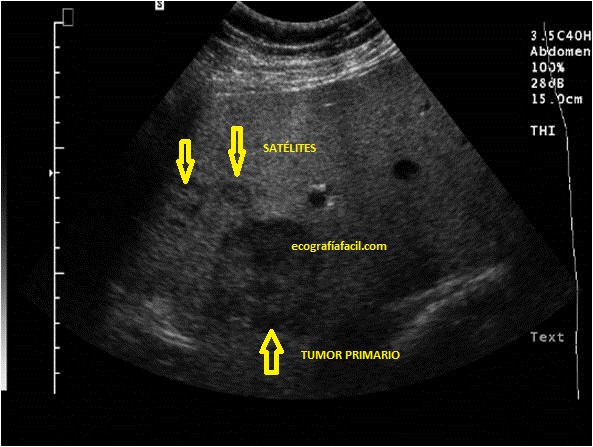
Carcinoma Hepatocelular.
El patrón característico es una lesión dominante de gran tamaño con pequeñas lesiones satélites dispersas.
– La Ecogenicidad es variable y el aspecto ecográfico inespecífico. Esto quiere decir que en muchas ocasiones la patología debe ser analizada histológicamente para ser diagnosticada ya que sus signos ecográficos son comunes a otras patologías menos graves.
Hepatocellular carcinoma The characteristic pattern is a large dominant lesion with small scattered satellite lesions. – Echogenicity is variable and the non-specific echographic aspect. This means that in many cases the pathology must be analyzed histologically to be diagnosed since its sonographic signs are common to other less serious pathologies.
La mayoría son hipervasculares, es decir, están muy vascularizadas si se les pone Doppler Color.
Quiste Hidatídico.
Están producidos por un celodo Echinococcus granulosus.
Ecográficamente los quistes hidatídicos pueden manifestarse como quistes simples, quistes con múltiples vesículas hijas, quistes con membrana endoquística, quistes con detritus internos y quistes con calcificaciones internas o periféricas. Suelen tener aspecto heterogéneo.
Hydatid Cyst They are produced by an Echinococcus granulosus cell. Ultrasound hydatid cysts can manifest as simple cysts, cysts with multiple daughter vesicles, cysts with endocystic membrane, cysts with internal detritus and cysts with internal or peripheral calcifications. They tend to have a heterogeneous appearance
Quiste hidatídico.
Afortunadamente y gracias a las medidas de higiene, son cada vez menos casos los que se descubren en las consultas de ecografía en el caso de los Quistes hidatídicos.
Abscesos Hepáticos.
-Aparecen como colecciones líquidas de ecogenicidad variable y que a veces imitan a masas sólidas.
Ecográficamente se presentan como zonas anecoicas, multilobulares y a menudo irregularmente circunscritas.
Liver abscesses -They appear as liquid collections of variable echogenicity and sometimes mimic solid masses. Ecographically, they appear as anechoic, multilobal and often irregularly circumscribed areas.
Aspecto irregular, heterogéneo.
Pueden darse por complicación de cirugías u otras patologías cuyo tratamiento no sea efectivo.
Esteatosis Hepática:
-El diagnóstico de esteatosis hepática se realiza comparando la diferencia de ecogenicidad entre el hígado y el riñón. Siendo el primero más hiperecogénico.
-En la esteatosis hepática avanzada es dificil visualizar los vasos. En muchos casos se observan zonas focales de parénquima conservado. Habitualmente en la zona de la bifurcación portal y en la región perivesicular.
Hepatic steatosis: -The diagnosis of hepatic steatosis is made by comparing the difference in echogenicity between the liver and the kidney. Being the first most hyperechogenic. – In advanced hepatic steatosis it is difficult to visualize the vessels. In many cases focal areas of conserved parenchyma are observed. Usually in the zone of the portal bifurcation and in the perivesicular region.
Hígado esteatósico.
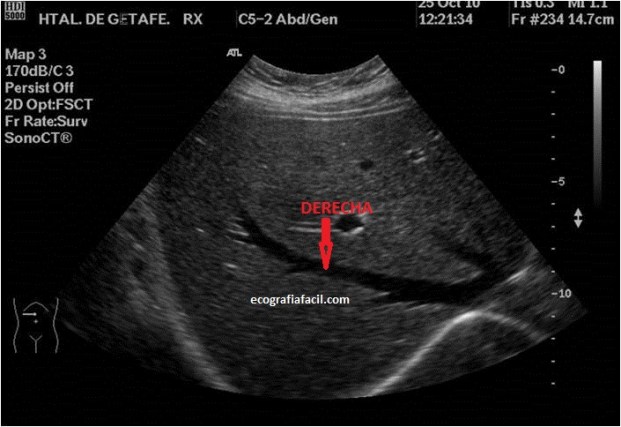
Se ve en la imagen superior un Hígado homogéneo e hiperecogénico con respecto a la corteza renal derecha. Esta es la representación típica.
Zona focal de Hígado preservado.
En esta imagen no todo el Hígado se ve afectado, una pequeña porción aún no ha sido infiltrado por la grasa y se mantiene Hipoecogénico en el entorno de un hígado esteatósico.
La imagen de a continuación es conocido esta presentación esteatósica del órgano como Hígado Bicolor y se ve una afectación que «divide» el órgano en dos, uno sano o Hígado Preservado (hipoecogénico) y otro patológico o Hígado graso (hiperecogénico).
In this image not all the Liver is affected, a small portion has not yet been infiltrated by fat and remains hypoechogenic in the environment of a steatotic liver. The image below is known this steatotic presentation of the organ as Bicolor Liver and an affectation that «divides» the organ in two, a healthy or Preserved Liver (hypoechogenic) and another pathological or fatty liver (hyperechogenic) is seen.
Hiperpalsia Nodular Focal.
Estamos hablando del tumor benigno más frecuente del hígado tras los hemangiomas. Puede verse a cualquier edad y en ambos sexos pero predomina o es más frecuente en mujeres jóvenes y con antecedentes de ingesta de anticonceptivos por vía oral.
Ecográficamente se ven masas de aspecto isoecogénico, homogénea y de delimitación no definida. Ocasionalmente puede ser hipoecogénico o hiperecogénico, pero es menos habitual.
Focal Nodular Hyperpalsia. We are talking about the most common benign tumor of the liver after hemangiomas. It can be seen at any age and in both sexes but it predominates or is more frequent in young women with a history of oral contraceptive intake. Ultrasonically, masses of an isoechogenic, homogeneous and undefined delimitation are seen. Occasionally it can be hypoechogenic or hyperechogenic, but it is less common.
Posible presentación de HNF.
VESÍCULA Y VÍA BILIAR.
Colelitiasis.
Los cálculos biliares aparecen como estructuras móviles, ecogénicas, intraluminales, que generan sombra acústica.
Los cálculos menores de 3 mm pueden no causar sombra.
VESICLE AND BILIARY ROAD. Cholelithiasis Gallstones appear as mobile, echogenic, intraluminal structures that generate acoustic shadow. Calculations smaller than 3 mm may not cause shade.
Colelitiasis.
Barro Biliar.
-El barro biliar consiste en gránulos de bilirrubinato cálcico y cristales de colesterol en el seno de una bilis espesa.
Aparece como reflejos de bajo o alto nivel, sin sombra en la vesícula biliar.
Se localiza en porción más declive de la vesícula.
Con el movimiento del paciente este barro puede variar su localización.
Biliary Mud. -The biliary mud consists of granules of calcium bilirubinate and cholesterol crystals in the bile of a thick bile. It appears as low or high level reflexes, without shadow in the gallbladder. It is located in the lower part of the vesicle. With the movement of the patient this mud can vary its location.
Barro biliar.Flecha blanca.
Pólipos.
Los pólipos de colesterol son los más frecuentes.
Parecen masas adyacentes a la vesícula.
No presentan sombra posterior y tienen aspecto hiperecogénico parecido a piedras pequeñas.
No se mueven al cambiar de posición al paciente.
Pueden estar vascularizados.
Por encima de cierta medida son objeto de resección quirúrgica.
Polyps Cholesterol polyps are the most frequent. They appear masses adjacent to the gallbladder. They do not have a posterior shadow and have a hyperechogenic appearance similar to small stones. They do not move when the patient changes position. They can be vascularized. Above a certain extent they are subject to surgical resection.
Pólipo Vesicular.
Colecistitis Aguda.
En la mayoría de los casos se debe a la obstrucción persistente del conducto cístico o del cuello de la vesícula biliar.
Existen cierto número de hallazgos ecográficos:
Colelitiasis.
Engrosamiento de la pared.
Aumento del tamaño vesicular.
Líquido pericolecístico.
Colecciones perivesiculares.
Cálculo impactado en el cuello de la vesícula biliar.
Acute cholecystitis. In most cases it is due to persistent obstruction of the cystic duct or neck of the gallbladder. There are a number of ultrasound findings: Cholelithiasis Thickening of the wall. Increase in vesicular size. Pericholecystic liquid. Perivesicular collections. Calculus impacted in the neck of the gallbladder.
Carcinoma Vesicular.
La gran mayoría se asocian a colelitiasis.
Los signos ecográficos más frecuentes:
Masa de partes blandas centrada en la fosa vesicular con colelitiasis asociada.
Masa polipoidea intraluminal prominente.
Infiltración de hígado o vasos adyacentes.
Obstrucción de la via biliar.
Adenopatías periportales o peripancreáticas.
Vesicular carcinoma. The vast majority are associated with cholelithiasis. The most frequent ultrasound signs: Soft tissue mass centered in the vesicular fossa with associated cholelithiasis. Prominent intraluminal polypoid mass. Infiltration of liver or adjacent vessels. Obstruction of the bile duct. Periportal or peripancreatic adenopathies.
Ca. Vesicular.
Obstrucción de la Vía Biliar.
Se diagnóstica por el hallazgo de la dilatación de los conductos biliares. Aumento por encima de 7mm pueden ya considerarse como no normales y requerir otro tipo de pruebas como RMN sin no encontramos causa de dicha dilatación.
Obstruction of the Biliary Way. It is diagnosed by the finding of dilation of the bile ducts. Increase above 7mm can already be considered as not normal and require another type of tests such as MRI without finding no cause of said dilation.
Vía biliar extrahepática dilatada, obsérvese medida de 16mm.
La vía biliar intrahepática aparece como canales paralelo adyacentes a las venas portales y muestran el signo de canal paralelo o en cañón de escopeta.
Coledocolitiasis.
Es una de las causas más frecuentes de dilatación biliar.
Los cálculos ductales aparecen como imágenes hiperecogénicas con sombra posterior.
Suelen ser de difícil visualización y requieren mucho tiempo de estudio y muy buena técnica.
Coledocolithiasis It is one of the most frequent causes of biliary dilation. The ductal stones appear as hyperechoic images with posterior shadow. They are usually difficult to visualize and require a lot of study time and very good technique
Evidentemente en este Post no está toda la patología que afecta a estos órganos, tanto hígado como vesícula, pero si la que encontramos con más asiduidad.
La Vesícula es una de las estructuras más importantes dentro del estudio de Abdomen porque gran cantidad de estudios se van a realizar bajo la sospecha clínica de patologías que tienen que ver con esta estructura. Si bien la Vesícula es una estructura adosada al Hígado, se engloba en el estudio hepático por motivos obvios.
Conocer su anatomía y la de sus conductos nos hará comprender que es una estructura cuya participación en la digestión y en los procesos que se llevan a cabo en el abdomen superior están íntimamente relacionados e interconectados, sobre todo con el Páncreas.
La vesícula es un órgano oval en forma de saco que se divide en: Infundíbulo, Cuerpo y Fundus.
Los conductos biliares se dividen en porción intrahepática y extrahepática.
Los conductos intrahepáticos discurren en paralelo a las venas porta
La porción extrahepática incluye el conducto hepático común, el colédoco y una porción de los conductos centrales dcho e izdo.
Me parece muy importante que conozcas este detalle de cómo «convive» la Vesícula y sus Conductos con otras estructuras colindantes como la Arteria Hepática, y la Vena Porta en el hilio hepático, porque ecográficamente son estructuras milimétricas, en ocasiones virtualmente invisibles, pero vitales.
El Colédoco es una estructura muy importante, también se la conoce como vía biliar extrahepática y discurre paralela y anterior (ecográficamente hablando) a la Vena Porta Extrahepática en el hilio hepático.El Colédoco es una estructura que en ocasiones no vemos en ecografía ya que se estima que por cada 10 años que cumple un ser humano, la estructura crece 1 mm, por tanto es normal que en edades menores de la treintena, no lo veamos.
La Porta es nuestra guía para controlar al Colédoco y junto a ellos, muy pequeña, la Arteria Hepática, desconocida, pero que se visualizan siempre juntos y hay que saber distinguir, las estructuras vasculares, Porta y Arteria Hepática del Colédoco, ¿pero cómo?, muy fácil, con el Doppler Color, Vena y Arteria tienen flujo, el Colédoco, no.
Para el estudio de la Vesícula es incondicional las ayunas de la/el paciente.
El estudio ecográfico de la vesícula se tiene que realizar haciendo un corte longitudinal (negro) y transverso (verde) de la estructura, como en la imagen siguiente, el colédoco por su parte, debe verse, si se viera, paralelo en un corto espacio, a la Porta extrahepática, como dos estructuras alargadas.
The Vesicle is one of the most important structures in the study of Abdomen because a large number of studies are going to be carried out under the clinical suspicion of pathologies that have to do with this structure. Although the Vesicle is a structure attached to the Liver, it is included in the liver study for obvious reasons. Knowing its anatomy and that of its ducts will make us understand that it is a structure whose participation in digestion and in the processes that are carried out in the upper abdomen are closely related and interconnected, especially with the Pancreas. The vesicle is an oval organ in the form of a sac that is divided into: Infundibulum, Body and Fundus. The bile ducts are divided into intrahepatic and extrahepatic portions. The intrahepatic ducts run parallel to the portal veins The extrahepatic portion includes the common hepatic duct, the common bile duct, and a portion of the right and left central ducts. It seems very important that you know this detail of how the Vesicle and its Conduits «coexist» with other adjacent structures such as the Hepatic Artery, and the Porta Vena in the hepatic hilum, because ultrasound are millimeter structures, sometimes virtually invisible, but vital. The common bile duct is a very important structure, it is also known as extrahepatic bile duct and runs parallel and anterior (echographically speaking) to the extrahepatic portal vein in the hepatic hilum. The common bile duct is a structure that we sometimes do not see in ultrasound since it is It estimates that for every 10 years that a human being fulfills, the structure grows 1 mm, so it is normal that in ages under thirty, we do not see it. The Porta is our guide to control the common bile duct and, very small, the hepatic artery, unknown, but always visualized together and we must know how to distinguish the vascular structures, Porta and Hepatic Artery of the common bile, but how? , very easy, with the Color Doppler, Vein and Artery have flow, the Choledochus, no. For the study of the Vesicle, the fasting of the patient is unconditional. The ultrasound study of the gallbladder must be done by making a longitudinal (black) and transverse (green) section of the structure, as in the following image, the bile duct, on the other hand, should be seen, if seen, parallel in a short space , to the extrahepatic Porta, as two elongated structures.
Para visualizar la Vesícula pediremos a la/el paciente que esté en inspiración forzada, realizaremos un corte sobre el eje largo de la vesícula (negro) y otro sobre su eje corto (verde), longitudinal y transverso respectivamente.
Ecográficamente la Vesícula tiene un aspecto sacular y anecoico de paredes finas.Puede tener varias presentaciones anatómicas todas ellas normales, es decir, su forma, aunque sacular y normal, no siempre es igual, varía entre pacientes. Obsérvese el pictograma.
To visualize the Vesicle we will ask the patient to be in forced inspiration, we will make a cut on the long axis of the vesicle (black) and another on its short axis (green), longitudinal and transverse respectively. Ecographically the Vesicle has a saccular and anechoic aspect with thin walls. It can have several anatomical presentations, all of them normal, that is, its shape, although saccular and normal, is not always the same, varies between patients. Observe the pictogram.
Visualización normal Vesícula Biliar.
El Colédoco es por su parte, ecográficamente, anecoico y alargado, pero serpenteante en ocasiones.
The Choledochus is, on the other hand, echographically, anechoic and elongated, but sometimes serpentine
Colédoco marcado con línea blanca.
El Conducto hepático común es anatómicamente hablando un gran desconocido para los Técnicos, pero acompaña a la Porta Intrahepática, no suele visualizarse ecográficamente, y si lo hace se identifica como una doble vía y está en relación con procesos patológicos hepáticos.
Para el estudio de la Vía Biliar Extrahepática o Colédoco realizaremos un corte para sagital al eje largo de la Línea Alba (negro) y para ver la Vía Biliar Intrahepática, lo haremos axial o para axial al cuerpo (rojo), siempre en función de la estructuras como la imagen que ves a continuación y recomiendo realizar este estudio y el de la Vesícula tanto en decúbito supino como en decúbito lateral izquierdo y escoger las mejores visualizaciones para realizar las fotos.
The common hepatic duct is anatomically speaking a great unknown to the technicians, but it accompanies the intrahepatic portal, it is not usually visualized ecographically, and if it does it is identified as a double pathway and is related to liver pathological processes. For the study of the Extrahepatic Biliary or Copedopathic Way we will make a sagittal cut to the long axis of the Alba Line (black) and to see the Intrahepatic Biliary Path, we will do it axially or axially to the body (red), always depending on the structures like the image that you see below and I recommend doing this study and that of the Vesicle both in the supine position and in the left lateral decubitus and choose the best visualizations to take the photos
Porta Intrahepática.Porta Extrahepática.
En ambas imágenes superiores, tanto vía biliar intrahepática como la extrahepática acompañarían a ambas porciones de la Vena Porta. En la siguiente imagen vemos Porta Intrahepática con la Vía biliar intrahepática acompañando al vaso, anterior y ambas imágenes paralelas de aspecto ecográfico normal y anecoico, claro está.
In both superior images, both intrahepatic and extrahepatic biliary tract would accompany both portions of the portal vein. In the following image we see Porta Intrahepatic with intrahepatic biliary path accompanying the vessel, anterior and both parallel images of normal and anechoic echographic appearance, of course.
Imagen de doble vía.
Ahora con textos:
En la siguiente imagen, Vesícula, Vía Biliar Extrahepática y pequeña porción de Vena Porta:
Ahora, con textos…
Cuando hablemos de la patología biliar conoceremos mucho más y veremos más de la imágenes, pero hoy solo importaba la técnica y el aspecto ecográfico.
Post de difícil comprensión por la gran cantidad de información.
Vital la comprensión de la anatomía y sus interrelaciones.
Para el protocolo, nos guardamos la foto de ambas Venas Portas y eventual visualización de las vías biliares correspondientes y por supuesto la foto de la Vesícula Biliar.
Seguimos…
When we talk about biliary pathology we will know much more and we will see more of the images, but today only the technique and the sonographic aspect mattered. Post difficult to understand because of the large amount of information. Vital understanding of anatomy and its interrelations. For the protocol, we keep the photo of both Portas Portas and possible visualization of the corresponding bile ducts and of course the photo of the Gall Bladder. We continue …
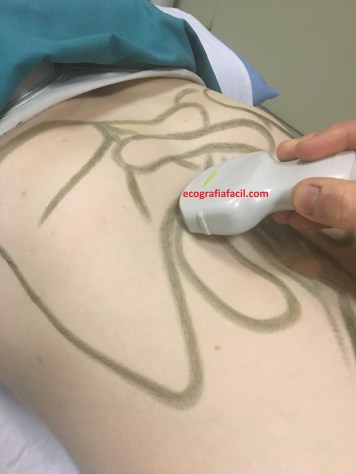
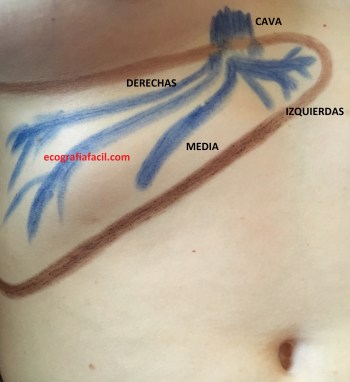
Las venas Suprahepáticas son vasos que van a parar a la Cava llevando sangre «sucia». Es primordial conocer su Anatomía. básicamente tenemos que saber en que se dividen en 3 bloques, Izquierda, Intermedia o media y Derecha, como tres bloques principales, luego, como si de ramas de un árbol se tratase, se subdividen según cada anatomía, así:
The Suprahepatic veins are vessels that go to the Cava carrying «dirty» blood. It is essential to know your Anatomy. Basically we have to know in which they are divided into 3 blocks, Left, Intermediate or Middle and Right, as three main blocks, then, as if they were branches of a tree, they are subdivided according to each anatomy, like this:
Disposición Anatómica.
Si observas en la imagen, el Hígado está protegido por la parrilla costal, las Suprahepáticas son proximales y por tanto para poder estudiarlas tendremos que apoyarnos en el reborde costal inferior y angularnos para poder estudiarlas, ya que justo encima de ellas es imposible virtualmente debido a las interfases provocadas por el hueso de las costillas, es decir, nos tenemos que colocar así:
If you look at the image, the Liver is protected by the rib cage, Suprahepatic proxies are proximal and therefore to study them we will have to rely on the inferior costal rim and angles to be able to study them, since just above them is virtually impossible due to the interfaces caused by the bone of the ribs, that is, we have to place it like this:
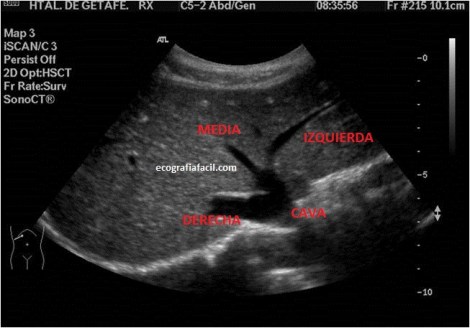
Esta imagen es el secreto de la imagen de hoy y cómo conseguirla. Localiza el reborde costal, tócalo, coloca el transductor paralelo a él, angula como si pusieses el transductor casi paralelo a la piel del paciente y busca las Suprahepáticas sabiendo su disposición anatómica, el resultado, este:
This image is the secret of today’s image and how to get it. Locate the costal flange, touch it, place the transducer parallel to it, angle as if you placed the transducer almost parallel to the skin of the patient and look for the Suprahepatic knowing its anatomical disposition, the result, this:
Anatomía ecográfica.
Respecto de la imagen anatómica puede parecer que la imagen está al revés, pero piensa que donde apoyamos la sonda es la zona superficial de la imagen ecográfica y la parte más profunda de la imagen correspondería con la anatomía que nos interesa estudiar.
Vuelvo a recordar, aquí los cortes son en extricta referencia a la estructura estudiada, no son cortes puros a los ejes del abdomen.
El aspecto ecográfico son de estructuras anecoicas, sin un marcado perfil hiperecogénico al contrario que la Porta, alargadas e intrahepáticas que se subdividen en ramas partiendo de tres ejes principales.
Regarding the anatomical image it may seem that the image is upside down, but think that where we support the probe is the surface area of the ultrasound image and the deepest part of the image would correspond to the anatomy that we are interested in studying. I remember again, here the cuts are in strict reference to the structure studied, they are not pure cuts to the axes of the abdomen. The echographic aspect is of anechoic structures, without a marked hyperechogenic profile unlike the Porta, elongated and intrahepatic that are subdivided into branches starting from three main axes.
Estas dos imágenes son la base del post de hoy junto con el posicionamiento de la sonda…
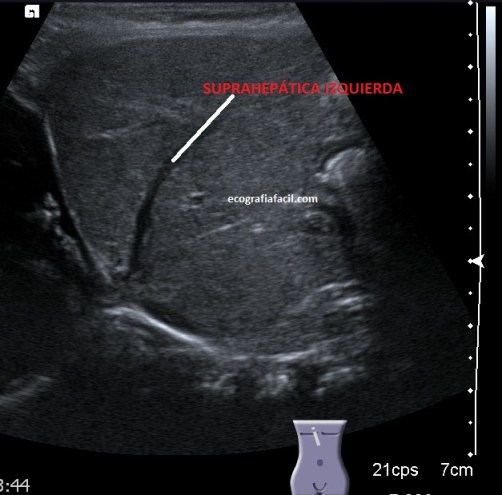
Ahora bien, recomiendo enfervorecidamente el estudio de cada una de las suprahepáticas de modo individual, y empezamos por la Suprahepática Izquierda. Para ello colocaremos la sonda como para el estudio del post anterior y la angularemos en función de la anatomía de la Suprahepática Izquierda, es decir, así:
These two images are the basis of today’s post along with the positioning of the probe … Now, I strongly recommend the study of each one of the suprahepatic ones in an individual way, and we start with the Left Suprahepatic. To do this we will place the probe as for the study of the previous post and we will angle it according to the anatomy of the Left Suprahepatic, that is, like this:
colocación en longitudinal oblicuo de la sonda (amarillo).
y tenemos que obtener este resultado:
and we have to obtain this result:
Suprahepática Izquierda.
Obsérvese en la imagen el pictograma.
Para la media y la suprahepática derecha se puede usar la colocación base, la primera que he contado e ir buscando cada una de forma individualizadamente hasta conseguir desplegarlas y lograr una imagen como esta:
Observe in the image the pictogram. For the mean and the right suprahepatic, the base placement can be used, the first one that I have counted and go searching each one individually to get them to unfold and achieve an image like this:
Detalle suprahepática derecha. Obsérvese el pictograma de la imagen.
Cuando nos enfrentamos a anatomías complicadas, hígados subcostales, mucho gás abdominal, etc, es interesante pedirle a la/el paciente que adopte la posición en decúbito lateral izquierdo para obtener los resultados más óptimos posibles, colocando nuestra sonda igual que si estuviese en decúbito supino. Y por cierto, en ocasiones podemos ver estos vasos mejor en apnea que en inspiración, pero siempre hay que probar ambas opciones.
Estos vasos pueden verse excesivamente grandes cuando hay patologías congestivas cardiacas y pueden llegar a llamar la atención por lo «llamativamente grandes que se ven», ojo, que es un signo de patología en este caso de posible origen cardiaco, pero corresponde al Radiólogo la valoración, eso sí, nosotros siempre atentos a cosas «no normales».
Muy interesante estos vasos, cuya circulación sanguínea aleja la sangre de la sonda y por tanto si aplicamos el modo de trabajo doppler color, veremos que su imagen es azul..
When faced with complicated anatomies, subcostal livers, much abdominal fat, etc., it is interesting to ask the patient to adopt the position in the left lateral decubitus to obtain the best possible results, placing our probe as if in the supine position. . And by the way, sometimes we can see these glasses better in apnea than in inspiration, but you always have to try both options. These vessels can be excessively large when there are congestive cardiac pathologies and can get attention because of the «strikingly large that are seen», eye, which is a sign of pathology in this case of possible cardiac origin, but the radiologist corresponds to the assessment , yes, we are always attentive to «not normal» things. Very interesting these vessels, whose blood circulation moves the blood away from the probe and therefore if we apply the Doppler color working mode, we will see that its image is blue ..
Detalle del color debido a la circulación sanguínea respecto de la sonda.
El ultrasonido cuando atraviesa los tejidos y estos devuelven los ecos de retorno no siempre lo hacen coherentemente, es decir, en ocasiones en la imagen ecográfica vamos a ver imágenes que no son deseadas, o sí…son los artefactos.
Artefactos hay en todas las técnicas de imagen, desde la radiología convencional hasta la Ecografía pasando por la RMN o el TAC.Cada una tiene sus propias características, íntimamente relacionadas con la naturaleza física de la técnica que estemos usando.
Los Artefactos ecográficos nocivos son Interacciones del haz con la materia que producen imágenes no deseadas. Pueden llevar a equívoco y/o facilitar el diagnóstico. ¿Todos los artefactos son negativos en Ecografía? la respuesta es NO.Hay algunos artefactos que son buenos, beneficiosos, porque ayudan al diagnóstico.
Dos tipos de Artefactos ecográficos:
Útiles
Nocivos
En este Post31 vamos a tratar los buenos, que además son importantísimos, porque los vamos a «disfrutar» todos los días que nos dediquemos a realizar ecografía…Por tanto…
No hay información detrás de esta interfase tan ecogénica. (Sombra Posterior).
Es muy característico de las litiasis biliares y renales y de las calcificaciones musculares y otro tipo de estructuras ricas en calcio.
The ultrasound when it crosses the tissues and these return echoes do not always do so coherently, that is, sometimes in the ultrasound image we will see images that are not desired, or yes … they are the artifacts. Artifacts are found in all imaging techniques, from conventional radiology to ultrasound through MRI or CT. Each has its own characteristics, closely related to the physical nature of the technique we are using. Harmful ultrasound artifacts are beam interactions with matter that produce unwanted images. They can mislead and / or facilitate diagnosis. Are all artifacts negative in Ultrasound? the answer is NO. There are some artifacts that are good, beneficial, because they help the diagnosis.
Two types of sonographic artifacts:
Tools
Harmful
In this Post31 we will try the good ones, which are also very important, because we are going to «enjoy» them every day that we dedicate ourselves to perform ultrasound … Therefore … Beneficial Ecographic Artifacts: Rear Acoustic Shade: Ultrasound collides with an interface that is very echogenic and can not pass through it. (Yellow arrow).
There is no information behind this echogenic interface. (Rear Shadow). It is very characteristic of biliary and renal stones and muscle calcifications and other types of structures rich in calcium.
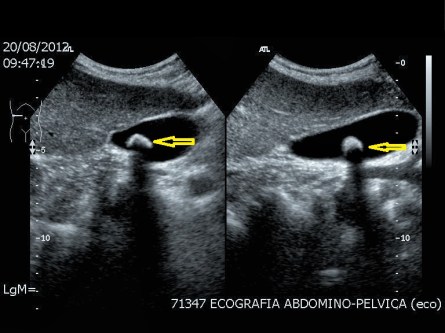
Litiasis Biliar y su Sombra Posterior.
En la imagen anterior observas, señalada por una flecha amarilla, una imagen hiperecogénica, porque brilla, redonda, única, dentro de una estructura anecoica (contiene líquido). Tras la imagen hiperecogénica vemos una estela negra alargada que busca la profundidad de la imagen…Bien, esta estela negra se llama Sombra Acústica Posterior. En la imagen estás viendo una piedra dentro de una vesícula biliar, es decir, una litiasis biliar.
Analicemos el término «Sombra Acústica Posterior». Sombra nos habla de una ausencia de luz. Acústica hace referencia a la naturaleza de los ultrasonidos. Posterior indica que se produce después de algo.
La sombra acústica posterior es la ausencia de información producida tras la piedra que impide que el haz ultrasónico atraviese dicha piedra debido a su alta impedancia provocando que el haz de ultrasonido que llega la piedra vuelva reflejado casi en su totalidad hacia el transductor.
In the previous image you can see, indicated by a yellow arrow, a hyperechoic image, because it shines, round, unique, inside an anechoic structure (it contains liquid). After the hyperechogenic image we see an elongated black wake that looks for the depth of the image … Well, this black stele is called Posterior Acoustic Shade. In the image you are seeing a stone inside a gall bladder, that is, a biliary lithiasis. Let’s analyze the term «Posterior Acoustic Shade». Shadow speaks of an absence of light. Acoustics refers to the nature of ultrasound. Later indicates that it occurs after something. The posterior acoustic shadow is the absence of information produced after the stone that prevents the ultrasonic beam from crossing that stone due to its high impedance, causing the ultrasound beam that reaches the stone to return reflected almost entirely to the transducer.
Reflexión total del haz de US y Sombra Posterior.
En la foto anterior ves dos flechas, la amarilla representa el tren de ultrasonidos que llega a la litiasis y la flecha roja los ecos de retorno que se devuelven hacia el transductor ya que no consiguen atravesarla y como consecuencia la sombra acústica posterior.
In the previous photo you see two arrows, the yellow represents the train of ultrasound that arrives at the lithiasis and the red arrow the return echoes that are returned to the transducer as they can not pass through and consequently the subsequent acoustic shadow.
2. Refuerzo Posterior:
Se produce cuando el ultrasonido atraviesa un medio sin interfases en su interior y pasa a un medio sólido ecogénico.
Nos permite diferenciar quistes.
Permite estudiar estructuras usando como ventana estructuras llenas de líquido.
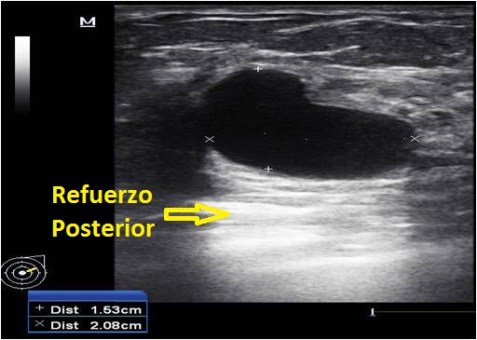
Este artefacto funciona diametralmente opuesto al anterior, ya que en vez de devolver todos los ecos del haz cuando llega a una estructura, estos ecos, en el caso de una estructura acuosa, atraviesan la estructura en un 100% prácticamente, y al llegar al tejido posterior a dicha estructura, se ve un halo hiperecogénico, es decir, más brillante, que es el Refuerzo Posterior y que responde a un paso casi total del haz de ultrasonido emitido desde nuestra sonda.
Es típico de los quistes, cuyo contenido es acuoso, y de las vejigas, y de aquellas estructuras cuyo porcentaje de agua sea muy elevado y que funcionan como ventanas para estudios de otros órganos, como el de la próstata, el útero y los ovarios, por eso decimos a los pacientes que para estudiar estas estructuras masculinas y femeninas, deben acudir a la cita con la vejiga llena.
2. Posterior Reinforcement: It occurs when the ultrasound passes through a medium without interfaces in its interior and passes to a solid echogenic medium. It allows us to differentiate cysts. It allows studying structures using structures filled with liquid as a window. This device works diametrically opposite to the previous one, since instead of returning all the echoes of the beam when it reaches a structure, these echoes, in the case of an aqueous structure, practically cross the structure in a 100%, and when reaching the tissue After this structure, a hyperechogenic halo is seen, that is, brighter, which is the Posterior Reinforcement and responds to an almost total passage of the ultrasound beam emitted from our probe. It is typical of cysts, whose content is aqueous, and bladders, and those structures whose water percentage is very high and which work as windows for studies of other organs, such as the prostate, uterus and ovaries, that’s why we tell patients that to study these male and female structures, they should go to the appointment with a full bladder.
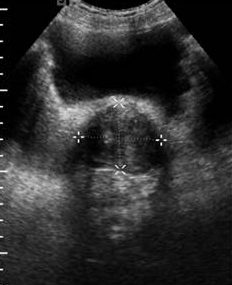
Halo Hiperecogénico correspondiente a Refuerzo Posterior.Estudio de Próstata con vejiga llena.
En la imagen anterior vemos la vejiga con líquido y una estructura posterior, hipoecogénica y que está medida, la próstata, que de no ser porque la vejiga está llena de líquido, no se podría haber estudiado tan bien.
Hemos estudiado dos importantes conceptos que te van a acompañar en todo el viaje que hagas por el mundo de la ecografía. La Sombra Posterior y El Refuerzo Posterior. Forman parte de los Artefactos Beneficiosos.
En el próximo post haré un resumen de los principales artefactos nocivos.
In the previous image we see the bladder with fluid and a posterior structure, hypoechoic and that is measured, the prostate, that of not being because the bladder is full of liquid, it could not have been studied so well. We have studied two important concepts that will accompany you throughout the journey you make in the world of ultrasound. The Posterior Shadow and the Posterior Reinforcement. They are part of the Beneficial Artifacts. In the next post I will summarize the main harmful artifacts.
Cuando nos enfrentamos a una ecografía, lo más importantes es ver lo que necesitamos estudiar y verlo lo me mejor posible.
La Resolución de la imagen es aquella cualidad del equipo que nos permite ver mejor la cantidad de detalles que dicha imagen pueda mostrarnos.
Cuando nos compramos un televisor nuevo lo que buscamos es que se vea bien, en la tienda todos tienen muy buena imagen, pero si te pones a comparar unos con otros, observas diferencias en la imagen, unos se ven mejor y otros se ven un poco peor, casi siempre en relación con el precio, los mejores, más caros siempre…
Con un ecógrafo pasa algo parecido, cuanta más alta es la gama del equipo, mejor imagen vamos a tener.
Esa calidad de imagen depende de varios aspectos, muchos los hemos tratado en los parámetros técnicos, pero hay uno que no hemos tratado y es la resolución de imagen, así que vamos a ello.
Existen varios tipos de resoluciones. Vamos a separarlas, definirlas y detallarlas una por una y desmenuzando los factores de los que dependen, vas a ver que te suenan la inmensa mayoría, porque ya los hemos estudiado.
1. Resolución Espacial:
Capacidad para distinguir interfases muy cercanas.
En esta resolución, podemos distinguir a su vez, otras dos:
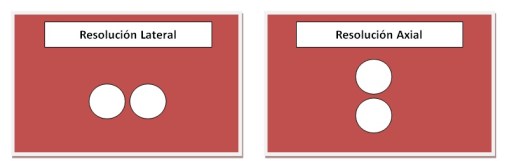
a. Resolución Axial:
Capacidad para distinguir dos estructuras en profundidades distintas.
Factores:
– Amplitud del pulso transmitido, siendo cuanto más corto mejor.
– Ancho de banda del transductor, es mejor siempre un transductor de banda ancha.
– Ancho de banda del receptor.
b.Resolución Lateral:
Capacidad para distinguir dos objetos uno al lado del otro.
Factores:
– Longitud de onda: A menor Longitud de onda, mejor resolución y mayor atenuación.
– Apertura del transductor siendo mejor cuanto más sea su apertura.
– Focalización.
– Profundidad del objeto. A más profundidad, pero resolución lateral.
When we are faced with an ultrasound, the most important thing is to see what we need to study and see it as well as possible. The resolution of the image is that quality of the equipment that allows us to see better the amount of details that this image can show us. When we buy a new television, what we look for is that it looks good, in the store all have a very good image, but if you start comparing with each other, you notice differences in the image, some look better and others look a bit worse, almost always in relation to the price, the best, most expensive always … With an ecograph something similar happens, the higher the range of the equipment, the better image we will have. That image quality depends on several aspects, many of us have dealt with the technical parameters, but there is one that we have not dealt with and it is the image resolution, so let’s go to it. There are several types of resolutions. We are going to separate them, define them and detail them one by one and shredding the factors on which they depend, you will see that they sound the vast majority, because we have already studied them. 1. Spatial Resolution: Ability to distinguish very close interfaces. In this resolution, we can distinguish, in turn, two others: to. Axial Resolution: Ability to distinguish two structures in different depths. Factors: – Amplitude of the transmitted pulse, the shorter the better. – Transducer bandwidth, a broadband transducer is always better. – Bandwidth of the receiver. b.Side Resolution: Ability to distinguish two objects side by side. Factors: – Wavelength: A shorter Wavelength, better resolution and greater attenuation. – Opening of the transducer, the better the opening. – Focus. – Depth of the object. Deeper, but lateral resolution.
Resolución espacial y sus dos variables.
2. Resolución Temporal.
La velocidad de refresco de la imagen en tiempo real debe ser suficientemente alta para que la imagen no vaya a saltos, es el “frame rate” y se mide en “imágenes por segundo”, puede ser un ajuste ecográfico que podamos variar en el menú.
Factores:
– Profundidad de la imagen: A más profundidad, menos resolución temporal.
– Campo de visión temporal: Cuanto más sea el campo de visión, más tiempo necesitará.
– Focalización dinámica: A más focos menos resolución espacial.
Escanear zonas pequeñas siempre mejorará la resolución temporal, por eso mejora con frecuencias altas.
3. Resolución de Contraste.
Determina qué diferencia de amplitud deben tener dos ecos para que se les asigne distintos niveles de grises.
Cuanto mejor sea mi equipo más capacidad de distinguir dos grises muy parecidos y por tanto, más capacidad tengo de distinguir patologías.
Factores:
– Depende del Rango Dinámico. El rango dinámico sufre la compresión reduciendo las amplitudes más pequeñas y más grandes, la diferencia de estas amplitudes es lo que se conoce como rango dinámico.
Como una imagen vale más que mil palabras os dejo esta imagen para que la comparéis.
2. Temporary Resolution. The refresh rate of the image in real time must be high enough so that the image does not jump, is the «frame rate» and is measured in «images per second», it may be an ultrasound adjustment that we can vary in the menu . Factors: – Depth of the image: The more depth, the less time resolution. – Temporal field of vision: The more the field of vision, the more time you will need. – Dynamic focus: A more spotlights less spatial resolution. Scanning small areas will always improve the temporal resolution, so it improves with high frequencies. 3. Contrast Resolution. Determine what difference in amplitude two echoes must have in order to be assigned different levels of grays. The better my team is, the more ability to distinguish two very similar grays and therefore, the more ability I have to distinguish pathologies. Factors: – Depends on the Dynamic Range. The dynamic range suffers compression by reducing the smaller and larger amplitudes, the difference of these amplitudes is what is known as dynamic range. As a picture is worth a thousand words I leave this image for you to compare.
Gran Resolución.Mala Resolución.
En las imágenes observamos el Tendón Extensor de los dedos de la mano en dos equipos diferentes, uno de alta gama y otro de gama media-baja, observar el detalle de los tendones.
Esta es la resolución de imagen, cuanto mejor imagen tengamos, mejor vamos a poder distinguir estructuras. Los mejores equipos ayudan al diagnóstico.
In the images we see the Tendon Extender of the fingers of the hand in two different equipment, one of high range and another one of medium-low range, to observe the detail of the tendons. This is the image resolution, the better image we have, the better we will be able to distinguish structures. The best equipment helps the diagnosis.
Hemos estudiado hasta aquí los parámetros más importantes del manejo de un ecógrafo, todos ellos eslabones vitales de una cadena sin la que es imposible conseguir una imagen diagnóstica en modo 2D.
Existen, sin embargo, gran cantidad de cantidad de ajustes o parámetros que son, desde mi punto de vista, menos importantes. ¿Porqué?, te preguntarás, te explico:
1.- Estos parámetros no aparecen en la botonera, suelen estar en el submenú.Y su uso es ocasional, en ocasiones de uso excepcional.
2.- Dependen de cada casa comercial, es decir, cada marca implementa en sus equipos una serie de ajustes para optimizar la imagen, por ejemplo, filtros, escalas de grises y otros que lo que hacen es modificar la imagen ligeramente, a veces, de manera casi imperceptible, por lo que, según mi opinión y para ti que estás empezando, pierden un poco de valor. Cuando ya estemos muy sueltos con el manejo de los equipos podemos empezar a trastear con estos otros comandos.
Eso no quiere decir que no los tengas que conocer, y por eso te presento alguno de ellos:
De estos ajustes «menos importantes», vamos a ver el primero que es el más importante de los menos importantes:
La Persistencia. Ojo, este ajuste puede variar de denominación según cada marca, pero sus efectos en la imagen son estos:
Lo que conseguimos con este ajuste es obtener una imagen más suave al aumentar este valor.
Elimina el moteado aleatorio.
Lo que estamos haciendo es controlar el tiempo que cada imagen permanezca en la pantalla antes de cambiarla por la siguiente.
Una imagen sin persistencia tendrá mucho grano.
Si la persistencia es demasiado alta la imagen estará “borrosa”
El Contorno: Ojo, este ajuste puede variar de denominación según cada marca, pero sus efectos en la imagen son estos:
Con este parámetro controlamos el tamaño del pixel.
Al aumentar el contorno aumentamos el pixel.
Si aumentamos el contorno mejoramos la diferenciación, pero ojo, si aumentamos en exceso podemos encontrar una imagen con demasiado grano.
Mapa o Escala de grises:
Son las distribuciones de la escala de grises.
Tendremos mapas muy contrastados, otros con más blancos, más suaves, etc.
Suele estar en todas las marca, pero su uso es residual.
We have studied until now the most important parameters of the handling of an ultrasound, all of them vital links of a chain without which it is impossible to obtain a diagnostic image in 2D mode. There are, however, a large amount of adjustments or parameters that are, from my point of view, less important. Why ?, you ask, I explain:
1.- These parameters do not appear in the keypad, they are usually in the submenu.And their use is occasional, sometimes of exceptional use.
2.- They depend on each commercial house, that is, each brand implements a series of adjustments in its equipment to optimize the image, for example, filters, gray scales and others that what they do is modify the image slightly, sometimes, almost imperceptibly, so, in my opinion and for you that you are starting, they lose a bit of value. When we are already very loose with the management of the equipment we can start to mess with these other commands. That does not mean that you do not have to know them, and that’s why I present one of them: Of these «less important» adjustments, we will see the first that is the most important of the least important:
Persistence Beware, this setting may vary in denomination according to each brand, but its effects on the image are these: What we achieve with this setting is to obtain a smoother image by increasing this value. Eliminate random speckle. What we are doing is controlling the time that each image remains on the screen before changing it for the next one. An image without persistence will have much grain. If the persistence is too high the image will be «blurry»
The Outline: Eye, this setting may vary in denomination according to each brand, but its effects in the image are these: With this parameter we control the size of the pixel. When increasing the contour we increase the pixel. If we increase the contour we improve the differentiation, but beware, if we increase in excess we can find an image with too much grain.
Map or Grayscale: They are the distributions of the gray scale. We will have very contrasted maps, others with whiter, softer, etc. It is usually in all brands, but its use is residual
Mínimos cambios en la imagen.
Tinte:
Es el cambio del color de la imagen.Nos puede mostrar cambios sutiles en el tejido que quizás no veríamos con la escala de grises…Hay tonos azules, Sepia, Rojo, etc.
Suele estar en todas las marca, pero su uso es residual.
Dye: It is the change of the color of the image. It can show us subtle changes in the fabric that perhaps we would not see with the grayscale … There are blue tones, Sepia, Red, etc. It is usually in all brands, but its use is residual.
Tinte azul.
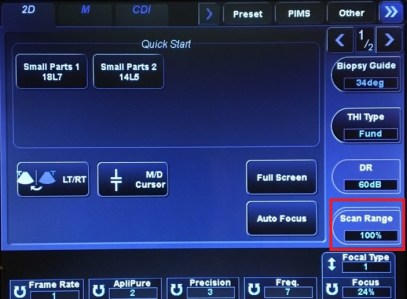
Campo visual:
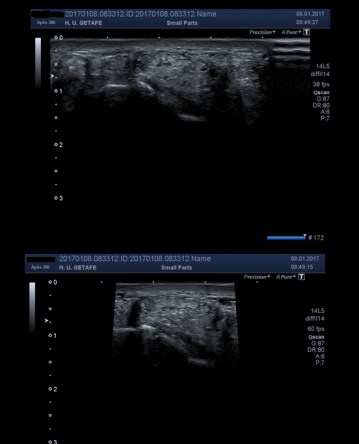
Modificamos la anchura de la imagen, menos campo visual, más imagen de refresco, más imágenes por segundo en nuestra pantalla.
Tiene que ver con la huella del transductor, es decir, la medida que tiene, no siempre necesitamos toda la huella de la sonda para estudiar una estructura. Por ejemplo en las imágen siguientes.
Visual field or Scan Range
We modify the width of the image, less visual field, more refresh image, more images per second on our screen. It has to do with the trace of the transducer, that is, the measurement it has, we do not always need the entire trace of the probe to study a structure. For example in the following images.
Scan Range de 100%.Imagen superior Scan Range 100%, Inferior, 50%.
Otros:
Realce de bordes: Incrementa el contraste entre diferentes interfases.
Suavizado: Suaviza la imagen, reduciendo el ruido global.
Rechazo: Umbralización para incrementar el contraste.
Recuerda, cada fabricante implementa los suyos y hay muchísimos. Los importantes están bien explicados, pero cuando te pones delante de un ecógrafo hay que conocer los importantes y los no tan importantes y para eso tenemos un técnico de aplicaciones que nos va a instruir en todos aquellos ajustes que su marca haya instalado en el modelo de ecógrafo con el que tengamos que trabajar. Quiero destacar aquí su gran labor porque conocen el ecógrafo al dedillo.
Con este post terminamos el estudio de los parámetros, a partir de ahora, nuestro objetivo va a ser la imagen de ecografía. Te espero.
Others:
Edge enhancement: Increase the contrast between different interfaces.
Smoothing: Softens the image, reducing overall noise.
Rejection: Threshold to increase the contrast.
Remember, each manufacturer implements their own and there are many. The important ones are well explained, but when you put yourself in front of an ultrasound scanner you have to know the important ones and the not so important ones and for that we have an application technician who will instruct us in all those adjustments that your brand has installed in the model of ecograph with which we have to work. I want to highlight here your great work because they know the ecograph at your fingertips. With this post we finish the study of the parameters, from now on, our objective will be the image of ultrasound. I wait for you.
Cuando empecé a hablar de los ajustes ecográficos o los parámetros técnicos, como se prefiera, quizá debería haber empezado por este ajuste, la razón es la siguiente, este ajuste, es el encargado de proporcionar la energía sónica que tiene que atravesar los tejidos y que lo hace partiendo desde el transductor. Sin esta energía, ninguno de los otros parámetros explicados aquí hasta ahora tendrían mucho sentido ya que la imagen, sin una correcta Potencia de Transmisión, no es válida, pero como el orden de los factores no altera el producto…empezamos…
La definición es: Es la potencia eléctrica que le llega a la sonda ecográfica o transductor.
Tiene relación estrecha con el índice mecánico (IM) y el Índice térmico (IT).
Estos índices son ambos efectos biomécanicos del sonido, efectos que requieren su post particular y que estudiaremos más adelante. Estos efectos pueden ser potencialmente dañinos.
La Potencia de Transmisión debe ser siempre ser tan baja como sea posible, según el criterio ALARA. ALARA son las siglas en inglés de «As Low As Reasonably Achievable» es decir “tan bajo como sea razonablemente alcanzable”. De este criterio sabemos muchísimo los Técnicos de Radiología ya que somos los responsables de aplicar estas energías o radiaciones, tanto ionizantes como no ionizantes,a los pacientes.
Por otro lado es necesario que para comprender como funciona la Potencia de Transmisión, entiendas lo que son estos dos índices, así que vamos a explicarlo brevemente.
El IM tiene que ver con el Riesgo de cavitación (aumento de presión y temperatura de las burbujas o cavidades con gas o líquidos). Este IM es un efecto No Térmico. Algunos equipos actuales pueden ocasionar este efecto, potencialmente dañino.
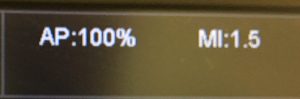
Este índice nunca debe ser superior a 1,9 y además este valor aparecerá en la pantalla para que lo tengamos bajo control.
When I started talking about the echographic settings or the technical parameters, as you prefer, maybe I should have started with this adjustment, the reason is this, this adjustment, is responsible for providing the sonic energy that has to go through the tissues and that it does so starting from the transducer. Without this energy, none of the other parameters explained here would make much sense since the image, without a correct Transmission Power, is not valid, but as the order of the factors does not alter the product … we started … The definition is: It is the electrical power that reaches the sonographic probe or transducer. This energy that then, by the Piezoelectric Effect https://ecografiafacil.com/2017/12/22/8-la-piezoelectricidad/ will become our ultrasound beam. Therefore, the more electrical energy, my beam will be more powerful too, but … It has a close relationship with the mechanical index (IM) and the thermal index (IT). These indices are both biomechanical effects of sound, effects that require their particular post and that we will study later. These effects can be potentially harmful. The Transmission Power must always be as low as possible, according to the ALARA criteria. ALARA stands for «As Low As Reasonably Achievable» that is «as low as reasonably achievable». From this criterion we know a lot Radiology Technicians since we are responsible for applying these energies or radiations, both ionizing and non-ionizing, to patients. On the other hand it is necessary that to understand how the Transmission Power works, understand what these two indexes are, so let’s explain it briefly. The IM has to do with the risk of cavitation (increase in pressure and temperature of bubbles or cavities with gas or liquids). This IM is a Non-Thermal effect. Some current equipment can cause this effect, potentially harmful. This index should never be higher than 1.9 and this value will also appear on the screen so that we have it under control.
El IT es otro valor numérico que indica la capacidad del ultrasonido de aumentar la temperatura del tejido. Este es un valor que marca efectos térmicos.
Se ha demostrado aumentos de 0,2 º Celsius por minuto a ultrasonido entregado a 1 W/cm2 a 1MHz.
Si no se superan 2º C es difícil que ocasionen efectos.
Ambos valores pueden estar representados en la imagen y deben seguir estas normas:
– Deben ser claramente visibles en pantalla cuando el valor sobrepase un 0,4.
– Aquellos equipos incapaces de sobrepasar un índice de 1 están exentos de representar este valor.
– Pueden estar representado un solo índice (IT o IM) en función del que pueda ocasionar el efecto.
El objetivo es ajustar la potencia para obtener una información clínicamente útil o que la imagen sea diagnóstica, para enternos.
Pero claro, sería lógico pensar que deberíamos reducir esta energía al mínimo, lamentablemente no puede ser porque al reducir la potencia disminuimos la calidad de imagen ya que reducimos la amplitud de señal, sí, otra vez la amplitud, magnitud de onda importantísima.https://ecografiafacil.com/2017/12/15/5-magnitudes-de-la-onda-otras-magnitudes/
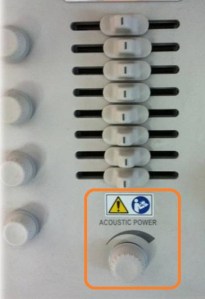
La potencia de transmisión es un ajuste que podemos manejar a través de un comando en forma de rueda, que se encuentra normalmente en la botonera o en el menú táctil en los equipos más nuevos y que en la pantalla se refleja en un porcentaje o en un valor numérico entre el 10 y el 100.
IT is another numerical value that indicates the ability of ultrasound to increase tissue temperature. This is a value that marks thermal effects. It has been shown increases of 0.2 º Celsius per minute to ultrasound delivered at 1 W / cm2 at 1MHz. If they are not exceeded 2 º C is difficult to cause effects. Both values can be represented in the image and must follow these rules: – They must be clearly visible on the screen when the value exceeds 0.4. – Those teams incapable of exceeding an index of 1 are exempt from representing this value. – A single index (IT or IM) can be represented depending on the one that may cause the effect. The objective is to adjust the power to obtain a clinically useful information or that the image is diagnostic, to enternos. But of course, it would be logical to think that we should reduce this energy to the minimum, unfortunately it can not be because when reducing the power we reduce the image quality since we reduce the amplitude of the signal, yes, again the amplitude, important magnitude of the wave.http: //ecografiafacil.com/2017/12/15/5-magnitudes-of-la-onda-otras-magnitudes/ The transmission power is an adjustment that we can manage through a wheel-shaped command, which is normally found in the keypad or in the touch menu in the newer equipment and which is reflected in the screen in a percentage or in a numerical value between 10 and 100.
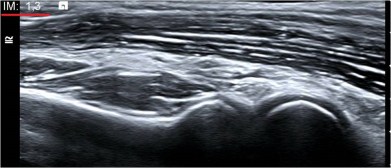
Potencia de Transmisión, aspecto en botonera.Potencia de transmisión en menú digital.Acustic power del 100 e IM de 1,5.Valor IM señalado con línea roja.
Si disminuimos este porcentaje, bajamos el valor de los índices antes comentados y también la calidad de imagen, así que ojo…
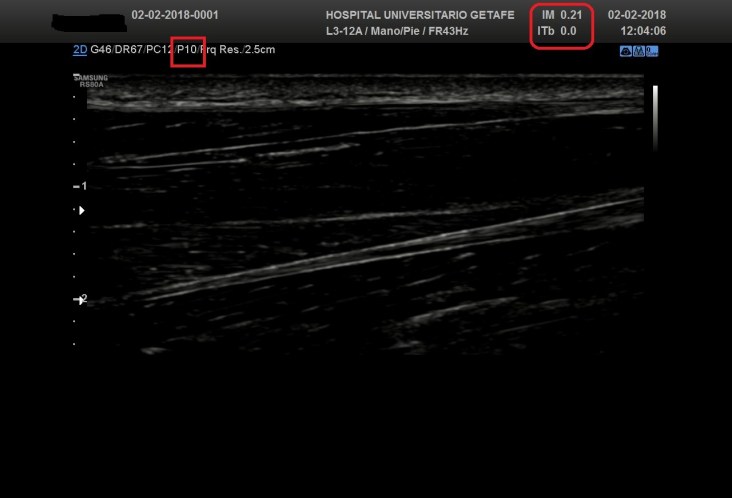
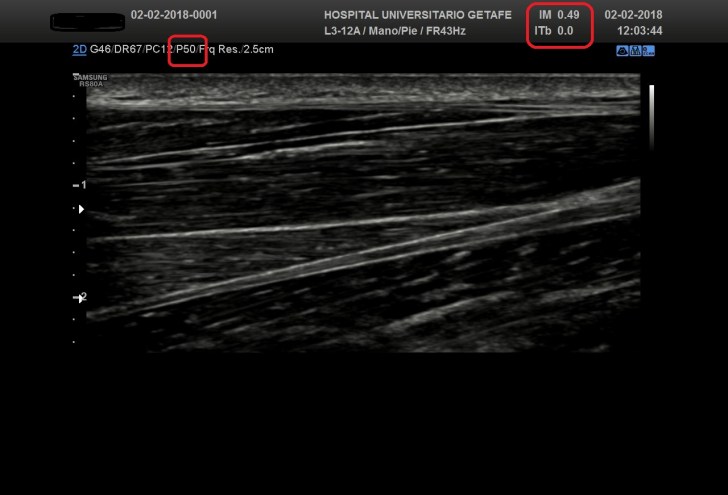
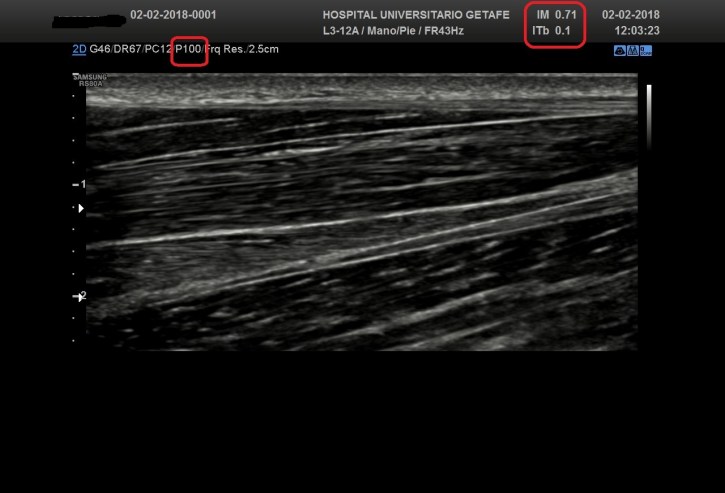
Las imágenes a continuación expuestas nos enseñan como la Potencia influye decisivamente en la calidad de la imagen obteniday además como los IM e IT se ven afectados según el valor de dicha potencia…observa.
If we decrease this percentage, we lower the value of the aforementioned indexes and also the image quality, so beware … The following images show us how the Power decisively influences the quality of the image obtained and also how the IM and IT are affected according to the value of said power … observe.
Potencia de 10, en rojo, Índices bajos, mala calidad de imagen.Potencia media (P50), regular calidad de imagen, IM y IT medios.Potencia máxima (P100), buena calidad de imagen, IM y IT altos, pero dentro de los márgenes de tolerancia.
En el caso de que hagamos una Ecografía con contraste, la potencia de transmisión tiene que estar al mínimo.Normalmente en estos casos, ya viene en la configuración del preset especial para contrates ecográficos que trataremos en un Post más adelante.
In the case that we do an Ultrasound with contrast, the transmission power must be at minimum. Normally in these cases, it already comes in the configuration of the special preset for ultrasound contracts that we will deal with in a Post later.
Los Armónicos o frecuencia armónica es un ajuste ecográfico que está muy ligado a la frecuencia de la que hablábamos en el capítulo anterior y que de modo general es un parámetro técnico muy desconocido para la mayoría de los operadores que se sientan frente a un ecógrafo a realizar una eco.
Es un ajuste o parámetro de difícil comprensión en lo que a su formación se refiere, pero es muy útil y vamos a intentar desmenuzar bien su base teórica para que nos ayude a usarlos mejor…
Es un sistema de recepción de ecos para captar señales con una frecuencia el doble o más que la emitida, que solo es posible producirla por la reverberación de los tejidos y nunca por un artefacto. Es decir, yo emito un pulso de ultrasonidos a 5 MHz y recojo ecos de retorno de 10 MHz discriminando los que están por debajo de ese umbral. Uno de los efectos perseguidos con este ajuste es «limpiar» la imagen de aquellos ecos de retorno que no son útiles y «ensucian» la imagen con ese moteado característico de la imagen fundamental de la ecografía.
En resumen, puedo emitir una frecuencia f y recibir aquellos ecos de retorno que sean 2f, 3f o más…
¿Imagen fundamental?, te explico, la imagen fundamental es una imagen primaria, sin armónicos, con sus cosas buenas y sus cosas malas desde el punto de vista diagnóstico, es la imagen de base que nos ofrece el ecógrafo. Esta imagen es susceptible de ser modificada con todos los ajustes que hemos ido explicando hasta ahora y luego, aplicar los armónicos para ver si nos ofrece ese salto de calidad, que se produce casi siempre cuando ponemos los armónicos.
Harmonics or harmonic frequency is an ultrasound adjustment that is closely linked to the frequency that we talked about in the previous chapter and that in general is a technical parameter that is very unknown to most operators who sit in front of an ultrasound machine to perform an echo It is an adjustment or parameter that is difficult to understand in terms of its training, but it is very useful and we are going to try to break down its theoretical base to help us use them better … It is a system of reception of echoes to pick up signals with a frequency twice or more than that emitted, which can only be produced by the reverberation of the tissues and never by an artifact. That is to say, I issue a pulse of ultrasound at 5 MHz and I collect echoes of 10 MHz return discriminating those that are below that threshold. One of the effects pursued with this adjustment is to «clean» the image of those return echoes that are not useful and «dirty» the image with that mottled characteristic of the fundamental image of the ultrasound. In summary, I can issue a frequency f and receive those return echoes that are 2f, 3f or more … Fundamental image ?, I explain, the fundamental image is a primary image, without harmonics, with its good things and its bad things from the diagnostic point of view, is the basic image that the ultrasound machine offers us. This image is susceptible to be modified with all the adjustments that we have been explaining so far and then apply the harmonics to see if it offers that quality jump, which occurs almost always when we put the harmonics.
Imagen de alta frecuencia con y sin armónicos.
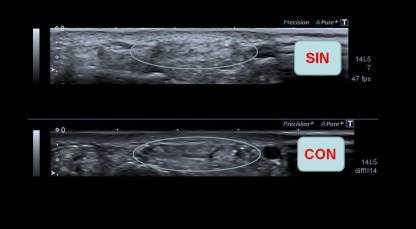
Las diferencias en algunos estudios son extremadamente llamativas, pudiendo llegar a diferenciar estructuras usando este ajuste que con la imagen fundamental se observan dificultosamente. En la imagen anterior, Tendón extensor común de los dedos de la mano. Misma imagen sin y con armónicos. Juzgar vosotros.
The differences in some studies are extremely striking, being able to differentiate structures using this adjustment that with the fundamental image are observed difficultly. In the previous image, Tendon extensor common of the fingers of the hand. Same image without and with harmonics. Judge you.
Observa las diferencias entre las dos imágenes.
En la imagen vemos dos imágenes, observamos que la nitidez y la definición de las estructuras es mucho mayor con armónicos que sin ellos.
Los armónicos es un ajuste implementado gracias al avance y la investigación de las casas comerciales en pos de conseguir una imagen mejor. Ya suelen estar integrados en los presets que vienen de fábrica o en la configuración personal que nos ofrece el técnico de aplicaciones cuando nos instala el equipo, una labor vital, por cierto.
Podemos explicar que los armónicos son, ecos de retorno múltiplos de la frecuencia transmitida en origen y que se debe a una propagación de la onda de ultrasonidos donde el componente de alta presión o compresión se transmite más rápidamente que el componente negativo o rarefacción.
Como esta explicación resulta bastante dura, pero no hay otra, puesto que es física pura, vamos a centrarnos en lo que importa en la práctica y que son sus ventajas, las mismas que a continuación te presento esquemáticamente.
In the image we see two images, we observe that the clarity and definition of the structures is much greater with harmonics than without them. The harmonics is an adjustment implemented thanks to the advance and research of the commercial houses in pursuit of achieving a better image. They are usually integrated in the presets that come from the factory or in the personal configuration that the application technician offers us when he installs the equipment, a vital task, by the way. We can explain that harmonics are return echoes multiples of the frequency transmitted at origin and that is due to a propagation of the ultrasound wave where the component of high pressure or compression is transmitted faster than the negative component or rarefaction. As this explanation is quite hard, but there is no other, since it is pure physics, we are going to focus on what matters in practice and what are its advantages, the same ones that I present here schematically.
Reducen los artefactos y aumentan la resolución.
Los armónicos o frecuencia armónica mejora la imagen respecto de la frecuencia fundamental, ya que esta debida a las interfases puede resultar poco resolutiva
Utilizaremos armónicos cuando la imagen fundamental no sea suficientemente buena.
Es una imagen más nítida ya que “limpia” la imagen fundamental.
En frecuencias altas ofrece una gran calidad de imagen.
Con los armónicos reducimos el moteado.
They reduce the artifacts and increase the resolution.
The harmonics or harmonic frequency improves the image with respect to the fundamental frequency, since this due to the interfaces can be not very resolutive
We will use harmonics when the fundamental image is not good enough.
It is a sharper image because it «cleans» the fundamental image.
In highs frequencies it offers a great image quality.
With the harmonics we reduce the mottling.
El moteado es un factor de degradación de la imagen producido por la dispersión de ultrasonidos de pequeños reflectores o pequeñas interfases, mostrando una imagen con un grano característico. En estas pequeñas interfases se producen ecos de retorno que ensucian la imagen y no aportan información porque una parte de los ecos de retorno producidos en las interfases ni siquiera llega al transductor, los eliminamos y nos queda una imagen mejor.
No confundamos, para ir terminando, armónicos con filtros porque no es lo mismo, el armónico es una representación selectiva de los mejores ecos de retorno. Dependiendo del equipo, normalmente de su gama, podemos disfrutar de varios tipos de armónicos.
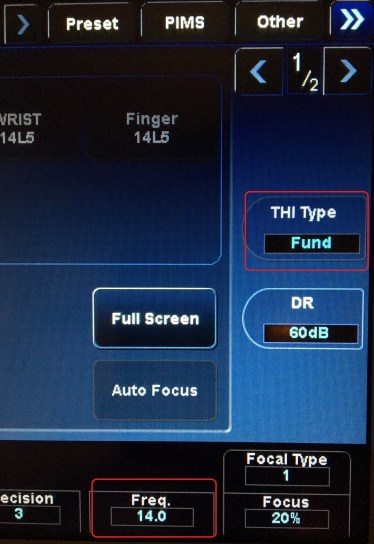
En la pantalla la imagen armónica se identifica habitualmente dependiendo de la casa comercial acompañando al valor de la frecuencia alguna letra o palabra, en la imagen fundamental, la frecuencia aparecerá como un valor numérico solitario (últimas imágenes).
Los armónicos deben estar siempre a disposición del operador, y se identifican en muchas marcas como THI o tissue harmonic imaging. El uso de los armónicos no es obligatorio, pero recomendable. Siempre asociando su uso a las características del paciente y del estudio.
Mottle is a factor of degradation of the image produced by the scattering of ultrasound of small reflectors or small interfaces, showing an image with a characteristic grain. In these small interfaces return echoes are produced that dirty the image and do not provide information because a part of the return echoes produced at the interfaces does not even reach the transducer, we eliminate them and we have a better image. Let’s not confuse, to finish, harmonics with filters because it is not the same, the harmonic is a selective representation of the best return echoes. Depending on the equipment, normally of its range, we can enjoy several types of harmonics. In the screen the harmonic image is usually identified depending on the commercial house accompanying the value of the frequency some letter or word, in the fundamental image, the frequency will appear as a solitary numerical value (last images). Harmonics must always be available to the operator, and are identified in many brands as THI or tissue harmonic imaging. The use of harmonics is not mandatory, but recommended. Always associating its use with the characteristics of the patient and the study.
Observar en recuadro rojo el tipo de armónico y su valor numérico con las letras.Imagen fundamental y valor de frecuencia en solitario.














 Ecografía Fácil