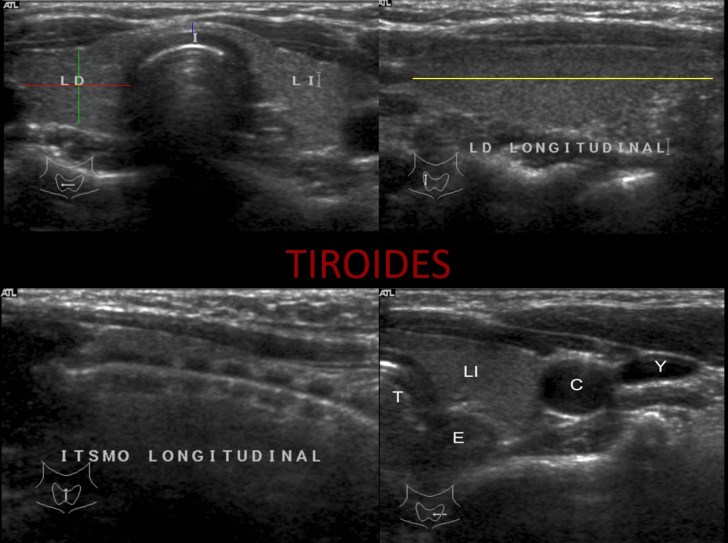
36. Protocolo de Tiroides. Los Cortes.

Ahora vamos a ver los cortes, no el protocolo, los cortes, es decir, como tenemos que manejar el transductor para realizar un protocolo de Tiroides normal.

Esto que ves en este post es la teoria, pero se aprende con la práctica o en un taller, donde quien te enseñe te dirija la mano al principio ya que es una técnica que requiere destreza, pero todo se aprende¡¡¡

Una vez que todo está preparado para empezar el estudio debemos saber donde y como se coloca espacialmente la glándula, los vasos y todos aquellas estructuras que tengamos que estudiar. El problema es que están debajo de la piel, y eso no ayuda…Por eso es importante conocer muy la anatomía.

Los cortes de los lóbulos y el Istmo son en transverso y en logitudinal, es decir, axiales al cuello y sagitales a éste.

Cada lóbulo será estudiado individualmente en transverso y longitudinal y siempre siempre colocados perpendicularmente a la estructura. El cuello no es plano, desde el cartílago a los laterales, el cuello se inclina, por tanto tendremos que inclinarnos nosotros con nuestra sonda para buscar el lóbulo de cada lado.

El Istmo es central, por tanto debemos apoyar la sonda central  transverso y en longitudinal, teniendo mucho cuidado porque el istmo es muy pequeño y cogerlo en longitudinal puede hacerse complicado al principio ya que además, tenemos que estar apoyando sobre la tráquea que es un superficie muy inestable.

En radiología todo hay que estudiarlo en dos proyecciones, por tanto, para estudiar el Tiroides, también, así como todas aquellas estructuras que nos parezcan anómalas, por ejemplo, nódulos que nos parezcan que pueden ser de interés para el radiólogo por su aspecto, tamaño o forma.

Además siempre haremos transverso y longitudinal porque es la única manera de poder medir una estructura en los tres ejes del espacio, antero-posterior, derecha-izquierda y cráneo-caudal.

Ah, y muy muy importante, recuerda siempre posicionar el transductor para hacer coincidir la derecha del paciente con la derecha de la pantalla (nuestra izquierda), en el corte transverso y en el longitudinal, la parte craneal, a la derecha de la pantalla (nuestra izquierda).

Now let’s see the cuts, not the protocol, the cuts, that is, how we have to handle the transducer to perform a normal thyroid protocol. What you see in this post is the theory, but you learn with practice or in a workshop, where whoever teaches you to direct your hand at first since it is a technique that requires skill, but everything is learned! Once everything is ready to begin the study we must know where and how the gland, vessels and all those structures that we have to study are placed. The problem is that they are under the skin, and that does not help … That is why it is important to know the anatomy very well. The cuts of the lobes and the Isthmus are transverse and longitudinal, that is, axial to the neck and sagittal to the neck. Each lobe will be studied individually in transverse and longitudinal and always always placed perpendicular to the structure. The neck is not flat, from the cartilage to the sides, the neck is inclined, so we will have to lean ourselves with our probe to look for the lobe on each side. The Isthmus is central, therefore we must support the transverse and longitudinal central probe, being very careful because the isthmus is very small and taking it in longitudinal can be complicated at first since also, we have to be resting on the trachea that is a surface very unstable In radiology, everything has to be studied in two projections, therefore, to study the thyroid, as well as all those structures that seem anomalous, for example, nodules that we think may be of interest to the radiologist because of their appearance, size or form. In addition we will always make transverse and longitudinal because it is the only way to be able to measure a structure in the three axes of space, antero-posterior, right-left and cranio-caudal. Oh, and very important, always remember to position the transducer to match the patient’s right with the right of the screen (our left), in the transverse and longitudinal cuts, the cranial part, to the right of the screen ( our left).
Situación del Tiroides

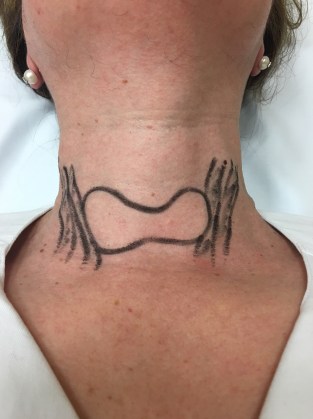
Para que te hagas una idea de como estudiar la glándula, primero tienes que saber cómo es y donde se sitúa. Luego saber lo que tiene más cerca, es decir, anatomía, este caso lo ves dibujado sobre el cuello con los vasos, la carótida y la yugular a sus lados.

To give you an idea of ​​how to study the gland, you must first know what it is like and where it is located. Then find out what is closest, that is, anatomy, this case you see it drawn on the neck with the vessels, the carotid and the jugular at its sides.
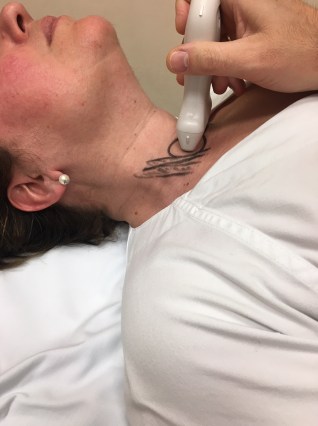
Corte tranverso

En este caso realizamos un corte transverso del lóbulo derecho que es un corte axial del cuello, adecuándonos a la posición del lóbulo.

In this case we perform a transverse cut of the right lobe that is an axial cut of the neck, adapting to the position of the lobe.
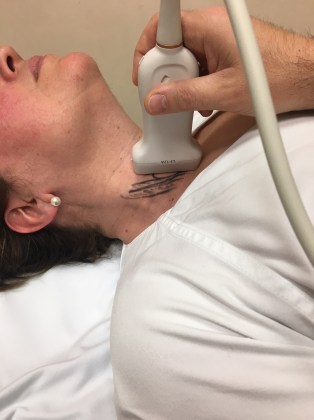
Corte longitudinal

Observa ahora cómo nos colocamos en función del lóbulo, mira como el corte no es en el eje sagital puro, sino que nos adaptamos a la estructura con el único fin de poder verla en su totalidad en longitudinal.

See now how we position ourselves according to the lobe, look how the cut is not in the pure sagittal axis, but we adapt to the structure with the sole purpose of being able to see it in its entirety in longitudinal.
Corte transverso del Istmo

El Itsmo requiere, obviamente su propio estudio, en este caso, corte transverso, apoyando levemente sobre la línea media del cuello, sin comprimir en exceso, observa como el transductor no apoya lateralmente, pero si tienes bastante gel y realizas compresión correcta, vas a poder ver el Istmo y ambos lóbulos, como te demuestro en la siguiente imagen…

The Isthmus require, obviously your own study, in this case, transverse cut, supporting slightly on the midline of the neck, without compressing excessively, observe how the transducer does not support laterally, but if you have enough gel and you perform correct compression, you will be able to see the Isthmus and both lobes, as I show you in the next image
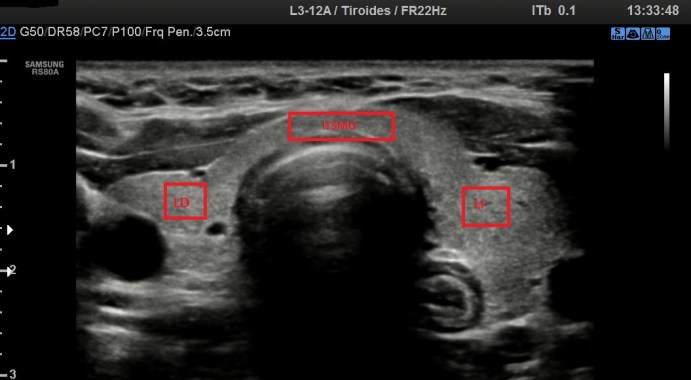
Posteriormente y sin movernos de ahí, giramos el transductor 90º en sentido horario, colocándonos sobre la línea media, perpendicularmente a la estructuctura para realizar el corte longitudinal o sagital al cuello.

Subsequently and without moving from there, we turn the transducer 90º in a clockwise direction, placing ourselves on the midline, perpendicular to the structure to make the longitudinal or sagittal cut to the neck.
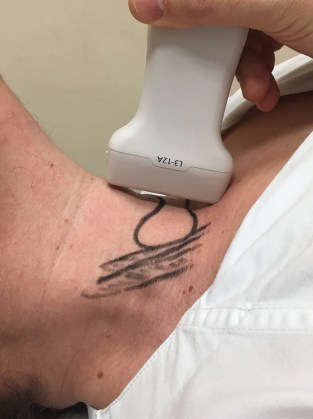
Longitudinal del Istmo

Esta imagen superior sería el corte longitudinal del Istmo, en la imagen el transductor no apoya, obviamente tendremos que apretar un poco más, pero quería mostrarte cómo sería el corte respecto de la estructura.

Para el lóbulo izquierdo realizaremos la misma operación que con el lóbulo derecho, pero al otro lado de la línea media.

Junto al lóbulo derecho y el izquierdo, encontramos lateralmente dos vasos, carótida, más medial y yugular, más externa, si observas en la imagen primera, no son completamente sagitales, por tanto para su estudio, tendremos que buscar su orientación y adaptarnos a su anatomía. Así:

This upper image would be the longitudinal cut of the Isthmus, in the image the transducer does not support, obviously we will have to tighten a little more, but I wanted to show you how the cut would be with respect to the structure. For the left lobe we will perform the same operation as with the right lobe, but on the other side of the midline. Next to the right and left lobes, we find laterally two vessels, carotid, more medial and jugular, more external, if you look at the first image, they are not completely sagittal, therefore for their study, we will have to look for their orientation and adapt to their anatomy.
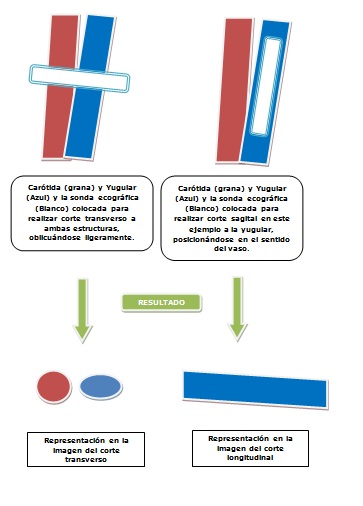
Representación de cortes de estudio de los vasos

Para resumir, realizaremos cortes transversos y longitudinales siempre adecuándonos a la colocación de la estructura a estudio. Así haremos tanto con las estructuras anatómicas normales como con aquellas que despierten nuestra atención porque puedan ser de significado relevante para el estudio.

En el próximo Post veremos la representación en imágenes del protocolo habitual.

To summarize, we will make transverse and longitudinal cuts always adapting to the placement of the structure under study. This way we will do as much with normal anatomical structures as with those that arouse our attention because they can be of significant significance for the study. In the next Post we will see the representation in images of the usual protocol. Do not forget to share if you like the Blog.

No olvides compartir si te gusta el Blog.
35. Protocolo de Tiroides. Consideraciones básicas.

El Tiroides es una glándula, vamos a verla con ecografía muy habitualmente porque es la técnica de elección para su estudio y los Endocrinólogos y los Médicos de Familia solicitan esta prueba muy a menudo.

Anatomía: Enlazo aquí una dirección donde conocerás suficientemente la anatomía y la fisiología del Tiroides. Te invito a investigar su anatomía y funcionamiento, ya que, aunque un poco desconocida, la glándula tiroidea es una gran  directora de orquesta que tiene repercusión en gran cantidad de procesos metabólicos del organismo.

Consideraciones:

  • DEBIDO A LA SITUACIÓN ANATÓMICA DEL TIROIDES, TANTO LA ECOGRAFÍA 2D EN TIEMPO REAL COMO LOS ESTUDIOS DOPPLER-COLOR HACE DE ESTA LA TÉCNICA DE ELECCIÓN PARA EL ESTUDIO DE ESTA REGIÓN ANATÓMICA.
  • Es una técnica barata, de fácil acceso en el ámbito sanitario y muy solicitada por los especialistas.
  • EN LOS AÑOS 80 SE CONVIERTE EN LA TÉCNICA MÁS SENSIBLE PARA DETECTAR NÓDULOS QUE NO SE VEN NI EN CT NI EN RMN.
  • Su uso se dispara por la alta incidencia de cánceres de Tiroides en la Europa del Este por el accidente de Chernobil.
Thyroid is a gland, we will see it with ultrasound very often because it is the technique of choice for its study and Endocrinologists and Family Physicians request this test very often. Anatomy: Here is an address where you will know enough about the anatomy and physiology of the Thyroid. I invite you to investigate its anatomy and functioning, since, although a little unknown, the thyroid gland is a great conductor of orchestra that has repercussion in a great amount of metabolic processes of the organism. Considerations: DUE TO THE ANATOMICAL SITUATION OF THE THYROID, BOTH THE 2D RECORDING IN REAL TIME AND THE STUDIES DOPPLER-COLOR MAKES THIS THE CHOICE OF CHOICE FOR THE STUDY OF THIS ANATOMICAL REGION. It is a cheap technique, easily accessible in the health field and highly requested by specialists. IN THE YEARS 80 IT BECOMES THE MOST SENSITIVE TECHNIQUE TO DETECT NODULES THAT ARE NOT SEEN IN CT OR MRI. Its use is triggered by the high incidence of thyroid cancers in Eastern Europe due to the Chernobyl accident.

La Técnica:

  • Usaremos sondas de Alta Frecuencia.
  • Necesitaremos Profundidad de estudio en torno a los 5 cms. dependiendo de las características de la paciente.
  • El Doppler es de uso habitual ya que la estructura está treméndamente vascularizada.
  • El paciente se tumbará en la camilla de estudio relajado y con el cuello hiperextendido para mejor acceso del operador.(Algunos pacientes, por esta posición pueden marearse al incorporarse de la camilla de exploración).
  • Luz adecuada en la sala.
  • Limpieza de superficies (Sondas y equipo).

Objetivo:

  • VALORAR Y MEDIR AMBOS LÓBULOS TIROIDEOS.
  • VALORAR ISTMO.
  • BARRIDO TRANSVERSO Y LONGITUDINAL.
  • VALORAR GANGLIOS REGIONALES.
  • VALORAR CARÓTIDAS Y YUGULARES.
  • BUSCAR PARATIROIDES.

Exploración Ecográfica:

  • ESTUDIAMOS LOS LÓBULOS Y EL ISTMO POR SEPARADO:
  • MEDIDAS LÓBULOS:
    • ANTERO-POSTERIOR, DERECHA-IZQUIERDA Y LONGITUDINALMENTE
  • MEDIDAS ISTMO
    • MEDIDA ANTERO-POSTERIOR

Descripción de la Exploración:

Cada sitio de trabajo puede tener su propios protocolos de estudio, yo te voy a explicar como me parece el ideal.

Una vez tumbado el paciente con el cuello en hiperextensión en función de su capacidad, cogeremos la sonda adecuada y nos aseguraremos de que el paciente sea el correcto cuando lo capturemos de la lista de trabajo y escogeremos el preseteado adecuado.

Empezaremos localizando el lóbulo tiroideo derecho en transverso, después el Istmo y luego el lóbulo tiroideo izquierdo realizando una vista general, realizaremos una foto colocados sobre el Istmo donde se vean ambos lóbulos para poder evaluar su apariencia y comparar su ecogenicidad, así:

The technique: We will use High Frequency probes. We will need depth of study around 5 cms. depending on the characteristics of the patient. Doppler is commonly used because the structure is tremendously vascularized. The patient will lie down on the study table relaxed and with the neck hyperextended for better access of the operator (Some patients, due to this position can get dizzy when getting up on the examination table). Adequate light in the room. Surface cleaning (Probes and equipment). Objective: VALUING AND MEASURING BOTH THYROID LLOBES. VALUING ISTHMUS. TRANSVERSE AND LONGITUDINAL SWEEP. VALUATE REGIONAL GANGLES. VALUING CAROTID AND YUGULAR. SEARCH FOR PARTYROIDES. Ultrasound scan: WE STUDY THE LOBULES AND THE ISTHMUS SEPARATELY: MEASURES LOBULOS: PREVIOUS-BACK, RIGHT-LEFT AND LONGITUDINALLY ISTMO MEASURES PREVIOUS-REAR MEASUREMENT Description of the Exploration: Each work site can have its own study protocols, I will explain how I think the ideal. Once the patient is lying down with the neck in hyperextension according to his capacity, we will take the appropriate probe and we will make sure that the patient is the correct one when we capture it from the work list and we will choose the right preset. We will start by locating the right thyroid lobe transverse, then the Isthmus and then the left thyroid lobe making a general view, we will make a photo placed on the Isthmus where both lobes can be seen to evaluate their appearance and compare their echogenicity, like this:

Ahora nos centramos en el lóbulo derecho, siempre buscando incidir sobre la estructura perpendicularmente. La cogeremos en toda su extensión y haremos medidas como verás después. Lo estudiaremos en transverso y longitudinal, repitiendo lo mismo con Istmo y lóbulo izquierdo.

Pondremos el Doppler color para comprobar la vascularización de ambos lóbulos.

Después nos centraremos en la patología que nos hayamos encontrado y la estudiaremos.

Es habitual encontrar nódulos, más adelante hablaremos de su aspecto y las recomendaciones de estudio.

Posteriormente haremos un recorrido general por el cuello valorando ganglios locorregionales, empezando debajo de la oreja y recorriendo la dirección del esternocleidomastoideo hasta llegar al espacio supraclavicular y después revisar vasos principales del cuello, especialmente carótidas y la aparición en su interior de placas de ateroma.

Buscaremos la presencia de patología de las paratiroides, pero a menudo, dicha patología es difícil de diferenciar de otras patologías tiroideas salvo que la/el paciente llegue con una sospecha alta debido a la clínica o pruebas que dirijan el estudio a dichas glándulas paratiroideas, por ejemplo la hipercalcemia.

Now we focus on the right lobe, always looking to influence the structure perpendicularly. We will take it to its full extent and we will take measures as you will see later. We will study it in transverse and longitudinal, repeating the same with Isthmus and left lobe. We will put the color Doppler to check the vascularization of both lobes. Then we will focus on the pathology we have encountered and we will study it. It is common to find nodules, later we will discuss their appearance and study recommendations. Later, we will make a general tour of the neck, evaluating locoregional ganglia, starting below the ear and crossing the direction of the sternocleidomastoid to the supraclavicular space and then reviewing main vessels of the neck, especially carotids and the appearance of atheroma plaques inside. We will look for the presence of pathology of the parathyroids, but often, this pathology is difficult to differentiate from other thyroid pathologies unless the patient arrives with a high suspicion due to clinical or tests that direct the study to said parathyroid glands, for example hypercalcemia.

Medidas:

Estudio general Tiroideo.

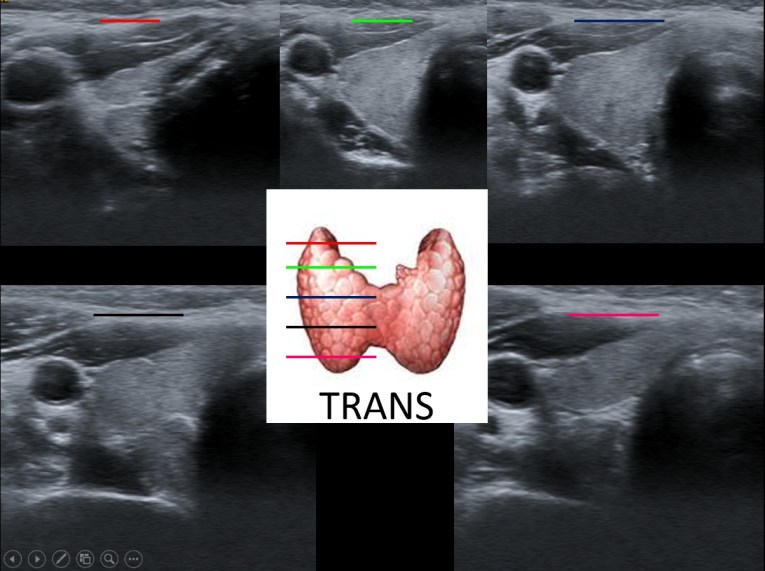
En la imagen superior ves una serie de cortes que nos sirven para realizar unas medidas:

Rojo: Medida derecha-izquierda

Verde: Medida antero-posterior

Azul: Medida antero-posterior del Istmo

Amarillo: Medida longitudinal del lóbulo

Rojo, Verde y Amarillo se repetirán en ambos lóbulos tiroideos.

Podemos realizar si lo deseamos unas fotos recorriendo de forma pormenorizada toda la estructura de la glándula tanto en transverso como en longitudinal. Así:

In the image above you see a series of cuts that help us to make some measurements: Red: Right-left measurement Green: Antero-posterior measurement Blue: Anteroposterior measurement of the Isthmus Yellow: Longitudinal measurement of the lobe Red, Green and Yellow will be repeated in both thyroid lobes. We can make some pictures if we want to go through in detail the entire structure of the gland both transverse and longitudinal. 
Cortes transversos de anterior a posterior.
Cortes Longitudinales desde externo a interno.

Los cortes están especificados en color y cada corte representado en la imagen anatómica de la estructura. No importa el sentido de los cortes, el caso es que valoremos la glándula en su totalidad.

En principio y salvo que se especifique en la petición, queda al margen del estudio las glándulas salivares, siempre que la clínica de la/el paciente no lo precise. Suelen ser estas glándulas objeto de estudio por otra clase de patologías.

En el próximo post veremos el protocolo en si, tal y como debes hacerlo para que sea valorado por un radiólogo.

The cuts are specified in color and each cut represented in the anatomical image of the structure. No matter the sense of the cuts, the case is that we value the gland in its entirety. In principle and unless specified in the request, salivary glands are excluded from the study, as long as the patient’s clinic does not require it. These glands are usually the object of study due to other types of pathologies. In the next post we will see the protocol itself, as you must do to be evaluated by a radiologist.

Como siempre te animo a compartir el Blog si lo consideras de utilidad.


34. Protocolos. Consideraciones.

Empezamos con la serie de protocolos que voy a desarrollar, siempre desde el punto de vista de mi profesión. No todos los profesionales de la Ecografía son médicos, en mi caso, mi objetivo no es diagnosticar, pero sí encontrar la mejor manera de conseguir la mejor imagen posible para poder darle al Radiólogo la oportunidad de ver lo que le pasa al/la paciente con la imagen técnicamente perfecta.

En esta serie de Post vas a poder ver cuales son las imágenes que tienes que realizar para poder tener un protocolo listo para presentar para la realización de un informe radiológico. Te voy a mostrar las imágenes de la región anatómica a estudio y como es el corte que tienes que realizar, pero desgraciadamente no puedo cogerte la mano para enseñarte a ejecutar la prueba, y es así como se aprende la Ecografía.

Te voy a enseñar los conceptos teóricos, pero la técnica de ejecución de un estudio se aprende ejecutando el estudio repetitívamente y enfrentándonos a gran cantidad de anatomías muy variopintas y vicisitudes que tienen que ver con la peculiaridad de cada paciente.

Como los protocolos son muy extensos los iré subiendo por partes y con números según la actualización que vaya realizando.

Sé que hay tutoriales que indican pormenorizadamente como colocar la sonda y donde para ver una estructura, pero desgraciadamente no vale con eso, no te frustres si no lo consigues a la primera, repite y repite teniendo clara, eso sí, la imagen que quieres conseguir.

La única manera de andar los primeros pasos en la Ecografía es como aprendí yo, como la experiencia me dice que tiene que ser, y que no es otra que dirigiéndote la mano al principio para que luego puedas caminar sola/o, eso se consigue en el centro de trabajo o taller práctico con una/un especialista.

Cuando empieces, vas a encontrarte en un mar de dudas, contacta conmigo por los canales del Blog que ya conoces en redes sociales, Facebook, Twitter, Instagram y en el mail ecografiafacil.com@gmail.com donde intentaré en la medida de lo posible contestar, incluso en los comentarios de cada Post, eso puede servir de enseñanza para otras/os que puedan tener las mismas dudas.

We start with the series of protocols that I will develop, always from the point of view of my profession. Not all professionals of the Ultrasound are doctors, in my case, my goal is not to diagnose, but to find the best way to get the best possible image to be able to give the radiologist the opportunity to see what happens to the patient. the technically perfect image. In this series of Post you will be able to see which are the images that you have to perform in order to have a protocol ready to present for the realization of a radiological report. I’m going to show you the images of the anatomical region to study and how is the cut you have to make, but unfortunately I can not take your hand to teach you how to run the test, and that is how you learn the ultrasound. I’m going to teach you the theoretical concepts, but the technique of running a study is learned by performing the study repetitively and facing a lot of very diverse anatomy and vicissitudes that have to do with the peculiarity of each patient. As the protocols are very extensive, I will upload them in parts and with numbers according to the update that I am making. I know there are tutorials that indicate in detail how to place the probe and where to see a structure, but unfortunately it is not worth it, do not get frustrated if you do not get it the first time, repeat and repeat having clear, yes, the image you want to get . The only way to walk the first steps in the Ultrasound is how I learned, as experience tells me that it has to be, and that it is nothing other than directing your hand at the beginning so that you can then walk alone, that is achieved in the work center or practical workshop with a specialist. When you start, you will find yourself in a sea of ​​doubts, contact me through the channels of the Blog that you already know in social networks, Facebook, Twitter, Instagram and in the email ecografiafacil.com@gmail.com where I will try as much as possible answer, even in the comments of each Post, that can serve as a teaching for others who may have the same doubts.
Un consejo, no empieces por el tejado, recorre todos los Post, la técnica y la física son vitales, así como los parámetros, no te olvides de esto…ah¡ super importante, la anatomía, para reconocer estructuras ecográficas debemos conocer perfectamente la antomía de dicha estructura.Esto es vital, no puede uno enfrentarse a la realización de un estudio sin conocer, así que repasa siempre la anatomía, enlazaré en cada Post con alguna página donde puedas repasar la anatomía.

Ánimo, es fácil¡¡¡…bueno, no tanto…jejej…

Empezamos¡¡¡¡

An advice, do not start on the roof, go through all the Post, technique and physics are vital, as well as the parameters, do not forget this … ah, super important, anatomy, to recognize ultrasound structures we must know perfectly the antimony of this structure. This is vital, you can not face the realization of a study without knowing, so always review the anatomy, link in each post with a page where you can review the anatomy. Courage, it’s easy … well, not so much … jejej … We started! ¡¡¡

33. La Imagen.Características y Planos de corte.

La imagen en ecografía es muy fácil de identificar si la vemos,pero ¿sabemos identificar aquello que nos cuenta la imagen de ecografía que no es el tejido que estamos estudiando?…Sí, nadie le hace mucho caso a eso, por eso voy a intentar explicarlo.

Lo primero que tenemos que saber es que una imagen de ecografía es una imagen DICOM.

Una de las características más curiosas de la imagen de ecografía es que una vez que le damos al botón destinado a hacer una foto de aquello que nos interese guardar, la captura que hace el equipo es de toda la imagen, incluido el nombre, por lo que es imposible, una vez enviado a PACS, corregir el nombre del paciente en el supuesto caso que nos hubiésemos confundido de paciente o hubiésemos puesto mal sus datos personales o de filiación. Habría que corregirlo en el equipo (si tuviésemos dicha opción) o volver a hacer el estudio con los datos correctos y volver a enviarlo.

The ultrasound image is very easy to identify if we see it, but do we know what the ultrasound image tells us is not the tissue we are studying? … Yes, nobody pays much attention to that, that’s why I’m going to try to explain it. The first thing we need to know is that an ultrasound image is a DICOM image. One of the most curious features of the ultrasound image is that once we click on the button to take a picture of what we want to save, the capture made by the team is of the whole image, including the name, so that it is impossible, once sent to PACS, to correct the name of the patient in the event that we had been confused as a patient or we had misplaced their personal or filiation data. It would have to be corrected in the team (if we had that option) or redo the study with the correct data and send it back.
Lo que nos cuenta la imagen.

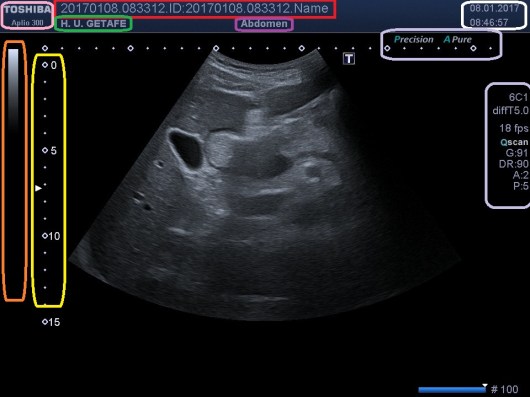
Por otro lado en la imagen de ecografía aparecen siempre con la imagen del tejido a estudiar, datos como la profundidad y posición del foco (amarillo), además una escala de grises y los datos básicos con los que hemos realizado el estudio,Ganancia General Rango Dinámico uso de armónicos o no, junto a la Frecuencia, también cuántas imágenes de Cine tenemos guardadas y otros filtros o parámetros técnicos que estemos usando, pero esto último no se da en todos los casos.

On the other hand, in the ultrasound image they always appear with the image of the tissue to be studied, data such as the depth and position of the focus (yellow), as well as a gray scale and the basic data with which we have carried out the study. General Gain Range Dynamic use of harmonics or not, along with the frequency, also how many movie images we have saved and other filters or technical parameters that we are using, but the latter does not occur in all cases.

Datos de ajustes ecográficos.

Índices Mecánicos y Térmicos siempre que fuera necesario saber su valor.

Datos de índice mecánico.

Me parece indispensable que aparezca siempre La Frecuencia.

Además del nombre del/de la paciente, debe aparecer su edad y el sexo.

Por supuesto la fecha y la hora de realización del estudio.También la marca e incluso el modelo de la marca comercial, el preseteado que hemos escogido para realizar el estudio y me parecería obligatorio que apareciese la identificación del responsable de la realización de la exploración. Además la institución donde se realiza el estudio.

Muy bien, pero ¿cómo se consigue la imagen de ecografía? Es decir, ¿cuales son los planos de corte?

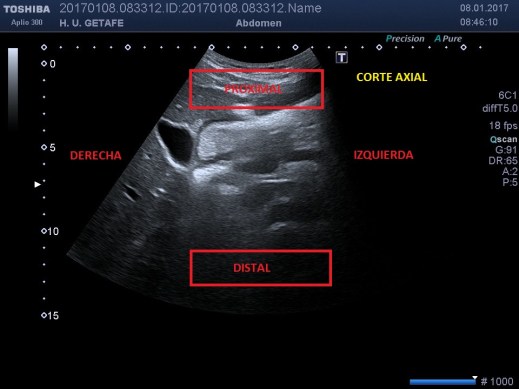
La base está en la colocación del transductor. La sonda que estemos usando tiene colocarse de manera que la derecha del paciente se sitúe a la derecha de la imagen en nuestro monitor, que corresponde a nuestra mano izquierda, si estamos realizando un corte axíal, para ello, tocaremos en uno de los dos lados de la huella (la parte gris) de la sonda con un dedo con un poco de gel y con la imagen descongelada, una vez que veamos en la pantalla donde se mueve nuestro dedo comprobaremos si ese movimiento marca la derecha de la imagen, entonces si es así, pondremos ese lado de la sonda a la derecha del paciente, si no,giraremos la sonda. De este modo, la derecha del paciente será la derecha de nuestro monitor.

It seems to me indispensable that Frequency always appear. In addition to the name of the patient, your age and gender must appear. Of course the date and time of conducting the study. Also the brand and even the model of the commercial brand, the preset that we have chosen to carry out the study and it would seem mandatory that the identification of the person responsible for carrying out the exploration should appear. In addition, the institution where the study is carried out. All right, but how do you get the ultrasound image? That is, what are the cutting planes? The base is in the placement of the transducer. The probe that we are using has to be placed so that the right of the patient is placed to the right of the image on our monitor, which corresponds to our left hand, if we are performing an axial cut, for this, we will touch on one of the two sides of the footprint (the gray part) of the probe with a finger with a little gel and with the image thawed, once we see on the screen where our finger moves we will check if that movement marks the right of the image, then if that is, we will put that side of the probe to the right of the patient, if not, we will rotate the probe. In this way, the patient’s right will be the right of our monitor.
Corte axial.

En esta imagen, vemos colocado todo correctamente, la vesícula a la derecha de la imagen y el hígado también, si hubiésemos colocado mal la sonda en este corte axial, el hígado aparecería a la izquierda de la imagen.

Si el corte es longitudinal, igual, pero en este caso haremos coincidir la sonda con la parte que corresponda a la derecha de la imagen y la zona craneal del paciente, así tendremos que la derecha de la pantalla es la parte craneal del paciente y la izquierda, la zona caudal.

In this image, we see everything correctly placed, the gallbladder to the right of the image and the liver also, if we had placed the probe wrong in this axial section, the liver would appear to the left of the image. If the cut is longitudinal, equal, but in this case we will match the probe with the part that corresponds to the right of the image and the cranial area of ​​the patient, so we will have that the right of the screen is the cranial part of the patient and the left, the caudal zone.
Corte Longitudinal.

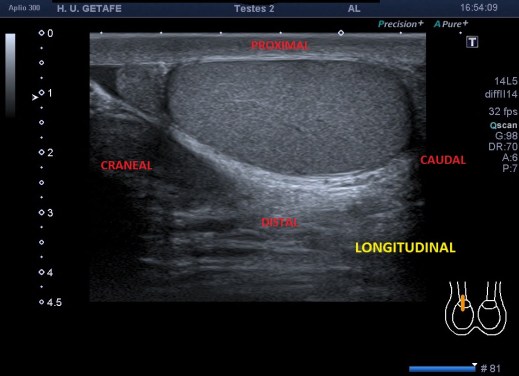
En esta imagen del testículo, el epidídimo que se ve, isoecogénico sobre el teste derecho, aparecería en la región caudal, pudiendo llevar a error si la sonda estuviese mal posicionada en el corte longitudinal (observa el pictograma).

Este método nunca os va a fallar, ya que hay sondas que tienen muescas para guiarnos, incluso en la pantalla, algún tipo de letra que nos indique la derecha, pero puede llevar a equívoco y por tanto, no lo recomiendo de base.

Una mala posición de la sonda hará que la imagen se mueva al revés y provocará un conflicto en la visualización del operador que al principio podemos no reconocer, pero que con un poco de práctica identificaremos rápidamente.

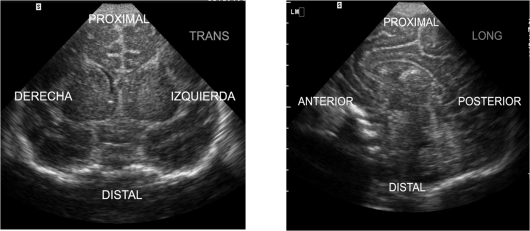
Esto no es así en todos lo casos, por ejemplo, en el estudio transfontanelar de la cabeza de un/una paciente neonato, como usamos la fontanela anterior, el corte que denominamos transverso, es un corte coronal de la cabeza de la criatura, siendo impepinable que la derecha de la pantalla sea la derecha de la cabeza del o de la paciente. En el corte longitudinal de este estudio la derecha de la pantalla corresponderá a la cara o región anterior de la cabeza y la izquierda, a la parte occipital de la cabeza o posterior.

In this image of the testicle, the epididymis that is seen, isoechogenic on the right testis, would appear in the caudal region, possibly leading to an error if the probe was incorrectly positioned in the longitudinal section (observe the pictogram). This method will never fail you, since there are probes that have notches to guide us, even on the screen, some type of letter that tells us the right, but it can lead to misunderstandings and therefore, I do not recommend it as a base. A bad position of the probe will cause the image to move backwards and will cause a conflict in the visualization of the operator that at the beginning we may not recognize, but with a little practice we will identify quickly. This is not the case in all cases, for example, in the transfontanel study of the head of a neonatal patient, as we use the anterior fontanelle, the cut we call transverse, is a coronal cut of the head of the creature, being impepinable that the right of the screen is the right of the head of the patient. In the longitudinal section of this study, the right side of the screen will correspond to the face or anterior region of the head and left, to the occipital part of the head or posterior.
Eco Transfontanelar. Distinta orientación.

Lo que es siempre fijo es que la parte donde apoya el transductor en la piel del paciente es la parte superior de la imagen y la parte más profunda es la parte más profunda del tejido que estemos estudiando.

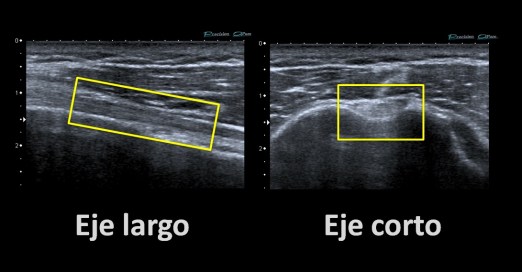
Una cosa más, en ocasiones podemos ver u oír llamar Eje Largo al corte Longitudinal y Eje Corto al Axial, es muy típico de la ecografía muscular. En estos casos, yo prefiero hablar de axial y longitudinal en función de la colocación de la sonda, no del músculo o tendón ya que su colocación puede llevar a error.

What is always fixed is that the part where the transducer rests on the skin of the patient is the upper part of the image and the deepest part is the deepest part of the tissue that we are studying. One more thing, sometimes we can see or hear call Long Axis Longitudinal cut and Short Axial Axial, is very typical of muscle ultrasound. In these cases, I prefer to talk about axial and longitudinal depending on the placement of the probe, not the muscle or tendon since its placement can lead to error.
Otras denominaciones.

Cabe considerar que en ecografía siempre trabajamos en función del tejido a estudio y los planos de colocación de los tejidos no respetan los ejes del espacio puros. Por eso aunque hablemos de corte axiales, longitudinales, pueden ser en función del órgano o de la colocación del transductor, es importante tener la idea clara en nuestro centro de trabajo y protocolos de uso diario.

Axial, transverso o eje corto es igual, Longitudinal, eje largo y sagital, también significa lo mismo.

It should be considered that in ultrasound we always work according to the tissue under study and the planes of tissue placement do not respect the pure space axes. For that reason, although we speak of axial, longitudinal cuts, they can be in function of the organ or the placement of the transducer, it is important to have the clear idea in our center of work and protocols of daily use. Axial, transverse or short axis is equal, Longitudinal, long and sagittal axis, also means the same.


32. Artefactos Nocivos.

En el Post anterior comentábamos los artefactos beneficiosos…https://ecografiafacil.com/2018/02/20/31-los-artefactos-artefactos-beneficiosos/

Hoy toca hablar de esos otros artefactos, los nocivos. De forma general vamos a decir que hay una gran cantidad de artefactos nocivos, algunos muy difíciles de percibir, otros muy claros, aquí vas a ver un resumen de los que a mi modo de ver, me parecen más importantes.

In the previous Post we mentioned the beneficial artifacts … http: //ecografiafacil.com/2018/02/20/31-los-artefactos-artefactos-beneficiosos/ Today we have to talk about those other artifacts, the noxious ones. In a general way we are going to say that there are a lot of harmful devices, some very difficult to perceive, others very clear, here you will see a summary of those that in my opinion, seem more important to me.
  1. Reverberaciones: Se producen cuando el haz de ultrasonidos incide sobre una interfase que separa dos medios de muy diferente impedancia acústica, como por ejemplo entre un sólido ecogénico y gas en el tubo digestivo.El empleo de armónicos y reducción de las ganancias minimizan la presencia de este artefacto.
    Reverberations: They occur when the ultrasound beam impinges on an interface that separates two media of very different acoustic impedance, such as between an echogenic solid and gas in the digestive tract. The use of harmonics and reduction of gains minimize the presence of this artifact.

    Las imágenes hipercogénicas de la izquierda de la imagen, como en bandas, son típicas del gas intestinal, un artefacto recurrente por el que se impone pedir a los pacientes que vayan en ayunas a las exploraciones de Ecografía Abdominal.

    The hypercogenic images on the left of the image, as in bands, are typical of the intestinal gas, a recurrent artifact that requires patients to be asked to go on fasting to Abdominal Ultrasound scans.

    Cola de cometa: Ocurre cuando el haz de ultrasonidos choca contra una interfase estrecha y muy ecogénica apareciendo detrás de esta interfase una serie de ecos lineales. Adenomiomas de pared vesical o pequeñas burbujas de aire en el seno de un medio sólido.Cuerpos extraños muy ecogénicos.

    Comet tail: Occurs when the ultrasound beam hits a narrow and very echogenic interface, appearing behind this interface a series of linear echoes. Adenomyomas of bladder wall or small bubbles of air in the bosom of a solid medium. Very echogenic foreign bodies.

    Casi inapreciable, pero marcada con una flecha blanca, observamos una imagen hiperecogénica, pegada a la pared de la vesícula, anecoica, y una pequeña línea hiperecogénica que sale de ella.

    Almost imperceptible, but marked with a white arrow, we observed a hyperechoic image, attached to the wall of the gallbladder, anechoic, and a small hyperechoic line that comes out of it.
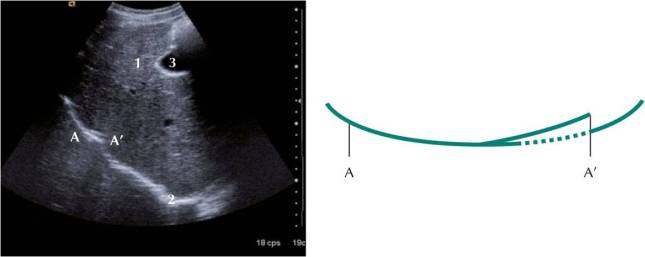
  2. Imagen en espejo: Se produce cuando una interfase muy ecogénica se encuentra delante de otra imagen curva tan ecogénica como ella. Es muy típico la imagen que ves a continuación donde la lesión medida en el parénquima hepático, hiperecogénica aparece al otro lado de la línea del diafragma (muy hiperecogénica) simulando otra lesión (flecha blanca), que no es real.
    Es un error en la lectura de los ecos de retorno, me explico, cuando el haz llega a la estructura y vuelven al transductor lo hacen apropiadamente, pero hay otra parte del haz que llega a la siguiente capa hiperecogénica, que devuelve ecos que chocan contra la parte posterior de la primera interfase hiperecogénica, estos ecos tardan más en llegar al transductor y por tanto hace que parezca que está más profundo, es para explicarlo muy básicamente, una doble lectura en tiempos distintos. En ecografía el tiempo de lectura equivale a profundidad, por tanto la segunda lectura del objeto será incongruente y ocasiona esta falsa imagen en profundo.


  3. Refracción divergente: Cuando el sonido traspasa dos medios de diferente velocidad de propagación. Se puede observar un efecto de discontinuidad como en el caso de la imagen siguiente, efecto irreal debido al cambio de velocidad entre dos tejidos de muy diferente impedancia. https://ecografiafacil.com/2017/12/15/5-magnitudes-de-la-onda-otras-magnitudes/       
    Divergent refraction: When the sound passes through two media of different velocity of propagation. A discontinuity effect can be observed as in the case of the following image, an unreal effect due to the change in speed between two tissues of very different impedance. 

    Imagen propiedad de Francisco Ordoñez en su manual de ecografía.                                                                                                                                                                         
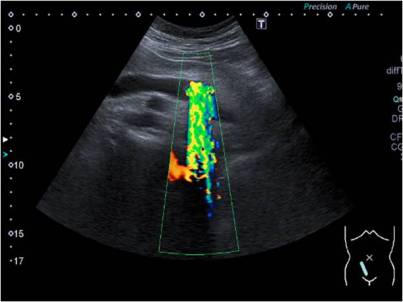
  4. Aliasing: Es un artefacto típico del modo de trabajo Doppler, donde vamos a encontrar un lectura incoherente de la señal doppler. Las causas son múltiples, desde limitaciones técnicas hasta la anatomía del paciente pueden provocar este artefacto. En la imagen vamos a ver una imagen desestructurada del Doppler. En La imagen observamos el efecto anómalo de lectura Doppler provocado por una litiasis  ureteral.
    Aliasing: It is a typical artifact of Doppler work mode, where we will find an inconsistent reading of the Doppler signal. The causes are multiple, from technical limitations to the anatomy of the patient can cause this artifact. In the image we will see a dysfunctional Doppler image. In the image we observe the anomalous effect of Doppler reading caused by a ureteral lithiasis.
    Aliasing.


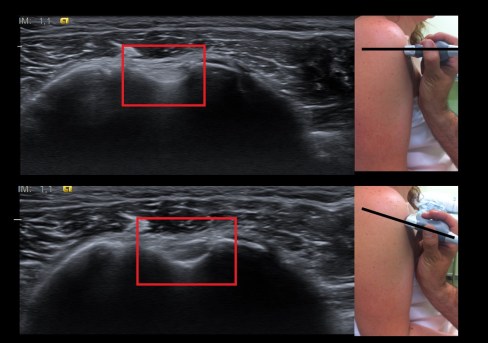
  5. Anisotropía: Es la propiedad que tienen algunos tejidos de variar su ecogenicididad dependiendo del ángulo de incidencia del haz ultrasónico sobre ellos. La estructura anisotrópica por excelencia es el tendón. Este artefacto es exclusivo de la ecografía muscular. Una correcta ejecución de la técnica garantiza la no aparición de dicho artefacto. Obsérvese en el recuadro rojo el origen del tendón del biceps, ovalado e hiperecogénico y la correcta colocación del transductor en ángulo de 90º con respecto al eje largo del húmero y su mala angulación en la imagen inferior con la consecuente repercusión en la imagen ecográfica donde no se visualiza dicho tendón.
    Anisotropy: It is the property that some tissues have to vary their echogenicity depending on the angle of incidence of the ultrasonic beam on them. The anisotropic structure par excellence is the tendon. This artifact is exclusive of muscle ultrasound. A correct execution of the technique guarantees the non-appearance of said artifact. Observe in the red box the origin of the biceps tendon, oval and hyperechogenic and the correct placement of the transducer at an angle of 90º with respect to the long axis of the humerus and its mala angulation in the lower image with the consequent repercussion in the ultrasound image where said tendon is visualized.
    Anisotropía en Tendón del Biceps.


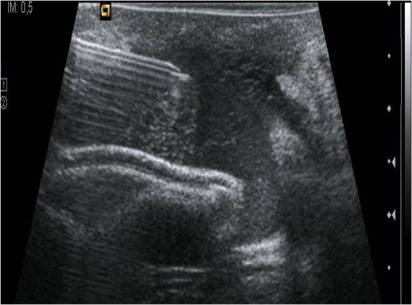
  6. Imagen doble: Debido a la refracción, pueden presentarse objetos reales en localización falsa. Se minimiza con un ángulo de incidencia lo más cercano posible a 90º. En este caso que pongo a continuación, una aguja de punción cuyo efecto parece simular que existan varias, siendo esta imagen el artefacto que estamos tratando en este punto.
    Double image: Due to refraction, real objects can be presented in a false location. It is minimized with an angle of incidence as close as possible to 90º. In this case that I put next, a needle of puncture whose effect seems to simulate that there are several, this image being the artifact that we are dealing with at this point.


    Aguja con varias capas en profundidad, sólo la primera es real.


  7. Ausencia de apoyo: Se produce al no apoyar el transductor en la piel del paciente convenientemente, bien por la estructura de la anatomía a estudiar o por falta de gel. En la imagen a la derecha de esta, se objetiva un área donde no se ve el tejido a estudio por falta de apoyo del transductor. Es típico del aprendizaje este tipo de artefactos que la experiencia pule y corrige.
    Absence of support: It occurs when the transducer is not supported on the patient’s skin conveniently, either by the structure of the anatomy to be studied or by lack of gel. In the image to the right of this, an area where the study tissue is not seen due to lack of transducer support is objectified. It is typical of learning this type of artifacts that experience polishes and corrects.
    Falta de apoyo en margen derecho de la imagen.


    Se puede luchar contra estos indeseables artefactos, la depuración de la técnica logrará minimizarlos, pero a continuación te recomiendo una serie de acciones que se pueden llevar a cabo para intentar hacer que desaparezcan.

    Recomendaciones:

    1. Acceder a la zona explorada por otra ventana. 

    2. Uso de gel adecuado para una buena transmisión.

    3. Estudio con otra frecuencia. (Ancho de banda).

    4. Ajuste de la ganancia total y parcial.https://ecografiafacil.com/2018/01/10/15-la-ganancia-general/

    5. Revisar situación del foco. https://ecografiafacil.com/2018/01/18/19-el-foco/

    6. Cambio de la profundidad y del ángulo de incidencia. https://ecografiafacil.com/2018/01/16/18-la-profundidad/

    7. Mover al paciente si es posible, por ejemplo cuando hay mucho gas intestinal para tratar de movilizarlo.

You can fight against these undesirable artifacts, the debugging technique will minimize them, but then I recommend a series of actions that can be carried out to try to make them disappear.
Recommendations:
1. Access the scanned area by another window.
2. Use of gel suitable for a good transmission.
3. Study with another frequency. (Bandwidth).
4. Adjustment of the total and partial profit.http: //ecografiafacil.com/2018/01/10/15-la-ganancia-general/
5. Review focus situation. https://ecografiafacil.com/2018/01/18/19-el-foco/
6. Change of depth and angle of incidence. https://ecografiafacil.com/2018/01/16/18-la-profundidad/
7. Move the patient if possible, for example when there is a lot of intestinal gas to try to mobilize it.


31. Los Artefactos.Artefactos Beneficiosos.

El ultrasonido cuando atraviesa los tejidos y estos devuelven los ecos de retorno no siempre lo hacen coherentemente, es decir, en ocasiones en  la imagen ecográfica vamos a ver imágenes que no son deseadas, o sí…son los artefactos.

Artefactos hay en todas las técnicas de imagen, desde la radiología convencional hasta la Ecografía pasando por la RMN o el TAC.Cada una tiene sus propias características, íntimamente relacionadas con la naturaleza física de la técnica que estemos usando.

Los Artefactos ecográficos nocivos son Interacciones del haz con la materia que producen imágenes no deseadas. Pueden llevar a equívoco y/o facilitar el diagnóstico. ¿Todos los artefactos son negativos en Ecografía? la respuesta es NO.Hay algunos artefactos que son buenos, beneficiosos, porque ayudan al diagnóstico.

Dos tipos de Artefactos ecográficos:

  • Útiles
  • Nocivos

En este Post31 vamos a tratar los buenos, que además son importantísimos, porque los vamos a «disfrutar» todos los días que nos dediquemos a realizar ecografía…Por tanto…

Artefactos Ecográficos beneficiosos:

  1. Sombra Acústica Posterior:

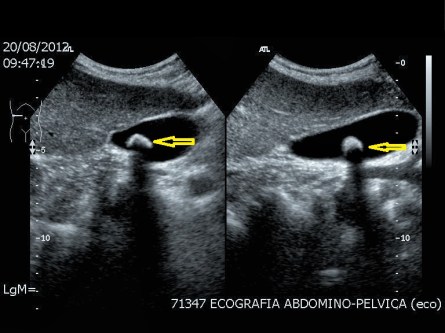
El ultrasonido choca con una interfase https://ecografiafacil.com/2017/12/19/7-las-interfases/ muy ecogénica y no puede atravesarla. (Flecha Amarilla). 

No hay información detrás de esta interfase tan ecogénica. (Sombra Posterior).

Es muy característico de las litiasis biliares y renales y de las calcificaciones musculares y otro tipo de estructuras ricas en calcio.

The ultrasound when it crosses the tissues and these return echoes do not always do so coherently, that is, sometimes in the ultrasound image we will see images that are not desired, or yes … they are the artifacts. Artifacts are found in all imaging techniques, from conventional radiology to ultrasound through MRI or CT. Each has its own characteristics, closely related to the physical nature of the technique we are using. Harmful ultrasound artifacts are beam interactions with matter that produce unwanted images. They can mislead and / or facilitate diagnosis. Are all artifacts negative in Ultrasound? the answer is NO. There are some artifacts that are good, beneficial, because they help the diagnosis.
Two types of sonographic artifacts:
Tools
Harmful
In this Post31 we will try the good ones, which are also very important, because we are going to «enjoy» them every day that we dedicate ourselves to perform ultrasound … Therefore … Beneficial Ecographic Artifacts: Rear Acoustic Shade: Ultrasound collides with an interface that is very echogenic and can not pass through it. (Yellow arrow).
There is no information behind this echogenic interface. (Rear Shadow). It is very characteristic of biliary and renal stones and muscle calcifications and other types of structures rich in calcium.
Litiasis Biliar y su Sombra Posterior.

En la imagen anterior observas, señalada por una flecha amarilla, una imagen hiperecogénica, porque brilla, redonda, única, dentro de una estructura anecoica (contiene líquido). Tras la imagen hiperecogénica vemos una estela negra alargada que busca la profundidad de la imagen…Bien, esta estela negra se llama Sombra Acústica Posterior. En la imagen estás viendo una piedra dentro de una vesícula biliar, es decir, una litiasis biliar.

Analicemos el término «Sombra Acústica Posterior». Sombra nos habla de una ausencia de luz. Acústica hace referencia a la naturaleza de los ultrasonidos. Posterior indica que se produce después de algo.

La sombra acústica posterior es la ausencia de información producida tras la piedra que impide que el haz ultrasónico atraviese dicha piedra debido a su alta impedancia provocando que el haz de ultrasonido que llega  la piedra vuelva reflejado casi en su totalidad hacia el transductor.

In the previous image you can see, indicated by a yellow arrow, a hyperechoic image, because it shines, round, unique, inside an anechoic structure (it contains liquid). After the hyperechogenic image we see an elongated black wake that looks for the depth of the image … Well, this black stele is called Posterior Acoustic Shade. In the image you are seeing a stone inside a gall bladder, that is, a biliary lithiasis. Let’s analyze the term «Posterior Acoustic Shade». Shadow speaks of an absence of light. Acoustics refers to the nature of ultrasound. Later indicates that it occurs after something. The posterior acoustic shadow is the absence of information produced after the stone that prevents the ultrasonic beam from crossing that stone due to its high impedance, causing the ultrasound beam that reaches the stone to return reflected almost entirely to the transducer.
Reflexión total del haz de US y Sombra Posterior.

En la foto anterior ves dos flechas, la amarilla representa el tren de ultrasonidos que llega a la litiasis y la flecha roja los ecos de retorno que se devuelven hacia el transductor ya que no consiguen atravesarla y como consecuencia la sombra acústica posterior.

In the previous photo you see two arrows, the yellow represents the train of ultrasound that arrives at the lithiasis and the red arrow the return echoes that are returned to the transducer as they can not pass through and consequently the subsequent acoustic shadow.

2. Refuerzo Posterior:

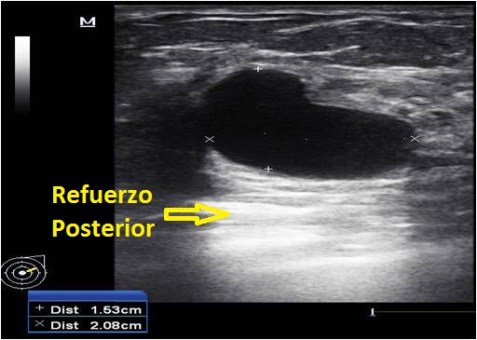
Se produce cuando el ultrasonido atraviesa un medio sin interfases en su interior y pasa a un medio sólido ecogénico.

Nos permite diferenciar quistes.

Permite estudiar estructuras usando como ventana estructuras llenas de líquido.

Este artefacto funciona diametralmente opuesto al anterior, ya que en vez de devolver todos los ecos del haz cuando llega a una estructura, estos ecos, en el caso de una estructura acuosa, atraviesan la estructura en un 100% prácticamente, y al llegar al tejido posterior a dicha estructura, se ve un halo hiperecogénico, es decir, más brillante, que es el Refuerzo Posterior y que responde a un paso casi total del haz de ultrasonido emitido desde nuestra sonda.

Es típico de los quistes, cuyo contenido es acuoso, y de las vejigas, y de aquellas estructuras cuyo porcentaje de agua sea muy elevado y que funcionan como ventanas para estudios de otros órganos, como el de la próstata, el útero y los ovarios, por eso decimos a los pacientes que para estudiar estas estructuras masculinas y femeninas, deben acudir a la cita con la vejiga llena.

2. Posterior Reinforcement: It occurs when the ultrasound passes through a medium without interfaces in its interior and passes to a solid echogenic medium. It allows us to differentiate cysts. It allows studying structures using structures filled with liquid as a window. This device works diametrically opposite to the previous one, since instead of returning all the echoes of the beam when it reaches a structure, these echoes, in the case of an aqueous structure, practically cross the structure in a 100%, and when reaching the tissue After this structure, a hyperechogenic halo is seen, that is, brighter, which is the Posterior Reinforcement and responds to an almost total passage of the ultrasound beam emitted from our probe. It is typical of cysts, whose content is aqueous, and bladders, and those structures whose water percentage is very high and which work as windows for studies of other organs, such as the prostate, uterus and ovaries, that’s why we tell patients that to study these male and female structures, they should go to the appointment with a full bladder.
Halo Hiperecogénico correspondiente a Refuerzo Posterior.
Estudio de Próstata con vejiga llena.

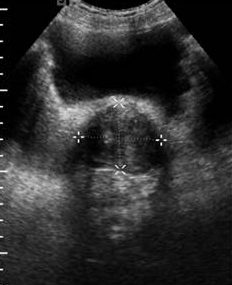
En la imagen anterior vemos la vejiga con líquido y una estructura posterior, hipoecogénica y que está medida, la próstata, que de no ser porque la vejiga está llena de líquido, no se podría haber estudiado tan bien.

Hemos estudiado dos importantes conceptos que te van a acompañar en todo el viaje que hagas por el mundo de la ecografía. La Sombra Posterior y El Refuerzo Posterior. Forman parte de los Artefactos Beneficiosos.

En el próximo post haré un resumen de los principales artefactos nocivos.

In the previous image we see the bladder with fluid and a posterior structure, hypoechoic and that is measured, the prostate, that of not being because the bladder is full of liquid, it could not have been studied so well. We have studied two important concepts that will accompany you throughout the journey you make in the world of ultrasound. The Posterior Shadow and the Posterior Reinforcement. They are part of the Beneficial Artifacts. In the next post I will summarize the main harmful artifacts.

Resolvemos las preguntas del Post anterior https://ecografiafacil.com/2018/02/17/30-la-homogeneidad-y-la-hetergenicidad-de-la-imagen/

Imagen 1: Heterogénea.

Imagen 2: Homogénea.


30. La Homogeneidad y la Heterogenicidad de la Imagen.

Es muy poco conocida y casi nunca explicada esta característica de la imagen en ecografía. Es más, aprendes esta característica de la imagen en el trabajo diario, no en libros, sin embargo es fundamental que seamos capaces de distinguir este tipo de diferencias en la imagen, porque muchos tejidos cambian de homogéneo a heterogéneo cuando se ven afectados por alteraciones patológicas.

Bien, profundicemos pues…

Lo primero es saber lo que es homogéneo y heterogéneo, la definición:

Homogéneo: Que está formado por elementos con características comunes referidas a su clase o naturaleza, lo que permite establecer entre ellos una relación de semejanza y uniformidad.

Heterogéneo: Que está formado por elementos de distinta clase o naturaleza.

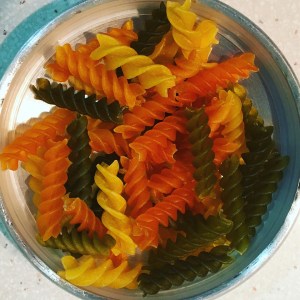
Pero qué significa esto, bien, como una imagen vale más que mil palabras, te pongo dos imágenes, mira:

It is very little known and almost never explained this feature of the image in ultrasound. Moreover, you learn this characteristic of the image in daily work, not in books, however it is fundamental that we are able to distinguish this type of differences in the image, because many tissues change from homogeneous to heterogeneous when they are affected by pathological changes . Well, let’s go deeper then … The first thing is to know what is homogeneous and heterogeneous, the definition: Homogeneous: That is formed by elements with common characteristics referring to their class or nature, which allows to establish between them a relation of similarity and uniformity. Heterogeneous: That is formed by elements of different class or nature. But what does this mean, well, as a picture is worth a thousand words, I put two images, look:
Imagen A.
Imagen B.

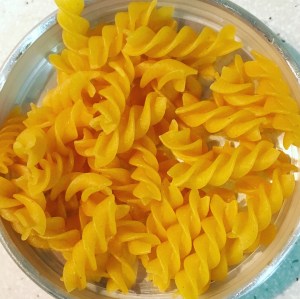
En la imagen A vemos un tipo de pasta, pasta de la de comer, sin gluten además…puedes reconocer que su color es uniforme, que globalmente, todo es igual…Bien, la imagen B es diferente, es la misma pasta, también sin gluten, pero en este caso toda diferente,con variedad de tonos, siendo de naturaleza idéntica…no es una clase de cocina, me sirve para explicarte que el tejido, a veces, cuando se ve afectado por algún tipo de patología, cambia, y siendo tejido igual, de un mismo órgano o lugar de la anatomía, se vuelve diferente…

Te lo voy a demostrar con una imagen ecográfica..

In the picture A we see a type of pasta, the pasta to eat, gluten-free addition … you can recognize that its color is uniform, that globally, everything is the same … Well, the image B is different, it is the same pasta, also gluten-free, but in this case all different, with a variety of shades, being identical in nature … it’s not a cooking class, it helps me to explain that the fabric, sometimes, when it is affected by some type of pathology, it changes, and being the same tissue, of the same organ or place of anatomy, it becomes different … I’ll show you with an ultrasound image ..
Imagen C.

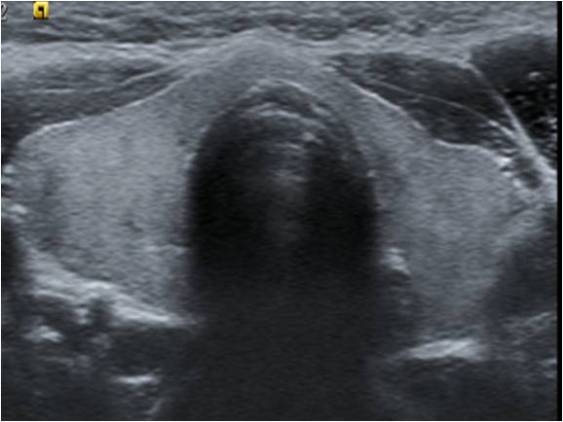
Ves en la imagen C, es un Tiroides, ecográficamente ves una glándula que es de aspecto hiperecogénico, es decir, es gris, brillante respecto al tejido que lo bordea, que son los músculos, y la tráquea que es una mancha hipoecogénica central, provocada por el aire que contiene…El tejido de Tiroides es gris y además es un gris uniforme, igual en toda la glándula, se dice que es Homogéneo.

Siguiente imagen…

You see in the image C, it is a thyroid, ecographically you see a gland that is hyperechogenic, that is, it is gray, bright with respect to the tissue that borders it, which are the muscles, and the trachea that is a central hypoechoic spot, provoked by the air it contains … Thyroid tissue is gray and is also a uniform gray, the same throughout the gland, it is said to be Homogeneous. Next image …
Imagen D.

En la imagen D vemos otro Tiroides, sin embargo ves claramente que este Tiroides es diferente, su gris, su aspecto global, ha cambiado, tiene un aspecto parcheado,ves varios tonos de gris, grises claros (hiperecogénicos) con otros más oscuros (hipoecogénicos), a esa mezcla le concede a la imagen el calificativo de Heterogénea…y sí, efectivamente, este Tiroides es una glándula afectada por un proceso patológico que afecta a su tejido…Es Heterogéneo.

Esto es lo que quería que aprendieses hoy, que algunas patologías hacen cambiar el aspecto de los tejidos, que es vital que el Técnico de Radiología y otros profesionales que trabajen con ecografía,conozcan, conozcamos, el aspecto normal de los tejidos para tener una base con la que valorar el posible cambio o afectación patológica de un órgano, y aunque no somos radiólogos, no podemos diagnosticar, somos los primeros en ver las imágenes y podemos alertar de esta condición que sufren algunos tejidos a quien tiene que firmar un informe, que es el Especialista.

Podemos ver este tipo de cambios en enfermedades de toda clase, tendinopáticas, inflamatorias, neoplásicas, etc. De facto, las lesiones también pueden ser ellas mismas homogéneas o heterogéneas…

Es muy importante este conocimiento para los Fisioterapeutas que trabajan con ecografía y deben valorar las características de una lesión…

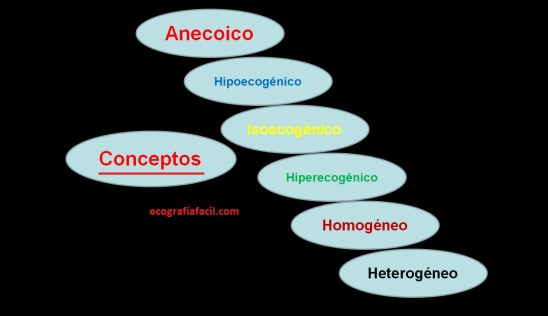
Ahora ya sabemos manejar varios conceptos con los que puedes identificar el aspecto ecográfico de los tejidos, entre el post anterior y este, recopilamos y sabemos lo que es Anecoico, Hipoecogénico, Isoecogénico, Hiperecogénico, Homogéneo y Heterogéneo, pero es que además, cualquiera de las características del post anterior es combinable con las que hemos estudiado hoy…Es decir, una estructura puede ser hipoecogénica y además heterogénea…o Hiperecogénea y homogénea, como la imagen A, porque cada tejido se refleja en la imagen según su naturalez y su afectación y siempre tenemos que caracterizar las imágenes de forma global, es decir, un Hígado, un testículo, una rotura muscular, lo que sea, lo vamos a evaluar de forma global, y así todas las estructuras.

In D image we see another Thyroid, however you see clearly that this Thyroid is different, its gray, its global aspect, has changed, it has a patchy appearance, you see several shades of gray, light gray (hyperechogenic) with darker ones (hypoechogenic) ), that mixture gives the image the qualification of Heterogeneous … and yes, indeed, this Thyroid is a gland affected by a pathological process that affects its tissue … It is Heterogeneous. This is what I wanted you to learn today, that some pathologies change the appearance of tissues, that it is vital that the Radiology Technician and other professionals who work with ultrasound, know, know, the normal appearance of the tissues to have a base with which to evaluate the possible change or pathological involvement of an organ, and although we are not radiologists, we can not diagnose, we are the first to see the images and we can alert of this condition that some tissues suffer to those who have to sign a report, which He is the Specialist. We can see this type of changes in diseases of all kinds, tendinophatic, inflammatory, neoplastic, etc. De facto, the lesions can also be themselves homogeneous or heterogeneous … This knowledge is very important for Physiotherapists who work with ultrasound and must assess the characteristics of an injury … Now we know how to handle several concepts with which you can identify the ecographic aspect of tissues, between the previous post and this, we collect and know what Anecoic, Hypoecogenic, Isoechogenic, Hyperecogenic, Homogeneous and Heterogeneous, but it is also that the characteristics of the previous post is combinable with those we have studied today … That is, a structure can be hypoechogenic and also heterogeneous … or Hyperecognea and homogeneous, like image A, because each tissue is reflected in the image according to its nature and its affectation and we always have to characterize the images globally, that is, a Liver, a testicle, a muscle break, whatever, we will evaluate it globally, and so all the structures.
Conceptos básicos de la imagen en ecografía.

Te pongo dos imágenes y quiero que me digas como las ves, si homogénea o heterogénea.

Imagen 1.
Imagen 2.

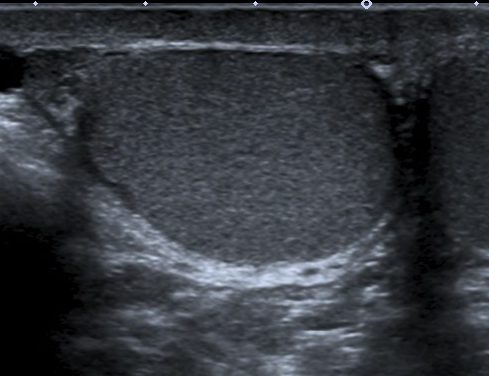
Las imágenes 1 y 2 son la imagen de un testículo. Observa las diferencias y elige como son:

Imagen 1: 

a. Heterogénea

b. Homogénea

Imagen 2:

a. Heterogénea

b. Homogénea

Resolvemos las imágenes del post anterior…https://ecografiafacil.com/2018/02/15/29-la-semiologia-ecografica/

  • Hipercogénico , flecha azul, porque brilla inténsamente, típico de las piedras vesiculares.
  • Anecoico, flecha amarilla, porque es negro (líquido) de la vesícula biliar.
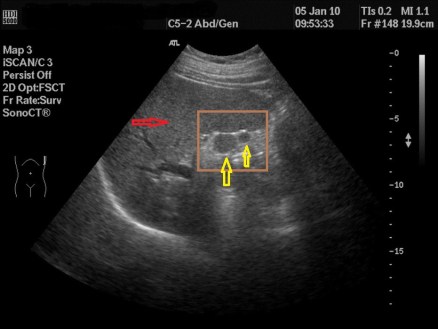
  • Isocoico, en el rectángulo, porque los bazos accesorios, las dos bolitas que se ven (flechas amarillas), son del mismo tejido que el órgano grande, que es el bazo (flecha roja).


29. La Semiología Ecográfica. La Ecogenicidad.

Se acabó la parte más teórica de la ecografía, ahora toca disfrutar con las imágenes.

En este post vas a aprender como se ven las estructuras y su comportamiento ecográfico según de la naturaleza que estén hechos. En radiología tenemos una serie de densidades que tenemos que estudiar cuando hacemos un estudio radiológico, en ecografía, el comportamiento de esas densidades es vital para poder identificar estructuras y patologías.

El comportamiento de esas estructuras cuando interaccionan con el haz ultrasónico va a dar una serie de imágenes, entre el blanco y el negro y todos los grises que hay entre medias, según sean negro, gris oscuro, gris, gris claro o casi blanco vamos a poder identificar esas estructuras como son, el agua, la grasa, el hueso, el aire…bueno, el aire no, ya sabes que en ecografía el aire provoca ausencia de información…Lo bueno de la ecografía a diferencia de la radiología convencional es que es capaz de identificar diferentes densidades de agua, por ejemplo, sangre, pus, etc.

Vamos a utilizar una serie de palabras para identificar esa representación de grises, es el argot de la ecografía y eso tiene un nombre, se conoce como la ECOGENICIDAD de la estructuras…eso es lo que voy a intentar explicar en este Post…adelante…

Anecoico o anecogénico: No devuelve ecos de retorno, cuando el haz llega a una estructura anecoica, esta va a dejar pasar todo el tren de ultrasonidos y es típico comportamiento del líquido, y donde tenemos líquido en el cuerpo, Vejiga (Orina), Vesícula (Bilis), Vasos (Sangre), LCR (Líquido cefalo-raquídeo)…También estructuras patológicas como los Quistes simples,que tienen un contenido acuoso…bien todas estas estructuras se van a ver en la imagen en colo negro. Por tanto, Anecoico=Negro.

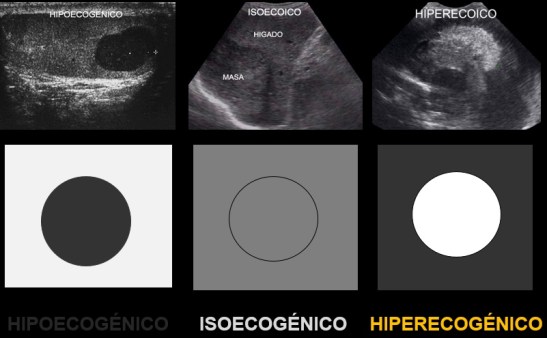
Hipoecogénico o Hipoecoico: Estas estructuras devuelven muy pocos ecos, su aspectos no es negro, pero tienden a un gris muy oscuro y son multitud de estructuras las que se ven así, tanto normales, como patológicas.

Isoecogénico o Isoecoico: Estas estructuras tienen un comportamiento que identificamos igual a la estructura con la que la comparamos, es decir, dentro de la escala de grises de mi equipo, ambas estructuras, aunque distintas anatómicamente, tienen que verse igual, es decir, del mismo gris, por ejemplo, el parénquima hepático y la corteza renal son isoecogénicas, es decir, iguales, el mismo gris.

Hipercogénico o hiperecoico: Estas estructuras devuelven muchos ecos en su interfase, su aspectos no es blanco, pero tienden a un gris muy claro, casi blanco, es decir, brillan mucho y son multitud de estructuras las que se ven así, tanto normales, como patológicas.

The most theoretical part of ultrasound is over, now it’s time to enjoy the images. In this post you will learn how the structures and their ecographic behavior are seen according to the nature they are made of. In radiology we have a series of densities that we have to study when we do a radiological study, in ultrasound, the behavior of these densities is vital to be able to identify structures and pathologies. The behavior of these structures when interacting with the ultrasonic beam will give a series of images, between white and black and all grays that are in between, depending on whether they are black, dark gray, gray, light gray or almost white. to be able to identify those structures as they are, water, fat, bone, air … well, the air does not, you know that in ultrasound the air causes lack of information … The good thing about ultrasound, unlike the Conventional radiology is that it is able to identify different densities of water, for example, blood, pus, etc. We are going to use a series of words to identify that representation of grays, it is the slang of the ultrasound and that has a name, it is known as the ECOGENICITY of the structures … that is what I will try to explain in this Post .. .ahead… Anechoic or anechogenic: It does not return echoes, when the beam reaches an anechoic structure, it will let the whole train of ultrasound pass and it is typical behavior of the liquid, and where we have fluid in the body, Bladder (Urine), Vesicle (Bile), vessels (blood), cerebrospinal fluid (cerebrospinal fluid) … Also pathological structures such as simple cysts, which have an aqueous content … well all these structures will be seen in the image in black. Therefore, Anecoico = Black. Hypoechogenic or Hypoechoic: These structures return very few echoes, their aspects are not black, but they tend to a very dark gray and there are many structures that look like this, both normal and pathological. Isoechogenic or Isoechoic: These structures have a behavior that we identify equal to the structure with which we compare it, that is, within the gray scale of my team, both structures, although different anatomically, have to look the same, that is, the same gray, for example, the hepatic parenchyma and the renal cortex are isoechogenic, that is, equal, the same gray. Hypercogenic or hyperechoic: These structures return many echoes in their interface, their aspects are not white, but tend to a very light gray, almost white, that is, they shine a lot and there are a multitude of structures that look this way, both normal and pathological.
La Ecogenicidad y sus variables.

Cuando decimos que una estructura es Hipo, Iso, Hiper – Ecoico, Ecogénico o Refringente – lo hacemos porque la comparamos, habitualmente, con la estructura que tenemos al lado…No sé si te ha quedado muy claro esto, pero te lo explico de otro modo, con imágenes…verás como lo entiendes.

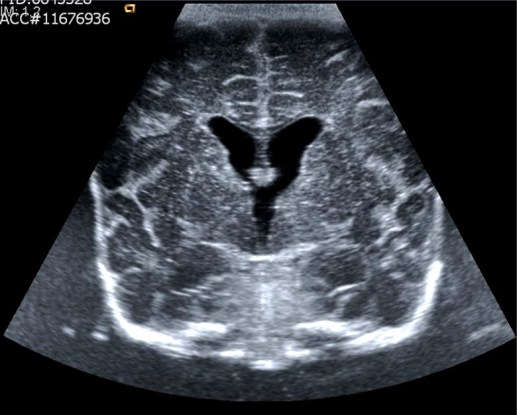
Anecoico: Negro, que no devuelve ecos. En la imagen que ves a continuación ves el corte coronal de un neonato en el contexto de una ecografía transfontanelar, se ven las circonvoluciones del cerebro y en el centro en forma de «Y» y completamente negro el líquido cefalorraquídeo en los ventrículos laterales.El LCR normal se ve así, negro, anecoico.

When we say that a structure is Hipo, Iso, Hiper – Ecoico, Ecogenic or Refringente – we do it because we compare it, usually, with the structure that we have next … I do not know if this has been very clear to you, but I explain it to you otherwise, with images … you’ll see how you understand it. Anechoic: Black, which does not echo. In the image that you see below you see the coronal cut of a neonate in the context of a transfontanel ultrasound, you can see the circonvolutions of the brain and in the center in the form of «Y» and completely black the cerebrospinal fluid in the lateral ventricles. Normal CSF looks like this, black, anechoic.
Imagen del LCR con aspecto Aneocico (Negro)
Imagen de la vejiga.Anecoica.

En la imagen inmediatamente superior objetivamos un corte longitudinal de la vejiga, completamente llena de orina, líquido, por tanto anecoico.

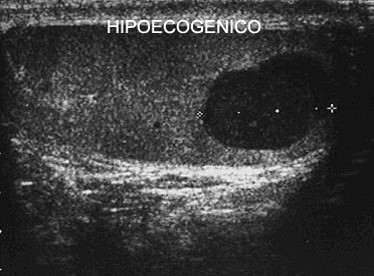
Hipoecogénico: Es toda aquella imagen que sea más oscura que el tejido que tenga alrededor o con el tejido que lo queramos comparar…esta imagen siguiente te lo va a aclarar.

In the image immediately above we objectify a longitudinal section of the bladder, completely filled with urine, liquid, therefore anechoic. Hypoecogenic: It is all that image that is darker than the tissue that has around or with the tissue that we want to compare … this next image will clarify it.
Estructura hipoecogénica dentro de un teste.

En la imagen, bastante antigua, por cierto, vemos una imagen de una estructura ovalada que en su interior alberga otra estructura más pequeña y oscura.Bien, en este caso, es el estudio de un testículo que en su interior tiene una masa de aspecto hipoecogénico, es hipoecogénico porque sin ser negro, es más oscuro que el testículo que lo contiene.

In the image, quite old, by the way, we see an image of an oval structure that inside houses another smaller and darker structure. Well, in this case, it is the study of a testicle that inside has a mass of appearance hypoechogenic, it is hypoechoic because without being black, it is darker than the testicle that contains it.
Isoecogenicidad de corteza renal y parénquima hepático.

En la imagen anterior vemos parénquima hepático y corteza renal cuyo gris es muy parecido, esa es la normalidad, se dice que ambas estructuras se ven isoecogénicas, si alguna de ellas no respetase ese aspecto, nos alertaría de una patología sobre ese órgano, por eso es vital un perfecto ajuste de los parámetros técnicos y una imagen técnicamente bien ejecutada.

Isoecogénico, por tanto será que tiene el mismo gris que el tejido que lo envuelve o con el que lo comparemos…por ejemplo…En la imagen que ves a continuación hay dos estructuras ovoides, del mismo gris, son los testículos en su aspecto ecogénico normal, por tanto iguales. Mismo tono de gris se dice que son de igual ecogenicidad, por tanto aplicamos el sufijo iso para interpretar igualda, por tanto ambos testes entre si son Isoecogénicos.

In the previous image we see liver parenchyma and renal cortex whose gray is very similar, that is normality, it is said that both structures are isoechogenic, if any of them did not respect that aspect, it would alert us of a pathology on that organ, for that reason a perfect adjustment of the technical parameters and a technically well executed image is vital. Isoechogenic, therefore it will be that it has the same gray as the tissue that surrounds it or with which we compare it … for example … In the image that you see below there are two ovoid structures, of the same gray, are the testicles in its normal ecogenic appearance, therefore equal. Same shade of gray is said to be of equal echogenicity, therefore we apply the iso suffix to interpret equal, therefore both tests are Isoechogenic
Comparativa de ambos testículos.

Hipercogénico, hiperecoico o hiperrefringente, son las diferentes denominaciones que unidas al sufijo hiper indican que brilla más que el tejido con el que lo compraremos…por ejemplo…

Estas imágenes devuelven muchos ecos de retorno, sus interfases https://ecografiafacil.com/2017/12/19/7-las-interfases/ son más potentes y por eso brillan más.

En esta imagen que ves a continuación,vemos un riñón, concrétamente el derecho, junto al hígado. Este riñón tiene aspecto ovalado y dos áreas muy definidas, la corteza (flecha naranja) y el seno renal (flecha azul).La corteza es hipoecogénica con respecto a la grasa del seno renal que se objetiva más brillante y por tanto hipercogénica.

Hypercogenic, hyperechoic or hyperrefrigent, are the different names that together with the hyper suffix indicate that it shines more than the tissue with which we will buy it … for example … These images return many echoes of return, their interfaces https://ecografiafacil.com/2017/12/19/7-las-interfases/ are more powerful and therefore shine more. In this image that you see below, we see a kidney, specifically the right, next to the liver. This kidney has an oval aspect and two very defined areas, the cortex (orange arrow) and the renal sinus (blue arrow). The cortex is hypoechoic with respect to the fat of the renal sinus that is seen as brighter and therefore hypercogenic.
Corteza y seno renal y su aspecto ecogénico diferente.

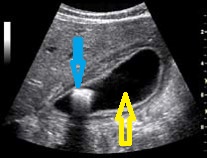
En la imagen anterior vemos una estructura anecoica (negra), que es la vesícula llena de bilis, en su interior una estructura Hiperecogénica, muy brillante, que corresponde a una colelitiasis.

Ya sabes que los tejidos se ven en escala de grises y según sea su brillo los vamos a catalogar. Normales o patológicos los hallazgos deben de interpretarse en base al conocimiento de la normalidad.

A continuación te voy a poner dos imágenes para que puedas evaluar el aspecto ecográfico, en el próximo post te daré la solución.

In the previous image we see an anechoic (black) structure, which is the gall bladder, inside it is a very bright Hyperecogenic structure, corresponding to cholelithiasis. You already know that the fabrics are seen in gray scale and according to their brightness we are going to catalog them. Normal or pathological findings should be interpreted based on knowledge of normality. Next I’m going to put two images so you can evaluate the echographic aspect, in the next post I will give you the solution.
Imagen A. 

En la imagen A tienes que decir qué aspecto ecográfico tiene la estructura que marca la flecha azul:

  1. Hiperecogénico
  2. Isoecogénico
  3. Anecoico
  4. Hipoecogénico.

En la imagen A tienes que decir qué aspecto ecográfico tiene la estructura que marca la flecha amarilla:

  1. Hiperecogénico
  2. Isoecogénico
  3. Anecoico
  4. Hipoecogénico.
Imagen B.

En la imagen B ves dos estructuras redondas dentro de un rectángulo y marcadas con flecha amarilla. Quiero que me digas que aspecto ecográfico tienen respecto del parénquima del bazo marcado con flecha roja.

  1. Hiperecogénico
  2. Isoecogénico
  3. Anecoico
  4. Hipoecogénico.


28. La Calidad de la Imagen. La Resolución.

Cuando nos enfrentamos a una ecografía, lo más importantes es ver lo que necesitamos estudiar y verlo lo me mejor posible.

La Resolución de la imagen es aquella cualidad del equipo que nos permite ver mejor la cantidad de detalles que dicha imagen pueda mostrarnos.

Cuando nos compramos un televisor nuevo lo que buscamos es que se vea bien, en la tienda todos tienen muy buena imagen, pero si te pones a comparar unos con otros, observas diferencias en la imagen, unos se ven mejor y otros se ven un poco peor, casi siempre en relación con el precio, los mejores, más caros siempre…

Con un ecógrafo pasa algo parecido, cuanta más alta es la gama del equipo, mejor imagen vamos a tener.

Esa calidad de imagen depende de varios aspectos, muchos los hemos tratado en los parámetros técnicos, pero hay uno que no hemos tratado y es la resolución de imagen, así que vamos a ello.

Existen varios tipos de resoluciones. Vamos a separarlas, definirlas y detallarlas una por una y desmenuzando los factores de los que dependen, vas a ver que te suenan la inmensa mayoría, porque ya los hemos estudiado.

1. Resolución Espacial:

Capacidad para distinguir interfases muy cercanas.

En esta resolución, podemos distinguir a su vez, otras dos:

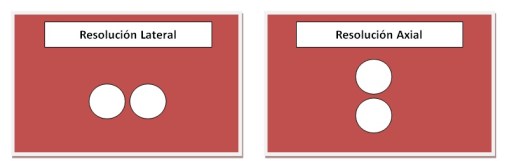
a. Resolución Axial:

 Capacidad para distinguir dos estructuras en profundidades distintas.

 Factores:

– Amplitud del pulso transmitido, siendo cuanto más corto mejor.

– Ancho de banda del transductor, es mejor siempre un transductor de banda ancha.

– Ancho de banda del receptor.

b.Resolución Lateral:

 Capacidad para distinguir dos objetos uno al lado del otro.

 Factores:

– Longitud de onda: A menor Longitud de onda, mejor resolución y mayor atenuación.

– Apertura del transductor siendo mejor cuanto más sea su apertura.

– Focalización.

– Profundidad del objeto. A más profundidad, pero resolución lateral.

When we are faced with an ultrasound, the most important thing is to see what we need to study and see it as well as possible. The resolution of the image is that quality of the equipment that allows us to see better the amount of details that this image can show us. When we buy a new television, what we look for is that it looks good, in the store all have a very good image, but if you start comparing with each other, you notice differences in the image, some look better and others look a bit worse, almost always in relation to the price, the best, most expensive always … With an ecograph something similar happens, the higher the range of the equipment, the better image we will have. That image quality depends on several aspects, many of us have dealt with the technical parameters, but there is one that we have not dealt with and it is the image resolution, so let’s go to it. There are several types of resolutions. We are going to separate them, define them and detail them one by one and shredding the factors on which they depend, you will see that they sound the vast majority, because we have already studied them. 1. Spatial Resolution: Ability to distinguish very close interfaces. In this resolution, we can distinguish, in turn, two others: to. Axial Resolution: Ability to distinguish two structures in different depths. Factors: – Amplitude of the transmitted pulse, the shorter the better. – Transducer bandwidth, a broadband transducer is always better. – Bandwidth of the receiver. b.Side Resolution: Ability to distinguish two objects side by side. Factors: – Wavelength: A shorter Wavelength, better resolution and greater attenuation. – Opening of the transducer, the better the opening. – Focus. – Depth of the object. Deeper, but lateral resolution.
Resolución espacial y sus dos variables.

2. Resolución Temporal.

La velocidad de refresco de la imagen en tiempo real debe ser suficientemente alta para que la imagen no vaya a saltos, es el “frame rate” y se mide en “imágenes por segundo”, puede ser un ajuste ecográfico que podamos variar en el menú.

Factores:

Profundidad de la imagen: A más profundidad, menos resolución temporal.

Campo de visión temporal: Cuanto más sea el campo de visión, más tiempo necesitará.

Focalización dinámica: A más focos menos resolución espacial.

Escanear zonas pequeñas siempre mejorará la resolución temporal, por eso mejora con frecuencias altas.

3. Resolución de Contraste.

Determina qué diferencia de amplitud deben tener dos ecos para que se les asigne distintos niveles de grises.

Cuanto mejor sea mi equipo más capacidad de distinguir dos grises muy parecidos y por tanto, más capacidad tengo de distinguir patologías.

Factores:

Depende del Rango Dinámico. El rango dinámico sufre la compresión reduciendo las amplitudes más pequeñas y más grandes, la diferencia de estas amplitudes es lo que se conoce como rango dinámico.

Como una imagen vale más que mil palabras os dejo esta imagen para que la comparéis.

2. Temporary Resolution. The refresh rate of the image in real time must be high enough so that the image does not jump, is the «frame rate» and is measured in «images per second», it may be an ultrasound adjustment that we can vary in the menu . Factors: – Depth of the image: The more depth, the less time resolution. – Temporal field of vision: The more the field of vision, the more time you will need. – Dynamic focus: A more spotlights less spatial resolution. Scanning small areas will always improve the temporal resolution, so it improves with high frequencies. 3. Contrast Resolution. Determine what difference in amplitude two echoes must have in order to be assigned different levels of grays. The better my team is, the more ability to distinguish two very similar grays and therefore, the more ability I have to distinguish pathologies. Factors: – Depends on the Dynamic Range. The dynamic range suffers compression by reducing the smaller and larger amplitudes, the difference of these amplitudes is what is known as dynamic range. As a picture is worth a thousand words I leave this image for you to compare.
Gran Resolución.
Mala Resolución.

En las imágenes observamos el Tendón Extensor de los dedos de la mano en dos equipos diferentes, uno de alta gama y otro de gama media-baja, observar el detalle de los tendones.

Esta es la resolución de imagen, cuanto mejor imagen tengamos, mejor vamos a poder distinguir estructuras. Los mejores equipos ayudan al diagnóstico.

In the images we see the Tendon Extender of the fingers of the hand in two different equipment, one of high range and another one of medium-low range, to observe the detail of the tendons. This is the image resolution, the better image we have, the better we will be able to distinguish structures. The best equipment helps the diagnosis.


27. Efectos biomecánicos del ultrasonido.

Habéis contactado conmigo algunos de vosotros por redes sociales a raíz del post sobre la potencia de transmisión y los posibles efectos adversos del sonido y aunque lo quería dejar para un poco más adelante vamos a tratar este tema para intentar despejar algunas dudas.

Hemos dicho y está probado científicamente que el ultrasonido utilizado en medicina puede ocasionar una serie de efectos en el tejido que atraviesa y que deben estar representados en la pantalla por los índices referidos en este post que te enlazo https://ecografiafacil.com/2018/02/04/24-la-potencia-de-transmision/ y que podemos dividir muy genéricamente en Efectos Térmicos y Efectos No Térmicos. Si bien, es una obviedad que el ultrasonido es una técnica segura en el ámbito de diagnóstico.

Por tanto, aunque es una técnica segura, vamos a estudiar aquellos efectos referidos en el párrafo anterior para comprender un poco más sobre los efectos del ultrasonido en el tejido.

Como norma general tenemos que el ultrasonido y sus efectos dependerán de:

Duración de la exposición.

Tipo de tejido expuesto.

Tasa de proliferación celular.

Potencial de regeneración.

Edad y estado del desarrollo (Fetales y Neonatos).

Debemos considerar además que:

  • Los adultos son más tolerantes a aumentos de temperatura.
  • En exposiciones a 50 horas de US no se ha observado efectos biológicos lo que hace entender a las claras que esta técnica es absolutamente segura en el ámbito del diagnóstico, pero debemos tener muy claro que la potencia acústica de salida en los dispositivos de US es suficiente para elevar la temperatura fetal y por tanto, debemos usarla, como recomiendan los organismos internacionales de modo responsable y siempre por profesionales cualificados.
You have contacted me some of you on social networks following the post on the power of transmission and the possible adverse effects of the sound and although I wanted to leave it for a little later we will try this topic to try to clear up some doubts. We have said and is scientifically proven that the ultrasound used in medicine can cause a series of effects on the tissue that crosses and that must be represented on the screen by the indexes referred to in this post that I link https://ecografiafacil.com/2018 / 02/04/24-the-power-of-transmission / and that we can divide very generically in Thermal Effects and Non-Thermal Effects. Although, it is a truism that ultrasound is a safe technique in the diagnostic field. Therefore, although it is a safe technique, we will study those effects referred to in the previous paragraph to understand a little more about the effects of ultrasound on tissue. As a general rule we have that ultrasound and its effects depend on:
-Duration of the exhibition.
-Type of exposed tissue.
-Cell proliferation rate.
-Potential regeneration.
-Age and state of development (Fetal and Neonatal).
We must also consider that: Adults are more tolerant of temperature increases. In exposures to 50 hours in the US, no biological effects have been observed, which makes it clear that this technique is absolutely safe in the field of diagnosis, but we must be very clear that the output acoustic power in US devices is sufficient to raise fetal temperature and therefore, we must use it, as recommended by international organizations in a responsible way and always by qualified professionals.

El riesgo más importante es por tanto, el aumento de temperatura reflejado en los Efectos Térmicos.

Efectos Térmicos:

Cuando hablábamos de que el ultrasonido recorre el tejido y pierde energía por la atenuación, es decir, energía debilitada en parte, por su transformación en calor que absorben los tejidos.Dicho de otro modo, la atenuación es la resulta de dos procesos, la dispersión del haz y la absorción del calor, nos interesa el último.

Con la absorción hay aumento de la temperatura tisular debido a una serie de factores muy claros en los que destacan estos. A saber:

  • Intensidad del ultrasonido o la forma en que la potencia de transmisión es entregada en los tejidos y de ellos depende mucho los modos de trabajo, donde el modo M y el PW mantienen un haz de ultrasonido quieto, inmóvil y por tanto,más dañino. En modo B o Doppler Color y Power doppler no son inmóviles, siendo por tanto en estos últimos menos acusado el efecto térmico.
  • Tiempo de permanencia a la exposición de los ultrasonidos, lógicamente el efecto será mayor,dependiendo de cuánto tiempo estemos realizando una prueba diagnóstica…pensemos en los comienzos o cuando tenemos poca práctica, los tiempos se alargan.
  • Coeficiente de atenuación  de los tejidos, es decir, no todos los tejidos absorben del mismo modo el calor provocado por el ultrasonido,por ejemplo, es irrelevante en tejido sanguíneo, pero es muy alto para el hueso, donde en la superficie de este tejido se puede presentar un aumento de temperatura muy rápido.
Thermal Effects: When we talked about the ultrasound travels through the tissue and loses energy by attenuation, that is, energy weakened in part, by its transformation into heat absorbed tissues. Said otherwise, the attenuation is the result of two processes, the dispersion of the beam and the absorption of heat, we are interested in the last one. With absorption, there is an increase in tissue temperature due to a series of very clear factors in which these stand out. Namely: Intensity of the ultrasound or the way in which the transmission power is delivered in the tissues and they depend on the modes of work, where the M mode and the PW maintain a still, motionless and, therefore, more harmful ultrasound beam. In B mode or Doppler Color and Power Doppler are not immobile, being therefore in these last less accused the thermal effect. Time of permanence to the exposure of the ultrasounds, logically the effect will be greater, depending on how long we are performing a diagnostic test … think of the beginnings or when we have little practice, the times lengthen. Attenuation coefficient of the tissues, that is, not all tissues absorb the heat caused by ultrasound in the same way, for example, it is irrelevant in blood tissue, but it is very high for the bone, where on the surface of this tissue it is It can present a very rapid temperature increase.
Escala de modos de trabajo y riesgo de ET.

Todo estos condicionantes y algunos otros van a hacer que el IT deba estar representado en la pantalla si bien no es necesario que aparezca en todos los equipos.

Podemos resumir según las conclusiones de la  AIUM, lo siguiente:

  • Es muy difícil que las exploraciones en adultos produzcan un aumento de hasta 2 grados centígrados y por tanto ocasionen efectos térmicos.
  • En exposiciones al feto, pueden producirse incrementos de temperatura superiores a los grados mencionados en el punto anterior.
  • Este efecto es multifactorial:–AtenuaciónAbsorciónVelocidad del sonidoImpedancia acústicaConductibilidad térmica

    Estructura anatómica

  • El hueso osificado es especialmente sensible.
  • El IT es el índice que mejor refleja los aumentos de temperatura.

Es especialmente sensible el Feto, como es comprensible, y debemos tener en cuenta estas consideraciones que detallamos a continuación siempre según la AIUM:

  • Cerca del hueso la temperatura es mayor que en tejidos blandos, aumentando pues con la osificación.
  • Mayores efectos visualizados en la Organogénesis.
  • Exposiciones que elevan la temperatura fetal + de 4ºC durante 5 minutos o más pueden inducir a Alteraciones graves del desarrollo

–Los equipos disponibles en la práctica clínica habitual hacen que sea improbable que se den este tipo de exposiciones térmicas.

Efectos Mecánicos (no térmicos):

  • Estos efectos son alteraciones mecánicas producidas por los ultrasonidos en los cuerpos gaseosos, se conoce como cavitación.
  • Pueden manifestarse como burbujas de aire microscópicas.
  • El índice mecánico (IM) se relaciona con la probabilidad de la formación de estas cavidades.
  • El IM es inversamente proporcional a la raíz cuadrada de la frecuencia del ultrasonido.
  • La Cavitación es un efecto producido por la presión ejercida por el ultrasonido para desencadenar el crecimiento de una cavidad de líquido. Esa presión mínima necesaria para originar dicho efecto cavitador tiene un umbral que sobrepasado, puede dar origen a este efecto.
    • Es un efecto mucho menos conocido y estudiado que el efecto térmico y sus consecuencias.
    • Tiene que ver obviamente con técnicas donde se emplee contraste ecográfico ya que dicho contraste se basa en microburbujas de gas estabilizadas.

Los efectos mecánicos tienen dos agentes participantes, el primero el ultrasonido y sus características, frecuencias, repeticiones de pulsos, etc. El segundo agente, es donde se produce el efecto, el líquido y sus características, por ejemplo, su viscosidad o su densidad.

Por tanto y para terminar, dos causas, el calor y sus efectos térmicos y la base mecánica de producción del ultrasonido como culpable de los efectos «no térmicos».

All these conditions and some others are going to make the IT should be represented on the screen although it is not necessary to appear on all computers. We can summarize according to the conclusions of the AIUM, the following: It is very difficult that the explorations in adults produce an increase of up to 2 degrees centigrade and therefore cause thermal effects. In exposures to the fetus, temperature increases higher than the degrees mentioned in the previous point may occur.
This effect is multifactorial: -Attenuation-Absorption-Speed ​​of sound-Acoustic impedance -Conductibility thermal -Anatomical structure Ossified bone is especially sensitive. IT is the index that best reflects temperature increases. The Fetus is especially sensitive, as is understandable, and we must take into account these considerations that we detail below according to the AIUM: Near the bone, the temperature is higher than in soft tissues, increasing with ossification. Greater effects visualized in the Organogenesis. Exposures that raise fetal temperature + 4 ° C for 5 minutes or more may induce severe developmental disturbances -The equipment available in routine clinical practice makes it unlikely that this type of thermal exposures will occur. Mechanical effects (non-thermal): These effects are mechanical alterations produced by ultrasounds in gaseous bodies, known as cavitation. They can manifest as microscopic air bubbles. The mechanical index (MI) is related to the probability of the formation of these cavities. The IM is inversely proportional to the square root of the ultrasound frequency. Cavitation is an effect produced by the pressure exerted by ultrasound to trigger the growth of a fluid cavity. That minimum pressure necessary to cause this cavitador effect has a threshold that exceeded, can give rise to this effect. It is a much less known and studied effect than the thermal effect and its consequences. It obviously has to do with techniques where ultrasound contrast is used since said contrast is based on stabilized gas microbubbles. The mechanical effects have two participating agents, the first the ultrasound and its characteristics, frequencies, repetitions of pulses, etc. The second agent is where the effect occurs, the liquid and its characteristics, for example, its viscosity or its density. Therefore and to finish, two causes, heat and its thermal effects and the mechanical basis of production of ultrasound as the culprit of the «non-thermal» effects.