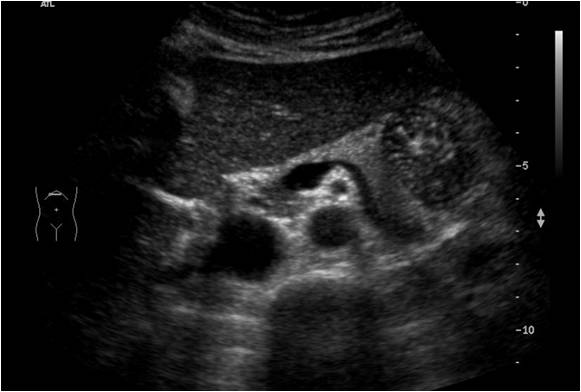
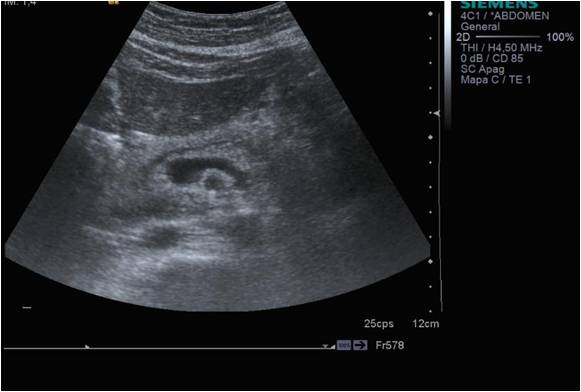
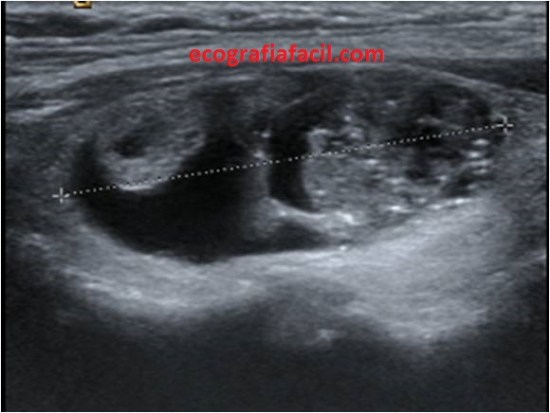
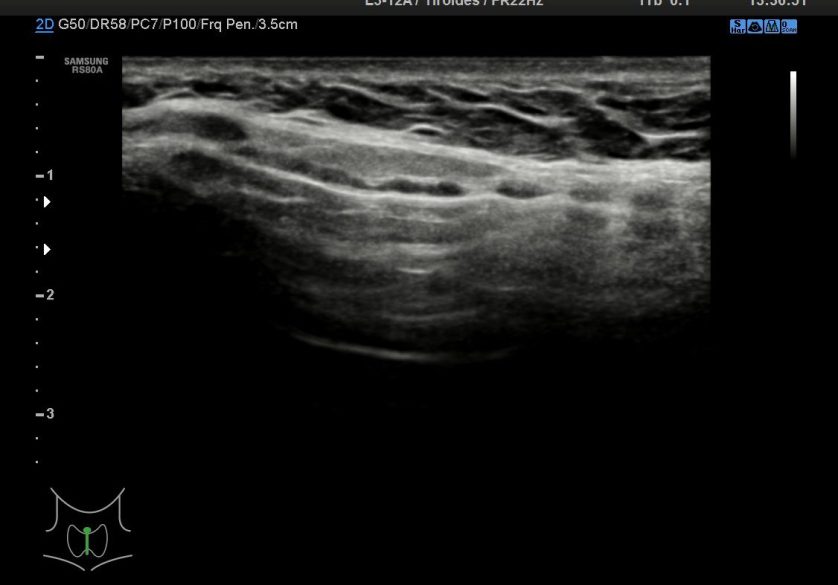
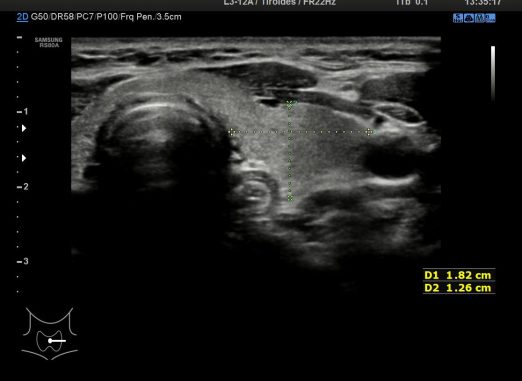
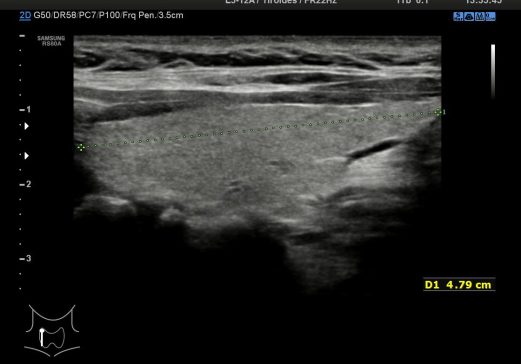
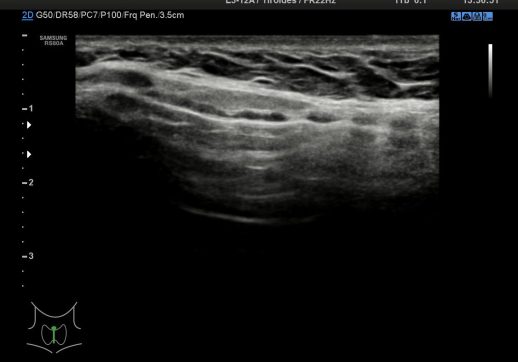
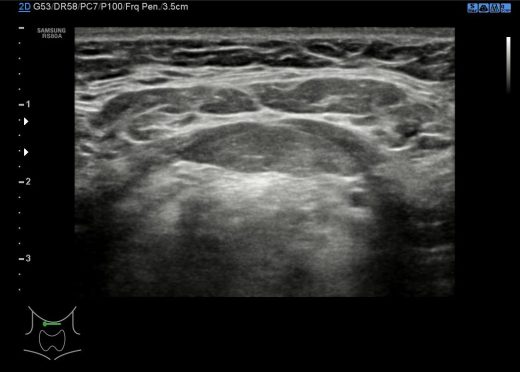
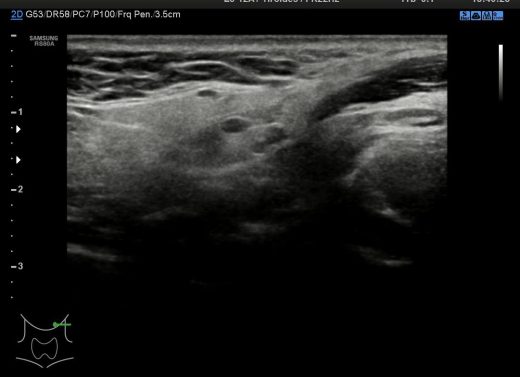
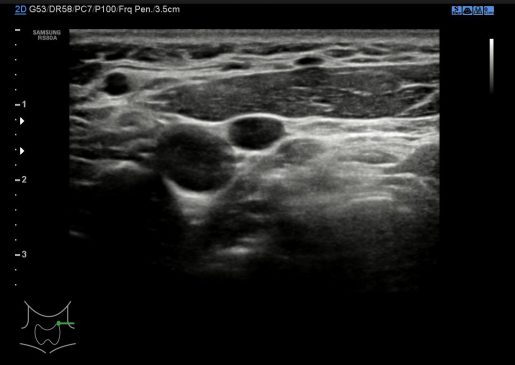
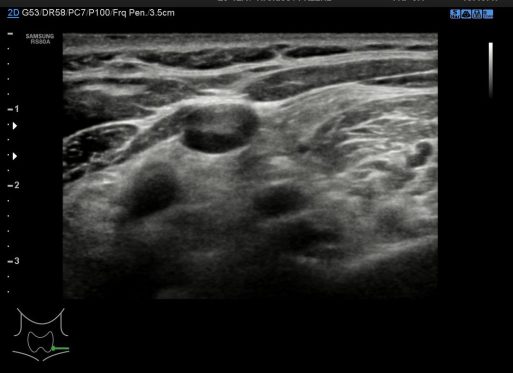
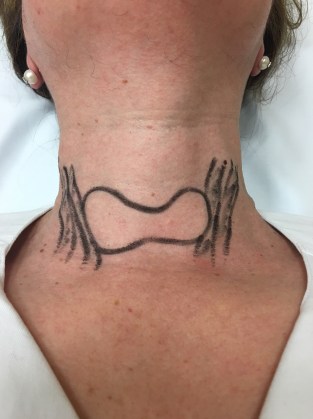
42. Protocolo de Abdomen. El Páncreas. Patología.

Como pudiste comprobar en el post anterior, la exploración del Páncreas es laboriosa. Después de muchos años de experiencia he aprendido que no puedes sentarte a explorar un abdomen con ecografía con prisas, especialmente el Páncreas donde la dificultad de la exploración también hace que objetivar su patología se haga complicado.

Siempre es importante saber lo que le pasa al paciente, leer la información clínica es vital y preguntar al Radiólogo si no lo tenemos claro para saber dónde tenemos que tener especial cuidado.

La patología grave del Páncreas cursa anodinamente, su sintomatología es insidiosa, cuando dá la cara un tumor maligno de Páncreas, sobre todo en la cabeza de éste, suele ser demasiado tarde. Por eso hay que ser escrupulosamente cuidadoso con este estudio y la búsqueda de este tipo de patología. 

Además el Páncreas suele verse afectado por el gas gástrico o del marco duodenal que provocará artefactos que impedirán ver bien el órgano y su posible patología, siempre notificar esta circunstancia al Radiólogo. Por eso las ayunas son vitales para este estudio.

Patologías como las Pancreatitis pueden ocasionar un gran dolor a la/el paciente en la exploración, con lo que la dificultad de la ejecución se multiplica.

Vamos a repasar como siempre, esquemáticamente, los signos más importantes que puedes encontrar en la patología más habitual del Páncreas. Recalco que no somos Radiólogos, no tenemos que diagnosticar, pero debemos conocer los signos ecográficos anormales en una exploración de Páncreas para poder identificar signos patológicos de interés para el informe radiológico.

La Pancreatitis: Es una de las patología más habituales, pueden estar en relación con piedras de la vesícula que saltan de ésta, discurren por el colédoco y terminan en la ampolla de vater taponando la salida al duodeno del Colédoco y del Wirsung, que al no poder realizar su función ocasiona la Pancreatitis, así es a muy groso modo el mecanismo de producción de una Pancreatitis Litiásica. También tumores en la cabeza pancreática pueden ocasionar esta sintomatología y son uno de los culpables de las Pancreatitis Alitiásicas.

As you can see in the previous post, the exploration of the Pancreas is laborious. After many years of experience I have learned that you can not sit down and explore an abdomen with ultrasound in a hurry, especially the Pancreas where the difficulty of the exploration also makes it difficult to objectify your pathology. It is always important to know what happens to the patient, read the clinical information is vital and ask the radiologist if we are not clear about where we need to be especially careful. The severe pathology of the pancreas goes smoothly, its symptoms are insidious, when the face gives a malignant tumor of pancreas, especially in the head of it, it is usually too late. That is why we must be scrupulously careful with this study and the search for this type of pathology. In addition, the pancreas is usually affected by gastric or duodenal gas that will cause artifacts that will prevent the organ from being seen and its possible pathology, always notify the radiologist of this circumstance. That’s why fasting is vital for this study. Pathologies such as Pancreatitis can cause great pain to the patient in the exploration, with which the difficulty of the execution is multiplied. Let’s review as always, schematically, the most important signs you can find in the most common pathology of the Pancreas. I emphasize that we are not radiologists, we do not have to diagnose, but we must know the abnormal ultrasound signs in a pancreas scan in order to identify pathological signs of interest for the radiological report. Pancreatitis: It is one of the most common pathologies, they can be in relation to gallbladder stones that jump out of it, run through the common bile duct and end up in the vater blister, plugging the outlet into the duodenum of the common bile duct and the Wirsung, which being able to perform its function causes Pancreatitis, thus it is very roughly the mechanism of production of a Lithiasic Pancreatitis. Also tumors in the pancreatic head can cause this symptomatology and are one of the culprits of Altiásicas Pancreatitis.
El papel de la/el Técnico de Ecografía en pacientes con pancreatitis es la búsqueda de litiasis biliar y otros signos patológicos:

Los hallazgos ecográficos de una Pancreatitis en el órgano son:

  1. Aumento del tamaño.
  2. Disminución de la ecogenicidad.
  3. Heterogenicidad del parénquima.

Pueden hallarse complicaciones como y otros signos ecográficos como:

  1. Masas inflamatorias.
  2. Colecciones líquidas peripancreáticas.
The role of the Ultrasound Technician in patients with pancreatitis is the search for biliary lithiasis and other pathological signs: -The sonographic findings of Pancreatitis in the organ are: Increase in size Decreased echogenicity. Heterogenicity of the parenchyma. Complications can be found as well as other echographic signs such as: Inflammatory masses Liquid peripancreatic collections.
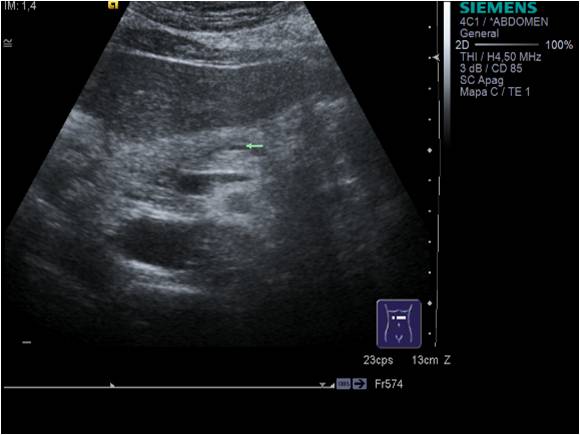
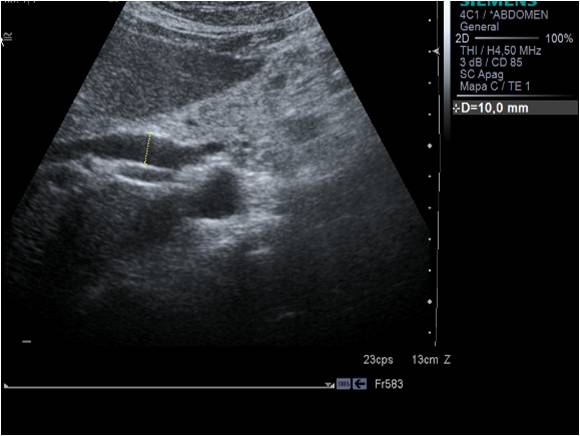
Wirsung dilatado. Flecha blanca.
Colédoco Dilatado.

La patología del colédoco será tratada cuando estudiemos la patología habitual del hígado en la Vía Biliar Intra e Extrahepática.

The pathology of the common bile duct will be treated when we study the habitual pathology of the liver in the Intra and Extrahepatic Biliary Route.
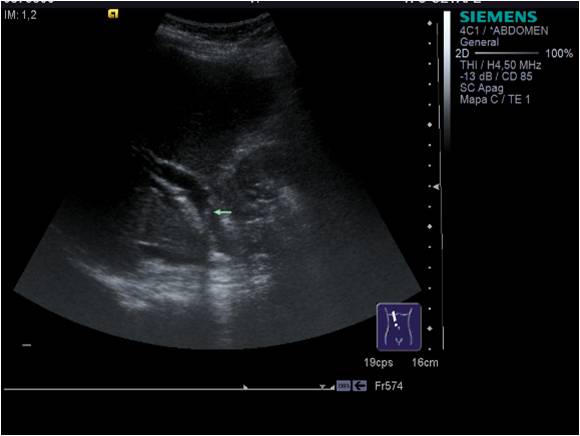
Coledocolitiasis.

Al igual que las Colédocolitiasis, que merecen estudio aparte como en la imagen de la dilatación del colédoco.

Like the Colédocolitiasis, which deserve separate study as in the image of the dilation of the common bile duc
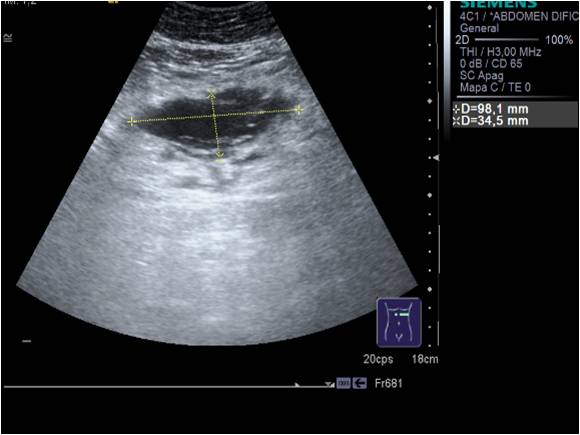
Colección líquida rodeando el Páncreas.


En el curso de una Pancreatitis, enfermedad muy grave, podemos hallar líquido bordeando el Páncreas, anecoico, habitualmente. Este líquido pudiera requerir eventualmente un drenaje porque pueden infectarse, con lo que tendríamos que estar atentos a los signos ecográficos de dicho drenaje (cuerpo extraño tubular).

El Cáncer de Páncreas: Un tumor de gran agresividad, con alta tasa de morbilidad.

  1. -El carcinoma pancreático es el adenocarcinoma.
  2. -La mayoría de los tumoresse originan  en la cabeza delPáncreas, sólo un 30% ocurren en cuerpo y cola.

Los hallazgos ecográficos más importantes son:

  1. Masas hipoecogénicas.
  2. Obstrucción del colédoco así como del conducto pancreático.
In the course of a Pancreatitis, a very serious illness, we can find fluid bordering the Pancreas, anechoic, usually. This fluid may eventually require drainage because they can become infected, so we should be aware of the echographic signs of said drainage (tubular foreign body). Pancreatic Cancer: A tumor of great aggression, with a high rate of morbidity. -The pancreatic carcinoma is adenocarcinoma. -The majority of tumors originate in the head of the pancreas, only 30% occur in body and tail. -The most important sonographic findings are: Hypoechoic masses. Choledochal obstruction as well as pancreatic duct.
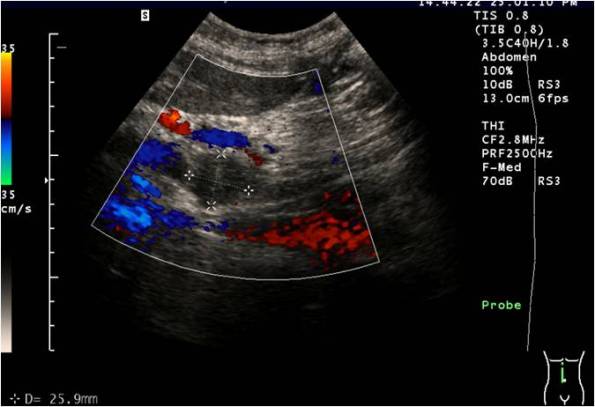
Cáncer de Páncreas. Imagen medida.

En ocasiones esta patología puede afectar a la vía biliar, taponando a ésta y provocando en el paciente, por ejemplo, la Ictericia.

Quistes Pancreáticos:

-Incluyen quistes congénitos, quistes de retención, neoplasias quísticas, y los más frecuentes los pseudoquistes, producidos por inflamación (pancreatitis), necrosis, hemorragia o traumatismo del páncreas.

Ecográficamente se comportan como lo hacen los quistes:

  1. Anecóicos.
  2. Presentan una pared fina, bien delimitado, de forma ovoide.
  3. Refuerzo Posterior.
Sometimes this pathology can affect the bile duct, plugging it and causing the patient, for example, jaundice.
Pancreatic cysts:
-Include congenital cysts, retention cysts, cystic neoplasms, and the most frequent pseudocysts, produced by inflammation (pancreatitis), necrosis, hemorrhage or trauma of the pancreas. -Ecographically behave as cysts do: Anechoic They present a thin, well-delimited, ovoid-shaped wall. Posterior Reinforcement
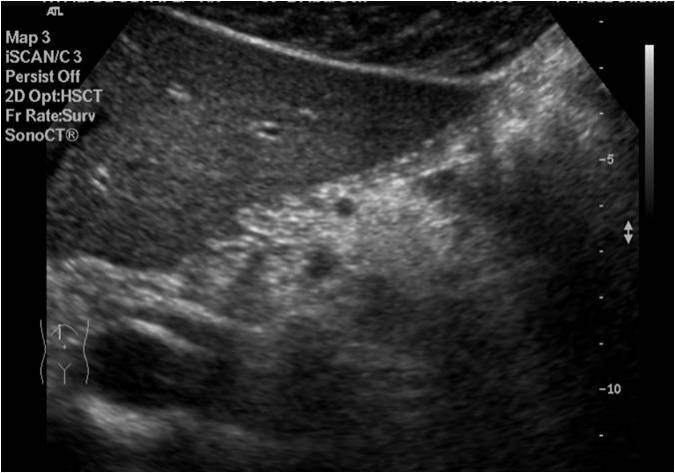
Quiste pancreático.

Uno o varios, pequeños habitualmente, anecoicos, muy dificultosos de objetivar si no prestamos atención plena.

Estas patologías son las más habituales, hay más, obviamente. Muchas veces requieren ampliaciones de estudio con otras Técnicas, TAC y RMN.

Es vital el conocimiento del comportamiento ecográfico de los tejidos, no tiene sentido que empieces a estudiar este Post si previamente no has dado los pasos pertinentes para llegar aquí y sobre todo el Post de Semiología y Homogeneidad de las imágenes.

Como recomendación final, siempre que hallemos patología pancreática debemos hacer medidas en los tres ejes del espacio y usar los modos de trabajo Doppler para intentar ofrecer máxima información al Radiólogo. Además y en esta región anatómica, siempre debemos revisar los hallazgos con el radiólogo para ver si necesita algo más de la exploración.

Quiero dedicar a mi compañera Victoria (TER), una super profesional de la ecografía, este Post por ser colabora del mismo con su buen hacer.

One or several, usually small, anechoic, very difficult to objectify if we do not pay full attention. These pathologies are the most common, there are more, obviously. Many times they require study extensions with other Techniques, CT and MRI. Knowledge of the ecographic behavior of the tissues is vital, it does not make sense that you start studying this Post if you have not previously taken the pertinent steps to get here and especially the Post of Semiology and Homogeneity of the images. As a final recommendation, whenever we find pancreatic pathology we must make measurements in the three axes of the space and use the Doppler work modes to try to offer maximum information to the Radiologist. In addition and in this anatomical region, we should always review the findings with the radiologist to see if he needs anything else from the scan. I want to dedicate my partner Victoria (TER), a super professional of the ultrasound, this Post for being a collaborator of it with her good work.

Quiero invitarte a participar en esta encuesta que me ha pedido que ponga en el Blog, quien probablemente, fue mi primer tutor de prácticas, Jaime García Calonge, hace más de 25 años, una persona estupenda y un Graduado en Radiología comprometido con su profesión, al que le agradezco mucho sus enseñanzas y al que me une una buena amistad y la pasión colchonera.
https://docs.google.com/forms/d/e/1FAIpQLSdrquftC8nJlEh7-HIg3eHrAFzjEX05S6EYXEy8DxQS-KjjSQ/viewform?embedded=true

41. Protocolo de Abdomen.El Páncreas.

Empezamos con el estudio del protocolo de abdomen y como indiqué en el Post anterior, comenzamos con el Páncreas.

El Páncreas es un órgano situado en la región superior y media del Abdomen, es decir, en el epigástrio. Su forma es alargada y tiene según la literatura escogida, 4 o 3 regiones anatómicas.

Esquemáticamente tenemos que saber:

  • Es una glándula exocrina y también endocrina.
  • Se divide en 4 partes: Cabeza, istmo, el cuerpo y la cola.
  • El conducto de Wirsung recorre la totalidad del páncreas.
  • El colédoco atraviesa la glándula de arriba abajo. Discurre por la parte postero-externa de la cabeza hasta la desembocadura del duodeno: Papila de vater.

El Páncreas se encuentra rodeado de la siguiente anatomía:

Anatomía área pancreática

Como ves el Páncreas se encuentra situado en una región anatómica donde un montón de estructuras se concentran en muy poco espacio lo que compromete la visualización y hace que sea uno de los órganos más complicados de estudiar dentro del protocolo de Abdomen.

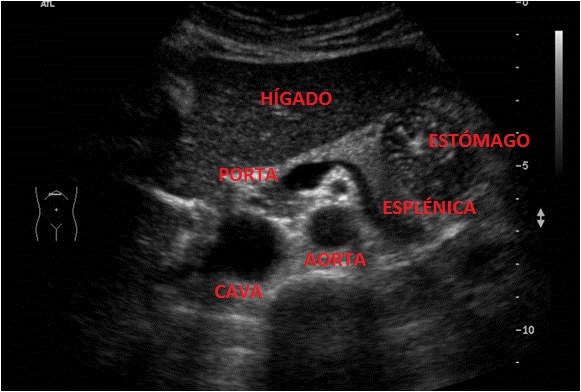
Se encuentra situado según la imagen anterior, posterior al Hígado y anterior a la aorta, pero lo que de verdad nos sirve de referencia para encontrar el órgano es una imagen en forma de renacuajo, anecoica y que en la imagen siguiente está silueteada en blanco.

Referencia, la Esplénica

Esta es la referencia más importante para encontrar el páncreas cuando lo estudiemos, encontrar esta estructura anecoica, que pasa justo posterior al órgano que lo acompaña y lo marca, que tiene forma de renacuajo y que es la Esplénica en su parte más delgada y la Porta en su parte más gruesa. Es sin duda la estructura que va a ayudarte, la aliada principal para encontrar ecográficamente el Páncreas.

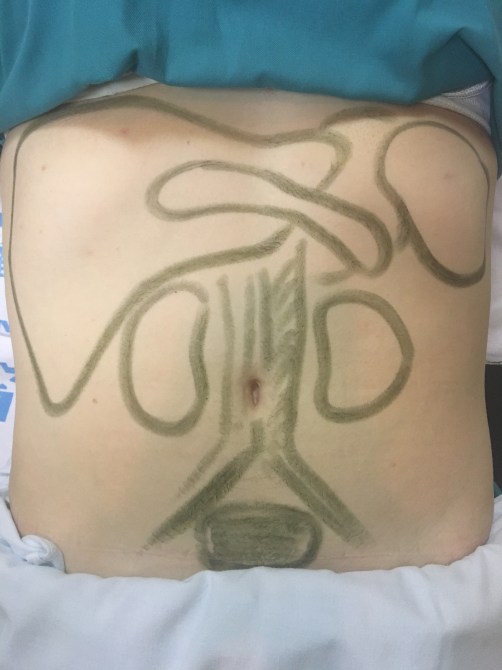
Lo primero que tenemos que conocer es como se dispone espacialmente el órgano en el Abdomen, para eso he dibujado sobre un abdomen, la disposición de los principales órganos:

El Páncreas en el abdomen

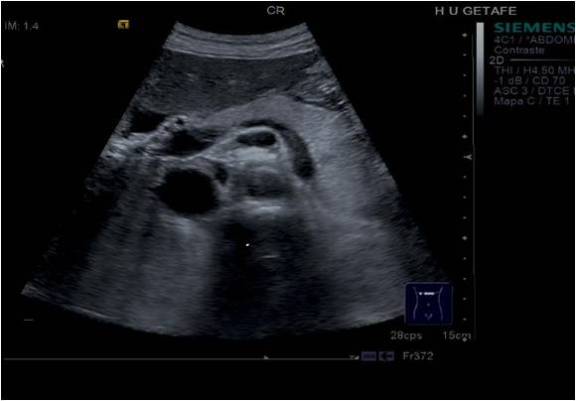
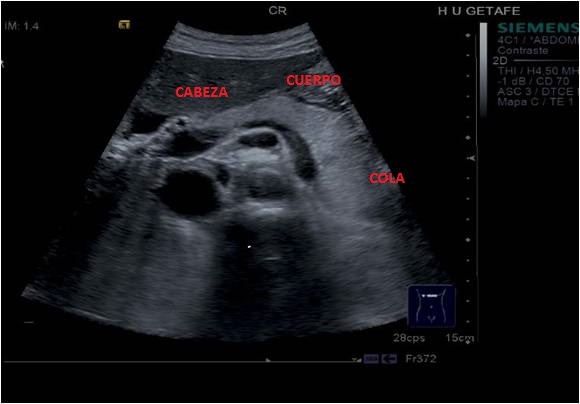
Hemos comentado que el Páncreas tiene varias regiones, ecográficamente nos importan 3, Cabeza, Cuerpo y Cola.

La Técnica es compleja de ejecutar. Colocaremos nuestra sonda con la frecuencia apropiada en el epigastrio abdominal, justo por debajo de xifoides y buscaremos el órgano valiéndonos de las referencia previamente reseñadas.

Cuando localicemos el Páncreas lo repasaremos y estudiaremos comprobando que sea normal tanto en axial o transverso como en longitudinal. Ecográficamente el Páncreas es una estructura alargada, hiperecogénica y homogénea, así:

Aspecto ecográfico

Al tener tres zonas anatómicas, tenemos que estudiarlas separadamente, debiendo colocar el transductor de manera adecuada a cada una de ellas. Son estas:

Regiones

Para el estudio de la cabeza pancreática colocaremos la sonda axial al cuerpo, ligeramente oblicuado hacia los pies del paciente y hacia la izquierda del paciente, así:

Para el Cuerpo del Páncreas seguiremos el órgano y nos colocaremos en la línea media del abdomen en un corte axial puro del abdomen y para la cola pancreática nos oblicuaremos ligeramente hacia abajo y sobrepasando la línea alba hacia el lado izquierdo, buscando la cola, pero no puedo darte una colocación estándar del transductor porque la posición anatómica de la cola pancreática es excesivamente caprichosa. Eventualmente recomiendo la búsqueda de la cabeza pancreática desde el lado izquierdo del paciente, como si estudiásemos el Bazo y la hallaremos pegada a éste, aunque para realizar esta maniobra hay que tener «muchas tablas».

Se recomienda estudiar la estructura pidiendo al paciente que coja aire y que lo aguante en los pulmones, consiguiendo así que todos los órganos abdominales desciendan y puedan ser mejor visualizados, pero esto no es un ejercicio que sirva para todas la anatomías y por ende para todos los estudios.

Realizaremos una foto de cada región pancreática, es decir, de la cabeza, del cuerpo y de la cola. Si podemos sacar una sola foto donde toda la estructura salga de una vez, nos vale, aunque esto no suele darse a menudo. Es vital por parte de el /la Técnico/a de Radiología el uso de los pictogramas en cada foto.

No es necesario mostrar cortes longitudinales del Páncreas en un estudio normal.

Pictogramas Abdomen

Ecográficamente, el Páncreas es una estructura que tiene normalmente una aspecto alargado, hiperecogénico y homogéneo, pero depende muchísimo de cada anatomía y de la edad del sujeto estudiado, pudiendo presentar infinidad de aspectos. Con la edad el órgano pierde grosor y se hace más delgado, perdiendo volumen.

Páncreas paciente joven. Voluninoso.
páncreas paciente mayor. Adelgazado.

Se observa en las imágenes anteriores las diferencias entre ambas estructuras según la edad, pero también influyen otros condicionantes, como la constitución más obesa o no de un paciente, por ejemplo.

El Conducto pancreático o Wirsung no suele visualizarse si es normal, solo cuando está dilatado, y se presentará en la imagen ecográfica como una estructura alargada, fina, anecoica, dentro del Páncreas, como en la imagen de a continuación:

Wirsung dilatado dentro del Páncreas

Repasaremos en el próximo post los condicionantes patológicos típicos de este conducto y del Páncreas en general.

En conclusión podemos decir que el estudio de esta estructura es de un alto nivel de complejidad, cuesta mucho encontrarlo cuando empezamos a hacer esta técnica así que es recomendable tener paciencia y no desesperar. Desgraciadamente aunque te enseñe como hacerlo, solo la práctica diaria y las repeticiones van a  depurar la técnica de quien realice el estudio. Se aconseja que en el comienzo una mano experta acompañe la mano de quien aprende para hacer de guía.

Gracias B. Wacka¡¡¡

Si te ha gustado y te ha parecido útil, por favor, comparte el Blog. Recuerda que puedes seguirlo en Twitter, Facebook e Instagram.


40. Protocolo de Abdomen. Consideraciones generales.

Dejamos atrás el Tiroides y pasamos a estudiar lo que es sin duda el protocolo estrella de las pruebas de radiología que se hacen con ecografía. El Protocolo de Abdomen.

Es un protocolo muy extenso, si el Tiroides tenía complicaciones en base a la anatomía y fisiología de la región a estudiar, imaginar lo que supone el abdomen. Es vital el conocimiento de la anatomía abdominal.

Por eso voy a tratar este protocolo desmenuzado y voy a ir subiendo los post imagen por imagen resultando al final de todos los post un protocolo de abdomen estándar para estudiar con ecografía.

La patología la estudiaremos cuando finalicemos cada órgano, por ejemplo, en el hígado veremos primero todos los cortes necesarios para observar el órgano, sus fotos, y después un post específico para explicar la patología más habitual y sus signos ecográficos.

Pasarán semanas hasta que completemos dicho protocolo, son muchísimas las imágenes que tenemos que hacer, eso siendo normal el estudio, es decir, sin patologías.

Que estructuras vamos a estudiar:

  • Páncreas
  • Hígado
    • Porta Izquierda
    • Aorta, Cava y Suprahepática Izquierda
    • Vesícula y Vía biliar y Porta
    • Suprahepáticas y Lóbulo Hepático Derecho
    • Porta Transcostal
    • Relación Hepato-Renal
  • Riñón Derecho
  • Bazo
  • Riñón Izquierdo
  • Aorta y espacio retroperitoneal
  • Vejiga
  • Útero y Ovarios o Próstata según el sexo del paciente.

Preparación previa:

Ayunas de 6 horas en adultos, en menores intentar ayunas de 4 horas y en bebés sin ayunas. El propósito es que no haya mucho aire intestinal proveniente de la digestión y que la vesícula no esté contraída.

El paciente estará en Decúbito Supino y lo movilizaremos en la medida de lo posible para poder acceder a algunas estructuras mucho mejor.

Utilizaremos sondas de baja frecuencia en adultos y en aquellos pediátricos que por su tamaño así lo requieran, en menores de 5 años y bebés usaremos, generalmente, altas frecuencias en nuestras Sondas.

Para ver aparato genito-urinario es necesario que el paciente venga con la vejiga llena deberá beber líquido y no orinar antes de la prueba.

Los Cortes:

Realizaremos cortes en función de la estructura siempre,es decir, cada órgano necesitará su propia angulación e inclinación de la sonda.

Todas las estructuras deben ser estudiadas en dos planos.

No realizaremos fotos de todos las estructuras en dos planos,siempre adaptándonos al protocolo de cada centro de trabajo y al radiólogo que informará la Ecografía.

El protocolo que voy a desarrollar en los próximos Post es el que recomiendo ya que es el que usamos en mi centro de trabajo desde hace decenas de años con total fiabilidad.

Realizar el protocolo no supone sólo realizar las fotos,debemos estudiar cada órgano, cada estructura, y luego realizar aquellas fotos para que quede constancia de haber repasado todo.

Usaremos siempre el pictograma como forma de comunicación no verbal con el radiólogo para decir el órgano que hemos estudiado, cómo hemos colocado al paciente y cómo hemos realizado el corte.

Cualquier duda que tengamos debemos plantearla siempre al Radiólogo.

Una vez terminada la prueba el paciente puede hacer vida normal.

Empezamos¡¡¡

The cuts: We will make cuts according to the structure always, that is, each organ will need its own angulation and inclination of the probe. All structures must be studied in two planes. We will not take pictures of all the structures in two planes, always adapting to the protocol of each work center and the radiologist who will inform the Ultrasound. The protocol that I will develop in the next Post is the one I recommend since it is the one that we used in my workplace for dozens of years with total reliability. Performing the protocol does not only mean taking the photos, we must study each organ, each structure, and then make those photos so that there is evidence of having reviewed everything. We will always use the pictogram as a form of non-verbal communication with the radiologist to tell the organ that we have studied, how we have placed the patient and how we have made the cut. Any questions that we have, we should always ask the Radiologist. Once the test is completed, the patient can live a normal life. We started! ¡¡


39.Protocolo de Tiroides.La Patología.

Seguimos para terminar con el protocolo de Tiroides con la patología. La primera consideración que tienes que tener en cuenta es que un Técnico de Radiología no es un médico y por tanto no diagnostica, no diagnosticamos. Si el lector es un profesional de la medicina, obviamente si puede dar un diagnóstico a los hallazgos que la exploración aporte.

El objetivo es, partiendo del conocimiento de la normalidad, poder reconocer hallazgos que no sean normales, es el médico encargado el responsable de emitir un eventual informe.

We continue to finish with the thyroid protocol with the pathology. The first consideration you have to take into account is that a Radiology Technician is not a doctor and therefore does not diagnose, we do not diagnose. If the reader is a medical professional, obviously if you can give a diagnosis to the findings that the exploration provides. The objective is, based on the knowledge of normality, to be able to recognize findings that are not normal, the responsible physician is responsible for issuing an eventual report.
Tiroides Normal
Tiroides patológico

Aquí viene lo complicado, poder explicarte esos hallazgos patológicos, el Tiroides es una glándula con una alta tasa de patología, en su mayoría benigna, pero es frecuente que conozcamos a gente que sufre «de Tiroides».

Lo primero de todo es saber muy básicamente como funciona el tiroides, es decir, su Fisiología.

Here comes the complicated, to explain those pathological findings, the Thyroid is a gland with a high rate of pathology, mostly benign, but often we meet people who suffer from «Thyroid.» The first of all is to know very basically how the thyroid works, that is, its physiology

Fisiología Tiroidea:

ES UNA GLÁNDULA NEUROENDOCRINA QUE ES PRODUCTORA DE T3 Y T4, pero además:

  1. LA TIROGLOBULINA ES LA MOLÉCULA PRECURSORA DE T3 Y T4
  2. ESTAS HORMONAS CONTROLAN PROCESOS METABÓLICOS EN EL CUERPO
  3. INFLUYEN EN EL CRECIMIENTO
  4. CONTROLAN ALGUNOS ASPECTOS DEL SISTEMA NERVIOSO CENTRAL
  5. EL TIROIDES ES RESPONSABLE DEL METABOLISMO DEL YODO (I)
  6. ESTÁ REGULADA POR LA HIPOFISIS Y LA CONTROLA MEDIANTE TSH

El Tiroides como cualquier otro órgano del cuerpo, puede sufrir enfermedades congénitas, a saber muy esquemáticamente:

IT IS A NEUROENDOCRINE GLAND THAT IS A PRODUCER OF T3 AND T4, but also: THYLOGLOBULINE IS THE PRECURSOR MOLECULE OF T3 AND T4 THESE HORMONES CONTROL METABOLIC PROCESSES IN THE BODY INFLUENCE ON GROWTH CONTROL OF SOME ASPECTS OF THE CENTRAL NERVOUS SYSTEM THE THYROID IS RESPONSIBLE FOR THE METODOLISM OF THE IODINE (I) IT IS REGULATED BY HYPOPHYSIS AND CONTROL THROUGH TSH Thyroid, like any other body organ, can suffer from congenital diseases, namely very schematically:

Patología Congénita:

–HEMIAGENESIA

  • ausencia de mitad de la glándula, mas frecuente la izqda. y en mujeres

– AGENESIA

  • ausencia completa
– HEMIAGENESIA absence of half of the gland, more frequent the left. and in women – AGENESIA complete absence

ECTOPIA GLANDULAR o localización anómala de la glándula, puede ser en el cuello o por ejemplo en la boca.

Recordemos que en el proceso embrionario fetal los órganos se colocan en su lugar desde otras localizaciones.

GLANDULAR ECTOPIA or anomalous localization of the gland, can be in the neck or for example in the mouth. Recall that in the fetal embryonic process the organs are placed in their place from other locations.

La anatomía, fisiología y embriología Tiroidea la enlazo aquí para que puedas ampliar estos conceptos.

Patología Nodular:

Debemos tener algunos conceptos muy básicos en lo que respecta a la patología nodular tiroidea, mira:

  • LA ENFERMEDAD NODULAR TIROIDEA REPRESENTA UN PROBLEMA CLÍNICO, la gran variedad de nódulos y de aspectos variados de ellos.
  1. –LA MAYORÍA DE LOS NÓDULOS SON BENIGNOS
  2. –ES LA MISIÓN DEL RADIÓLOGO DISCERNIR ENTRE NÓDULOS MALIGNOS (LOS MENOS), DE LOS BENIGNOS (LA MAYORÍA)
  • LA EXPOSICIÓN PREVIA A RADIACIONES IONIZANTES INCREMENTA LAS APARICIONES DE NÓDULOS BENIGNOS Y MALIGNOS

El Bocio o BMN (Bocio Multi Nodular)

  1. ES EL 80% DE LA ENFERMEDAD NODULAR TIROIDEA
  2. PUEDE TENER QUE VER CON LAS DEFICIENCIAS DE YODO
  3. ES UNA PATOLGÍA TÍPICAMENTE GENÉTICA
  4. PUEDEN DARSE O SER SECUNDARIOS A MALA UTILIZACIÓN DE MEDICAMENTOS
  5. ES EL CRECIMIENTO GLOBAL DE LA GLÁNDULA
  6. SE DENOMINA BOCIO
  7. LA INCIDENCIA ES MAYOR EN MUJERES 3 A 1 Y ENTRE LOS 35 Y 50 AÑOS
The anatomy, physiology and thyroid embryology link here so you can expand these concepts. Nodular pathology: We must have some very basic concepts with regard to nodular thyroid disease, look: THYROID NODULAR DISEASE REPRESENTS A CLINICAL PROBLEM, the great variety of nodules and varied aspects of them. -MORE OF THE NODULES ARE BENIGN -THE MISSION OF THE RADIOLOGIST TO DISCERN BETWEEN MALIGNANT NODULES (THE LESS), OF THE BENIGNOS (MOST) PRE-EXPOSURE TO IONIZING RADIATIONS INCREASES THE APPEARANCES OF BENIGN AND NEGLECT NODULES The Goiter or BMN (Goiter Multi Nodular) IS 80% OF THYROID NODULAR DISEASE IT CAN HAVE TO DO WITH THE IODINE DEFICIENCIES IT IS A TYPICALLY GENETIC PATOLGY CAN BE GIVEN OR BE SECONDARY TO BAD USE OF MEDICINES IT IS THE GLOBAL GROWTH OF THE GLAND IT IS DESIGNATED BOCIO THE INCIDENCE IS GREATER IN WOMEN 3 TO 1 AND BETWEEN 35 AND 50 YEARS
BMN


Los Nódulos:

  • CONOCIDOS COMO ADENOMATOSOS O COLOIDES
  • SUELEN SUFRIR DEGENERACIÓN LICUEFACTIVA (QUÍSTICA)
The Nodules: KNOWN AS COLOIDES SUELEN SUFFER LICUFACTURING DEGENERATION (CYSTIC)
Coloide
  1. –SANGRE, LÍQUIDO SEROSO Y MATERIAL COLOIDE
  2. –PUEDEN APARECER CALCIFICACIONES GROSERAS Y PERINODULAR
  3. –LOS QUISTES VERDADEROS SON MUY RAROS

En ocasiones puede ser innumerable la cantidad de nódulos que encontremos, nuestra actitud es la de buscar aquellos que no cumplan los criterios de benignidad explicados más adelante en este Post.

Si encontramos muchos del mismo aspecto, mediremos el dominante,en ocasiones están tan aglutinados que es imposible hacer medición alguna.

  • TIENE ASPECTO ISOECOGÉNICO CON EL TEJIDO TIROIDEO NORMAL
  1. –AL CRECER PUEDEN HACERSE HIPER
  2. –EN MENOR MEDIDA SE HARÁN HIPO
blood, SERIOUS LIQUID AND COLOID MATERIAL – COARSE AND PERINODULAR CALCIFICATIONS CAN APPEAR -THE TRUE CYSTS ARE VERY RARE Sometimes the number of nodules that we find can be innumerable, our attitude is to look for those that do not meet the benignity criteria explained later in this Post. If we find many of the same aspect, we will measure the dominant, sometimes they are so agglutinated that it is impossible to make any measurement. IT HAS AN ISOECOGENIC ASPECT WITH NORMAL THYROID TISSUE -By GROWING YOU CAN BECOME HIPER -WITHTER MEASURE YOU WILL GET HIM

El Adenoma Tiroideo:

  • 10% DE LA ENFERMEDAD NODULAR TIROIDEA
  • 7 VECES MAYOR EN MUJERES
  • 90% NO PRODUCEN DISFUNCIÓN TIROIDEA
  • LA MAYORÍA SON SOLITARIOS
  • ECO:
  1. –MASAS SÓLIDAS
  2. –HIPER, ISO O HIPO
  3. –HALO HIPOECOGÉNICO:
Thyroid Adenoma: 10% OF THYROID NODULAR DISEASE 7 TIMES GREATER IN WOMEN 90% DO NOT PRODUCE THYROID DYSFUNCTION MOST ARE SOLITARY ECHO:
SOLID MASSES –
HIPER, ISO OR HIPO
HIPOECOGÉNIC -HALO:
  • CÁPSULA FIBROSA

El Carcinoma Tiroideo:

  • AL CARCINOMA PAPILAR CORRESPONDE EL PORCENTAJE MAYOR DE TUMORES MALIGNOS TIROIDEOS (65%)
  1. –CARCINOMA FOLICULAR (15%)
  2. –CARCINOMA MEDULAR (5%)
  3. –CARCINOMA ANAPLÁSICO
  4. –LINFOMA
  • LAS METASTASIS DE OTROS ÓRGANOS SON RARÍSIMAS
  • PREVALENTE EN PACIENTES JOVENES
  • METASTATIZA EN GANGLIOS
  • ECO (CARCINOMA PAPILAR):

–HIPOECOGENICIDAD

  • 90%

–MICROCALCIFICACIONES

  • PUNTIFORMES,HIPERECOGÉNICAS Y MUY PEQUEÑAS

–HIPERVASCULARIZACIÓN

  • 90%

El objetivo principal de esta técnica es saber reconocer aspectos ecográficos de alarma como son estos que te resumo a continuación:

  • HIPOECOGENICIDAD
  • HALO GROSERO E IRREGULAR
  • MÁRGENES MAL DEFINIDOS
  • CALCIFICACIONES FINAS Y PUNTIFORMES
  • HIPERVASCULARIZACIÓN DOPPLER DE VASOS CAÓTICOS
Thyroid carcinoma: THE PAPILLARY CARCINOMA CORRESPONDS THE GREATER PERCENTAGE OF THYROID MALIGNANT TUMORS (65%) FOLICULAR CARCINOMA (15%) MEDULAR CARCINOMA (5%) ANAPLASTIC CARCINOMA -LINFOMA THE METASTASES OF OTHER ORGANS ARE VERY RARE PREVALENT IN YOUNG PATIENTS METASTATIZA IN GANGLIOS ECO (PAPILAR CARCINOMA): -HIPOECOGENICITY 90% -MICROCALCIFICATIONS PUNTIFORMES, HYPERECOGENIC AND VERY SMALL -CHERVASCULARIZATION 90% The main objective of this technique is to know how to recognize sonographic aspects of alarm such as these that I summarize below: HYPOECOGENICITY HALO RUDE AND IRREGULAR DEFINITE MARGINS FINE AND PUNTIFORM CALCIFICATIONS DOPPLER HIPERVASCULARIZATION OF CAOTIC VESSELS
Microcalcificaciones
Hipoecogenicidad y Márgenes mal definidos.
Dos nódulos, flecha roja, aspecto maligno, flecha blanca aspecto benigno

Las microcalcificaciones no nos deben dejar nunca tranquilos, siempre reseñarlo y comunicarlo al radiólogo. Existe en los equipos de alta gama, filtros que permiten definir mejor esos calcios. Te lo muestro en la imagen siguiente gentileza de Canon.

The microcalcifications should never leave us alone, always review it and communicate it to the radiologist. There is in the high-end equipment, filters that allow to better define these qualities. I show you in the following image courtesy of Canon.
Filtros para marcar calcios

Enfermedad Tiroidea Difusa:

No toda la patología tiroidea tiene que ver con los nódulos, hay otros signos como los que se dan en las Tiroiditis.

  • AFECTACIÓN DIFUSA GLANDULAR SIN NÓDULOS EVIDENTES
  • AUMENTO GENERALIZADO (BOCIO)
  • SIN NÓDULOS PALPABLES

–TIROIDITIS DE HASHIMOTO

  • HIPOTIROIDISMO
  • HETEROGENICIDAD

–ENFERMEDAD DE GRAVES

  • HETEROGENICIDAD INTRAPARINQUEMATOSA POR VASOS DE GRAN CALIBRE
  • «INFIERNO TIROIDEO»
Diffuse Thyroid Disease: Not all the thyroid pathology has to do with the nodules, there are other signs such as those that occur in thyroiditis. GLANDULAR DIFFUSE AFFECTION WITHOUT EVIDENT NODULES GENERALIZED INCREASE (BOCIO) NO PALPABLE NODULES -HASHIMOTO’S THYROIDITIS HYPOTHYROIDISM HETEROGENICITY -THE SERIOUS ILLNESS HETEROGENICIDAD INTRAPARINQUEMATOSA BY VASOS DE GRAN CALIBRE «THYROID HELL»
Aspecto típico de Tiroiditis

Las Paratiroides:

  • ENDOCRINAS
  • SITUADAS EN LOS POLOS DEL TIROIDES
  • PRODUCEN LA PARATOHORMONA

–FACILITA ABSORCIÓN DE CALCIO Y VITAMINA D

–REDUCE LA EXCRECIÓN RENAL DEL CALCIO

  • HIPERPARATIROIDISMO: AUMENTO DE NIVELES DE CALCIO
  • POR LO GENERAL HAY 4
  • TIENEN FORMA DE LENTEJA
  • PESAN 30 mg CADA UNA

La ecografía es muy útil para:

  • LOCALIZACIÓN EXACTA PREOPERATORIA E INTRAOPERATORIA DE LAS PARATIROIDES
  • TAMBIEN COMO GUIA PERCUTANEA PARA PAAF
  • ABLACIONES PERCUTÁNEAS, ALTERNATIVAS AL TRATAMIENTO QUIRÚRGICO
  • EL EXAMEN ECOGRÁFICO ES IGUAL QUE EL DEL CUELLO

Anatomo-Patología Paratiroidea:

  • PAREJA DE PARATIROIDES, SUPERIOR E INFERIOR
  • CUANDO CRECEN SE DENOMINAN ADENOMAS
  1. –USUALMENTE SON OVALES
  2. –AL CRECER TOMAN ASPECTO DE LÁGRIMA
  3. –MIDEN ENTRE 0,8 Y 1,5 cm
  4. –PESAN HASTA 1000 mg
  5. –NIVELES DE CALCIO EN SANGRE AUMENTADOS

El Adenoma Paratiroideo tiene este aspecto ecográfico:

  • HIPOECOGÉNICOS Y HOMOGÉNEO
  • UNIFORMES
  • 2% COMPONENTE QUÍSTICO
  • CALCIFICACIONES FOCALES
  • VASCULARIZACIÓN AUMENTADA RESPECTO DEL TIROIDES
The Parathyroid: ENDOCRINES SITUATED IN THE THYROID POLES PRODUCE PARATOHORMONE -FACILIT ABSORPTION OF CALCIUM AND VITAMIN D -REDUCE THE CALCIUM RENAL EXCRETION HYPERPARATHYROIDISM: INCREASE OF CALCIUM LEVELS THERE IS ALMOST 4 THEY HAVE THE FORM OF LENTEJA PESAN 30 mg EACH ONE Ultrasound is very useful for: EXACT PRE-OPERATIVE AND INTRA-OPERATIVE LOCALIZATION OF THE PARATHYROID ALSO AS A PERCUTANEOUS GUIDE FOR PAAF PERCUTANEOUS ABLATIONS, ALTERNATIVE TO SURGICAL TREATMENT THE ECOGRAPHIC EXAMINATION IS THE SAME AS THE NECK Anatomy-Pathology Parathyroid: PATIENT OF PARATHYROIDS, UPPER AND LOWER WHEN THEY GROW, THEY ARE DENOMINATED ADENOMAS -Usefully, they are OVAL -THE GROW TAKE LEAVES ASPECT -MIDEN BETWEEN 0.8 AND 1.5 cm – WEIGH UP TO 1000 mg – CALCIUM IN AUGMENTED BLOOD LEVELS The parathyroid adenoma has this echographic aspect: HYPOECHOGENIC AND HOMOGENEOUS UNIFORMS 2% CYSTIC COMPONENT FOCAL CALCIFICATIONS INCREASED VASCULARIZATION REGARDING THYROID
Adenoma Paratiroideo

–DIFERENCIACIÓN RESPECTO DE LAS ADENOPATÍAS

  • VASCULARIZACIÓN HILIAR

Carcinoma Paratiroideo:

  • TAMAÑO MAYOR DE 2 cm
  • CONTORNO LOBULADO
  • ARQUITECTURA INTERNA HETEROGÉNEA
  • AUNQUE MAYORITARIAMENTE SON INDISTINGUIBLES DEL ADENOMA

Este Post solo pretende mostrar algunos de los signos ecográficos más significativos de aquella patología que puede afectar de manera típica al Tiroides, pero es vital entender que esta patología es infinitamente mayor y que corresponde al Clínico su manejo. La punción de los nódulos es una tarea exclusiva del Radiólogo, donde el Técnico brindará su conocimiento en el manejo de los controles del equipo y será auxiliar para la punción.

DIFFERENTIATION REGARDING THE ADENOPATHIES HILIAR VASCULARIZATION Parathyroid carcinoma: LARGE SIZE OF 2 cm LOBULATED CONTOUR INTERNAL ARCHITECTURE HETEROGÉNEA ALTHOUGH THEY ARE MAJORLY INDISTINGUIBLE OF THE ADENOMA This Post only aims to show some of the most significant echographic signs of that pathology that can typically affect the thyroid, but it is vital to understand that this pathology is infinitely greater and that it corresponds to the clinician’s management. The puncture of the nodules is an exclusive task of the Radiologist, where the Technician will provide his knowledge in the handling of the controls of the equipment and will be auxiliary for the puncture


38.Protocolo de Tiroides.La Semiología.

Una vez que sabemos qué fotos tenemos que hacer para poder hacer un protocolo, debemos saber qué aspecto ecográfico tienen los tejidos que aparecen en estas fotos y que te explico a continuación.

Esta semiología que vamos a ver es la que se refiere a aquellos tejidos de aspecto normal. Este concepto es muy importante, la única manera de identificar la patología en un tejido es conocer como es su aspecto normal. Esto siempre me lo preguntan cuando hacemos las clases tanto teóricas como talleres, porque normalmente siempre queremos empezar por lo más difícil, pero hay que conocer primero el tejido normal, luego el patológico.

Once we know what photos we have to do to be able to make a protocol, we must know what ecographic appearance the tissues that appear in these photos have and what I explain next. This semiology that we are going to see is the one that refers to those tissues of normal appearance. This concept is very important, the only way to identify the pathology in a tissue is to know how is its normal appearance. This is always asked when we do both theoretical and workshop classes, because normally we always want to start with the most difficult, but we must first know the normal tissue, then the pathological one.
Imagen 1. La glándula tiroidea.

Es la estructura base del estudio, alrededor de esta estructura va todo. El aspecto ecográfico normal del Tiroides es hiperecogénico y homogéneo, es decir, brilla más que el tejido adyacente y además el tono de gris es uniforme en toda la glándula. Patologías como las Tiroiditis, o gran cantidad de nódulos que afectan a esta glándula, alteran la ecoarquitectura y también el aspecto ecogénico. En la imagen la glándula la reconocemos por las dos flechas blancas.

It is the basic structure of the study, around this structure everything goes. The normal sonographic appearance of the thyroid is hyperechogenic and homogeneous, that is, it shines more than the adjacent tissue and also the tone of gray is uniform throughout the gland. Pathologies such as thyroiditis, or large number of nodules that affect this gland, alter the ecoarchitecture and also the echogenic aspect. In the image we recognize the gland by the two white arrows.
Imagen 2.El Músculo.

La musculatura cervical en la ecografía de Tiroides no suele tener significación patológica, pero dentro del estudio realizamos cortes donde vamos a sacar dicha anatomía y debemos reconocerla. En la imagen superior observamos tres flechas blancas que indican la presencia de una ecoestructura hipoecogénica que en su interior tiene pequeñas imágenes hiperecogénicas, lineales y paralelas. Son las fibras de colágeno de dichas fibras. El Esternocleidomastoideo es el más grande,pero son multitud los músculos que conforman la musculatura del cuello, reconocer su aspecto es vital.

The cervical musculature in the thyroid ultrasound does not usually have pathological significance, but within the study we made cuts where we are going to get that anatomy and we must recognize it. In the upper image we see three white arrows that indicate the presence of a hypoechoic echoestructure that has small hyperechoic, linear and parallel images in its interior. They are the collagen fibers of these fibers. The Esternocleidomastoideo is the largest, but there are many muscles that make up the muscles of the neck, recognizing its appearance is vital.
Imagen 3. Vasos.

Los vasos tienen un aspecto anecoico, tubular y hay muchísimos ya que el cuello en general y especficamente el Tiroides, son una anatomía muy vascularizada. Carótida (interna) y Yugular (externa) son las más reconocibles. La Arteria Carótida es pursátil y no compresible y la Vena Yugular es compresible. Además las arterias y la venas tiroideas llegan y salen del tiroides irrigándolo, pero son de menor calibre aunque su aspecto también es anecoico.

The vessels have an anechoic, tubular appearance and there are many because the neck in general and specifically the Thyroid, are a very vascularized anatomy. Carotid (internal) and jugular (external) are the most recognizable. The Carotid Artery is non-compressible and non-compressible and the Jugular Vein is compressible. In addition, the arteries and the thyroid veins come and go from the thyroid irrigating it, but they are of smaller caliber although their appearance is also anechoic.
Imagen 4. Los Ganglios.

Los Ganglios cervicales son muy numerosos en el cuello, se establecen en forma de cadenas ganglionares, laterales a la glándula tiroidea. Su aspecto normal es una imagen ovoidea hipoecogénica y en el centro de esa estructura, una imagen hiperecogénico, la corteza es la parte hipoecogénica y la grasa del ganglio, la parte hiperecogénica. Pueden aparecer solitarios o en varias unidades.

The cervical lymph nodes are very numerous in the neck, they are established in the form of ganglion chains, lateral to the thyroid gland. Its normal appearance is an ovoid hypoechoic image and in the center of that structure, a hyperechogenic image, the cortex is the hypoechoic part and the ganglion fat, the hyperechoic part. They can appear solitary or in several units.
Imagen 5a. La Tráquea.
Imagen 5b. Detalle de los anillos traqueales.

La tráquea es una imagen central, grande, marcada con flecha blanca en la imagen 5a, con imágenes curvas hiperecogénicas que corresponden a los cartílagos y anillos traqueales. El aspecto ecográfico de la tráquea es hipoecogénico por ausencia de información debido al contenido aéreo de la estructura. El aire, aunque con muy baja impedancia, no transmite el sonido.
Los anillos traquelaes son fácilmente reconocible en la imagen 5b por su aspecto ovalado justo después del Istmo tiroideo en el corte longitudinal.

Superior a la tráquea encontramos el Istmo tiroideo, del mismo aspecto ecográfico que los lóbulos tiroideos.

The trachea is a central, large image, marked with a white arrow in image 5a, with hyperechoic curved images corresponding to the cartilages and tracheal rings. The ultrasound appearance of the trachea is hypoechogenic due to the absence of information due to the air content of the structure. The air, although with very low impedance, does not transmit the sound. The tracheal rings are easily recognizable in image 5b because of their oval aspect just after the thyroid isthmus in the longitudinal section. Superior to the trachea we find the thyroid Isthmus, with the same ultrasound appearance as the thyroid lobes.
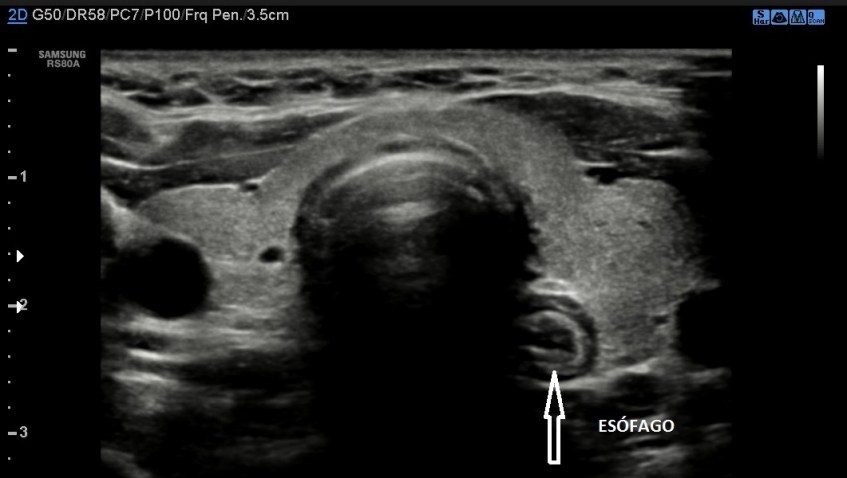
Imagen 6.El Esófago.

Esta estructura como muy bien sabes pertenece al sistema digestivo, teóricamente aparece siempre en la linea media según la anatomía, pero cuando hacemos el corte ecográfico axial del cuello para ver en transverso de ambos lóbulos aparece hacia la izquierda una estructura en forma de diana, que con la deglución se mueve, el Esófago. Tiene aspecto circular, hipoecogénico con círculos hiperecogénicos correspondiente a las capas de dicha estructura. Su presencia hace que el LTI sea ligeramente más pequeño, como curiosidad.
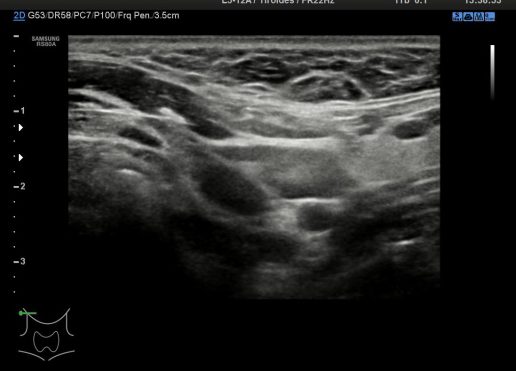
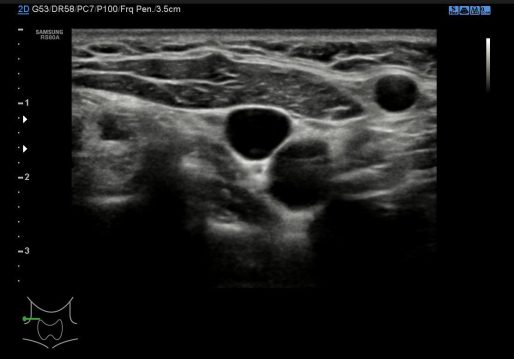
This structure as you know very well belongs to the digestive system, theoretically always appears in the middle line according to the anatomy, but when we make the axial ultrasonographic section of the neck to see in transverse of both lobes a target structure appears to the left, which with swallowing it moves, the esophagus. It has a circular, hypoechogenic appearance with hyperechogenic circles corresponding to the layers of said structure. Its presence makes the LTI slightly smaller, as a curiosity.
Imagen 7. Otros Tejidos.

Residuales y carentes de importancia para el estudio de la glándula tenemos la piel y el tejido celular subcutáneo que está debajo.

La piel es justo una línea hiperecogénica, lisa, que es la primera barrera anatómica que se encuentra el haz de ultrasonido.

El Tejido Celular Subcutáneo está inmediatamente posterior y es la grasa que se encuentra bajo la piel, con aspecto hipoecogénico, anterior a la musculatura y separada de esta por una fina línea hiperecogénica correspondiente a la fascia muscular.

La grasa, distribuida aleatóriamente por el tejido del cuello, puede verse hipoecogénica siempre dependiendo del tejido que tenga alrededor.

Con esto queda repasado el aspecto ecográfico de la anatomía que podremos ver con este protocolo.

Residual and unimportant for the study of the gland we have the skin and the subcutaneous cellular tissue that is below. The skin is just a hyperechoic, smooth line, which is the first anatomical barrier found in the ultrasound beam. The subcutaneous cellular tissue is immediately posterior and is the fat that is under the skin, with hypoechogenic appearance, anterior to the musculature and separated from it by a thin hyperechoic line corresponding to the muscular fascia. The fat, distributed randomly by the tissue of the neck, can be seen hypoechogenic always depending on the tissue around it. This is reviewed the sonographic aspect of anatomy that we can see with this protocol.


37.Protocolo de Tiroides.Las imágenes.

Bien, hemos visto las consideraciones básicas del protocolo del Tiroides, como se hacen los cortes y hoy vamos a ver qué fotos necesitas sacar en un protocolo de Tiroides normal para poder ser presentado a un radiólogo para que realice un informe. Buscaremos también en esta primera parte del estudio la presencia de las Paratiroides.

Well, we have seen the basic considerations of the Thyroid protocol, how the cuts are made and today we are going to see what photos you need to take in a normal thyroid protocol to be presented to a radiologist to make a report. We will also look for the presence of parathyroids in this first part of the study.
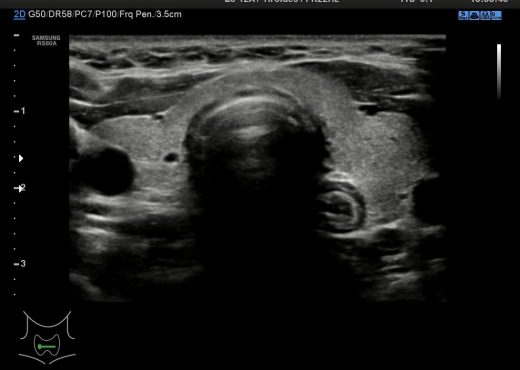
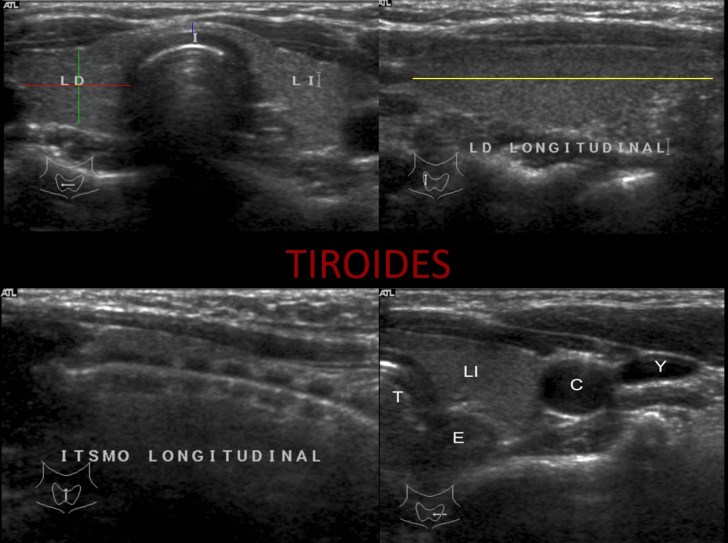
1. Corte axial ambos lóbulos.

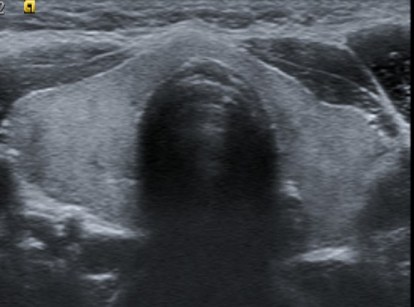
En esta imagen 1 buscamos una visualización global de la glándula y nos interesa el aspecto ecográfico de ambos lóbulos.Junto al lóbulo izquierdo observamos la porción visible del esófago.

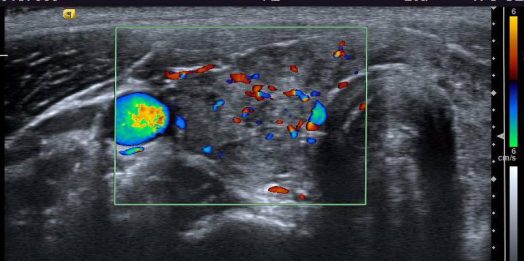
Colocaremos el doppler color para comprobar vascularización normal de la glándula y sacaremos foto si lo consideramos necesario. (recomendado).

In this image 1 we look for a global visualization of the gland and we are interested in the echographic aspect of both lobes. Next to the left lobe we observe the visible portion of the esophagus. We will place the color Doppler to check normal vascularization of the gland and we will take a photo if we consider it necessary. (recommended).
Comprobación doppler
2. Medidas LD

Imagen 2 para las medidas AP y RL (Antero-Posterior y Derecha Izquierda) del Lóbulo tiroideo Derecho.Observamos dos vasos, Carótida Derecha y Yugular, interna y externa respectivamente.

Image 2 for the AP and RL measurements (Anteroposterior and Right Left) of the Right Thyroid Lobe. We observe two vessels, Right Carotid and Jugular, internal and external respectively
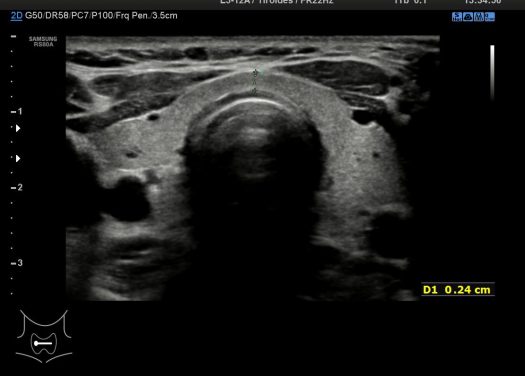
3. Medida Istmo

Imagen 3 donde observamos el Istmo y hacemos medida para evaluar un posible aumento de la glándula, no debe superar esta medida en AP los 0,3 cms.

Image 3 where we observe the Isthmus and measure to evaluate a possible increase in the gland, this measure should not exceed 0.3 cm in AP.
4. Medida LI

Imagen 4 para las medidas AP y RL (Antero-Posterior y Derecha Izquierda) del Lóbulo tiroideo Izquierdo.Observamos dos vasos, Carótida Derecha y Yugular, interna y externa respectivamente el Esófago en forma de diana en posición medial junto a la tráquea.

Image 4 for AP and RL measurements (Antero-Posterior and Left Right) of the Left Thyroid Lobe.We observe two vessels, Right and Jugular Carotid, internal and external, respectively, the esophagus in the form of a bullseye in medial position next to the trachea.
5. Medida LD Longitudinal

La 5 es la foto correspondiente a la medida en Longitudinal del LD. Es vital sacar todo el Tiroides en longitudinal para poder medirlo en toda su extensión en este corte,tanto LD como LI.(Luz Noemí).

The 5 is the photo corresponding to the measure in Longitudinal of the LD. It is vital to remove the entire Thyroid in longitudinal to be able to measure it in its entirety in this section, both LD and LI
6. Istmo Longitudinal

La 6 es la foto correspondiente a la vista en Longitudinal del Istmo.

7. Medida LI Longitudinal

La 7 es la foto correspondiente a la medida en Longitudinal del LI.

En las siguientes imágenes vamos a ver la segunda parte del estudio del cuello que no es el Tiroides y que es de obligatorio repaso como decíamos en el Post 35 donde hablábamos de las consideraciones básicas a tener en cuenta y detallábamos que otras estructuras se incluían en el estudio del Protocolo de Tiroides.

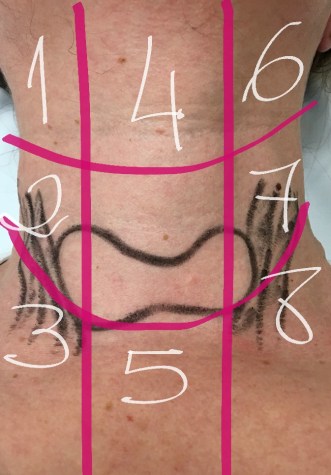
Para ello vamos a dividir el cuello de la/el paciente que estemos estudiando en 8 regiones así:

The 7 is the photo corresponding to the measure in LI longitudinal. In the following images we will see the second part of the study of the neck that is not the thyroid and that is mandatory review as we said in the Post 35 where we talked about the basic considerations to take into account and detailed that other structures were included in the study of the Thyroid Protocol. To do this we are going to divide the neck of the patient we are studying in 8 regions like this:
Regiones del cuello

Cada región del cuello tiene que tener una foto en el estudio y que puedes ver a continuación, el objeto de esta división es la búsqueda de ganglios locorregionales, así como otros hallazgos extratiroideos que pudieran ser de interés, calcificaciones carotídeas, Tiroides ectópico, incluso las glándulas submaxilares (espacio 1 y 6 pegados al 4) y parótidas (espacio 1 y 6, debajo del pabellón auditivo u oreja).

Con esta división nos garantizamos que repasamos la parte lateral del cuello (1,2,3,6,7,8) y la parte central – superior al Tiroides (4) donde encontramos el Conducto del Tirogloso. También el espacio número 5 o escotadura supraesternal donde pueden ocultarse ganglios o restos del Timo.

Los espacios 1,2,3,6,7,8 siguen la longitud del Esternocleidomastoideo y todas las cadenas ganglionares del cuello.

Debemos permanecer muy atentos a la situación del pictograma y como se corresponde con los espacios del cuello de la foto superior.

En condiciones normales no tenemos que encontrarnos hallazgos patológicos, pero es habitual ver ganglios que no deben sobrepasar el centímetro de diámetro en eje corto para ser considerados normales, todos los hallazgos no normales deben ser registrados para posterior evaluación del Radiólogo/a.

Each region of the neck has to have a photo in the study and you can see below, the object of this division is the search for locoregional ganglia, as well as other extrathyroidal findings that might be of interest, carotid calcifications, ectopic thyroid, even the submaxillary glands (space 1 and 6 attached to 4) and parotid glands (space 1 and 6, below the auditory pinna or ear).
With this division we guarantee that we review the lateral part of the neck (1,2,3,6,7,8) and the central part – superior to the Thyroid (4) where we find the Tirogloso Conduit. Also the space number 5 or suprasternal notch where ganglia or remains of the Thymus can be hidden. The spaces 1,2,3,6,7,8 follow the length of the Esternocleidomastoideo and all the ganglionic chains of the neck. We must remain very attentive to the situation of the pictogram and how it corresponds to the spaces in the neck of the upper photo. Under normal conditions we do not have to find pathological findings, but it is usual to see nodes that should not exceed one centimeter in diameter on a short axis to be considered normal, all non-normal findings should be recorded for further evaluation by the radiologist.
8. Región 1 o Infrauricular (igual que la región 6)
9. Región 2
10. Región 3 o supraclavicular (igual que la región 8)
11. Región 4 Conducto del Tirogloso
12. Región 5
13. Región 6


14. Región 7
15. Región 8

Estas son las fotos del protocolo estándar, normal, es decir, estas son las imágenes mínimas que debemos sacar en un protocolo de Tiroides normal, lo que se considere patológico o deba ser estudiado se registrará a posteriori.

These are the photos of the standard protocol, normal, that is, these are the minimum images that we should take in a normal thyroid protocol, what is considered pathological or should be studied will be recorded a posteriori.

Muchas gracias Vito…

36. Protocolo de Tiroides. Los Cortes.

Ahora vamos a ver los cortes, no el protocolo, los cortes, es decir, como tenemos que manejar el transductor para realizar un protocolo de Tiroides normal.

Esto que ves en este post es la teoria, pero se aprende con la práctica o en un taller, donde quien te enseñe te dirija la mano al principio ya que es una técnica que requiere destreza, pero todo se aprende¡¡¡

Una vez que todo está preparado para empezar el estudio debemos saber donde y como se coloca espacialmente la glándula, los vasos y todos aquellas estructuras que tengamos que estudiar. El problema es que están debajo de la piel, y eso no ayuda…Por eso es importante conocer muy la anatomía.

Los cortes de los lóbulos y el Istmo son en transverso y en logitudinal, es decir, axiales al cuello y sagitales a éste.

Cada lóbulo será estudiado individualmente en transverso y longitudinal y siempre siempre colocados perpendicularmente a la estructura. El cuello no es plano, desde el cartílago a los laterales, el cuello se inclina, por tanto tendremos que inclinarnos nosotros con nuestra sonda para buscar el lóbulo de cada lado.

El Istmo es central, por tanto debemos apoyar la sonda central  transverso y en longitudinal, teniendo mucho cuidado porque el istmo es muy pequeño y cogerlo en longitudinal puede hacerse complicado al principio ya que además, tenemos que estar apoyando sobre la tráquea que es un superficie muy inestable.

En radiología todo hay que estudiarlo en dos proyecciones, por tanto, para estudiar el Tiroides, también, así como todas aquellas estructuras que nos parezcan anómalas, por ejemplo, nódulos que nos parezcan que pueden ser de interés para el radiólogo por su aspecto, tamaño o forma.

Además siempre haremos transverso y longitudinal porque es la única manera de poder medir una estructura en los tres ejes del espacio, antero-posterior, derecha-izquierda y cráneo-caudal.

Ah, y muy muy importante, recuerda siempre posicionar el transductor para hacer coincidir la derecha del paciente con la derecha de la pantalla (nuestra izquierda), en el corte transverso y en el longitudinal, la parte craneal, a la derecha de la pantalla (nuestra izquierda).

Now let’s see the cuts, not the protocol, the cuts, that is, how we have to handle the transducer to perform a normal thyroid protocol. What you see in this post is the theory, but you learn with practice or in a workshop, where whoever teaches you to direct your hand at first since it is a technique that requires skill, but everything is learned! Once everything is ready to begin the study we must know where and how the gland, vessels and all those structures that we have to study are placed. The problem is that they are under the skin, and that does not help … That is why it is important to know the anatomy very well. The cuts of the lobes and the Isthmus are transverse and longitudinal, that is, axial to the neck and sagittal to the neck. Each lobe will be studied individually in transverse and longitudinal and always always placed perpendicular to the structure. The neck is not flat, from the cartilage to the sides, the neck is inclined, so we will have to lean ourselves with our probe to look for the lobe on each side. The Isthmus is central, therefore we must support the transverse and longitudinal central probe, being very careful because the isthmus is very small and taking it in longitudinal can be complicated at first since also, we have to be resting on the trachea that is a surface very unstable In radiology, everything has to be studied in two projections, therefore, to study the thyroid, as well as all those structures that seem anomalous, for example, nodules that we think may be of interest to the radiologist because of their appearance, size or form. In addition we will always make transverse and longitudinal because it is the only way to be able to measure a structure in the three axes of space, antero-posterior, right-left and cranio-caudal. Oh, and very important, always remember to position the transducer to match the patient’s right with the right of the screen (our left), in the transverse and longitudinal cuts, the cranial part, to the right of the screen ( our left).
Situación del Tiroides

Para que te hagas una idea de como estudiar la glándula, primero tienes que saber cómo es y donde se sitúa. Luego saber lo que tiene más cerca, es decir, anatomía, este caso lo ves dibujado sobre el cuello con los vasos, la carótida y la yugular a sus lados.

To give you an idea of ​​how to study the gland, you must first know what it is like and where it is located. Then find out what is closest, that is, anatomy, this case you see it drawn on the neck with the vessels, the carotid and the jugular at its sides.
Corte tranverso

En este caso realizamos un corte transverso del lóbulo derecho que es un corte axial del cuello, adecuándonos a la posición del lóbulo.

In this case we perform a transverse cut of the right lobe that is an axial cut of the neck, adapting to the position of the lobe.
Corte longitudinal

Observa ahora cómo nos colocamos en función del lóbulo, mira como el corte no es en el eje sagital puro, sino que nos adaptamos a la estructura con el único fin de poder verla en su totalidad en longitudinal.

See now how we position ourselves according to the lobe, look how the cut is not in the pure sagittal axis, but we adapt to the structure with the sole purpose of being able to see it in its entirety in longitudinal.
Corte transverso del Istmo

El Itsmo requiere, obviamente su propio estudio, en este caso, corte transverso, apoyando levemente sobre la línea media del cuello, sin comprimir en exceso, observa como el transductor no apoya lateralmente, pero si tienes bastante gel y realizas compresión correcta, vas a poder ver el Istmo y ambos lóbulos, como te demuestro en la siguiente imagen…

The Isthmus require, obviously your own study, in this case, transverse cut, supporting slightly on the midline of the neck, without compressing excessively, observe how the transducer does not support laterally, but if you have enough gel and you perform correct compression, you will be able to see the Isthmus and both lobes, as I show you in the next image

Posteriormente y sin movernos de ahí, giramos el transductor 90º en sentido horario, colocándonos sobre la línea media, perpendicularmente a la estructuctura para realizar el corte longitudinal o sagital al cuello.

Subsequently and without moving from there, we turn the transducer 90º in a clockwise direction, placing ourselves on the midline, perpendicular to the structure to make the longitudinal or sagittal cut to the neck.
Longitudinal del Istmo

Esta imagen superior sería el corte longitudinal del Istmo, en la imagen el transductor no apoya, obviamente tendremos que apretar un poco más, pero quería mostrarte cómo sería el corte respecto de la estructura.

Para el lóbulo izquierdo realizaremos la misma operación que con el lóbulo derecho, pero al otro lado de la línea media.

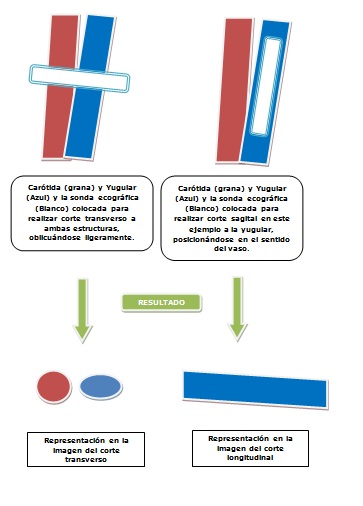
Junto al lóbulo derecho y el izquierdo, encontramos lateralmente dos vasos, carótida, más medial y yugular, más externa, si observas en la imagen primera, no son completamente sagitales, por tanto para su estudio, tendremos que buscar su orientación y adaptarnos a su anatomía. Así:

This upper image would be the longitudinal cut of the Isthmus, in the image the transducer does not support, obviously we will have to tighten a little more, but I wanted to show you how the cut would be with respect to the structure. For the left lobe we will perform the same operation as with the right lobe, but on the other side of the midline. Next to the right and left lobes, we find laterally two vessels, carotid, more medial and jugular, more external, if you look at the first image, they are not completely sagittal, therefore for their study, we will have to look for their orientation and adapt to their anatomy.
Representación de cortes de estudio de los vasos

Para resumir, realizaremos cortes transversos y longitudinales siempre adecuándonos a la colocación de la estructura a estudio. Así haremos tanto con las estructuras anatómicas normales como con aquellas que despierten nuestra atención porque puedan ser de significado relevante para el estudio.

En el próximo Post veremos la representación en imágenes del protocolo habitual.

To summarize, we will make transverse and longitudinal cuts always adapting to the placement of the structure under study. This way we will do as much with normal anatomical structures as with those that arouse our attention because they can be of significant significance for the study. In the next Post we will see the representation in images of the usual protocol. Do not forget to share if you like the Blog.

No olvides compartir si te gusta el Blog.

35. Protocolo de Tiroides. Consideraciones básicas.

El Tiroides es una glándula, vamos a verla con ecografía muy habitualmente porque es la técnica de elección para su estudio y los Endocrinólogos y los Médicos de Familia solicitan esta prueba muy a menudo.

Anatomía: Enlazo aquí una dirección donde conocerás suficientemente la anatomía y la fisiología del Tiroides. Te invito a investigar su anatomía y funcionamiento, ya que, aunque un poco desconocida, la glándula tiroidea es una gran  directora de orquesta que tiene repercusión en gran cantidad de procesos metabólicos del organismo.

Consideraciones:

  • DEBIDO A LA SITUACIÓN ANATÓMICA DEL TIROIDES, TANTO LA ECOGRAFÍA 2D EN TIEMPO REAL COMO LOS ESTUDIOS DOPPLER-COLOR HACE DE ESTA LA TÉCNICA DE ELECCIÓN PARA EL ESTUDIO DE ESTA REGIÓN ANATÓMICA.
  • Es una técnica barata, de fácil acceso en el ámbito sanitario y muy solicitada por los especialistas.
  • EN LOS AÑOS 80 SE CONVIERTE EN LA TÉCNICA MÁS SENSIBLE PARA DETECTAR NÓDULOS QUE NO SE VEN NI EN CT NI EN RMN.
  • Su uso se dispara por la alta incidencia de cánceres de Tiroides en la Europa del Este por el accidente de Chernobil.
Thyroid is a gland, we will see it with ultrasound very often because it is the technique of choice for its study and Endocrinologists and Family Physicians request this test very often. Anatomy: Here is an address where you will know enough about the anatomy and physiology of the Thyroid. I invite you to investigate its anatomy and functioning, since, although a little unknown, the thyroid gland is a great conductor of orchestra that has repercussion in a great amount of metabolic processes of the organism. Considerations: DUE TO THE ANATOMICAL SITUATION OF THE THYROID, BOTH THE 2D RECORDING IN REAL TIME AND THE STUDIES DOPPLER-COLOR MAKES THIS THE CHOICE OF CHOICE FOR THE STUDY OF THIS ANATOMICAL REGION. It is a cheap technique, easily accessible in the health field and highly requested by specialists. IN THE YEARS 80 IT BECOMES THE MOST SENSITIVE TECHNIQUE TO DETECT NODULES THAT ARE NOT SEEN IN CT OR MRI. Its use is triggered by the high incidence of thyroid cancers in Eastern Europe due to the Chernobyl accident.

La Técnica:

  • Usaremos sondas de Alta Frecuencia.
  • Necesitaremos Profundidad de estudio en torno a los 5 cms. dependiendo de las características de la paciente.
  • El Doppler es de uso habitual ya que la estructura está treméndamente vascularizada.
  • El paciente se tumbará en la camilla de estudio relajado y con el cuello hiperextendido para mejor acceso del operador.(Algunos pacientes, por esta posición pueden marearse al incorporarse de la camilla de exploración).
  • Luz adecuada en la sala.
  • Limpieza de superficies (Sondas y equipo).

Objetivo:

  • VALORAR Y MEDIR AMBOS LÓBULOS TIROIDEOS.
  • VALORAR ISTMO.
  • BARRIDO TRANSVERSO Y LONGITUDINAL.
  • VALORAR GANGLIOS REGIONALES.
  • VALORAR CARÓTIDAS Y YUGULARES.
  • BUSCAR PARATIROIDES.

Exploración Ecográfica:

  • ESTUDIAMOS LOS LÓBULOS Y EL ISTMO POR SEPARADO:
  • MEDIDAS LÓBULOS:
    • ANTERO-POSTERIOR, DERECHA-IZQUIERDA Y LONGITUDINALMENTE
  • MEDIDAS ISTMO
    • MEDIDA ANTERO-POSTERIOR

Descripción de la Exploración:

Cada sitio de trabajo puede tener su propios protocolos de estudio, yo te voy a explicar como me parece el ideal.

Una vez tumbado el paciente con el cuello en hiperextensión en función de su capacidad, cogeremos la sonda adecuada y nos aseguraremos de que el paciente sea el correcto cuando lo capturemos de la lista de trabajo y escogeremos el preseteado adecuado.

Empezaremos localizando el lóbulo tiroideo derecho en transverso, después el Istmo y luego el lóbulo tiroideo izquierdo realizando una vista general, realizaremos una foto colocados sobre el Istmo donde se vean ambos lóbulos para poder evaluar su apariencia y comparar su ecogenicidad, así:

The technique: We will use High Frequency probes. We will need depth of study around 5 cms. depending on the characteristics of the patient. Doppler is commonly used because the structure is tremendously vascularized. The patient will lie down on the study table relaxed and with the neck hyperextended for better access of the operator (Some patients, due to this position can get dizzy when getting up on the examination table). Adequate light in the room. Surface cleaning (Probes and equipment). Objective: VALUING AND MEASURING BOTH THYROID LLOBES. VALUING ISTHMUS. TRANSVERSE AND LONGITUDINAL SWEEP. VALUATE REGIONAL GANGLES. VALUING CAROTID AND YUGULAR. SEARCH FOR PARTYROIDES. Ultrasound scan: WE STUDY THE LOBULES AND THE ISTHMUS SEPARATELY: MEASURES LOBULOS: PREVIOUS-BACK, RIGHT-LEFT AND LONGITUDINALLY ISTMO MEASURES PREVIOUS-REAR MEASUREMENT Description of the Exploration: Each work site can have its own study protocols, I will explain how I think the ideal. Once the patient is lying down with the neck in hyperextension according to his capacity, we will take the appropriate probe and we will make sure that the patient is the correct one when we capture it from the work list and we will choose the right preset. We will start by locating the right thyroid lobe transverse, then the Isthmus and then the left thyroid lobe making a general view, we will make a photo placed on the Isthmus where both lobes can be seen to evaluate their appearance and compare their echogenicity, like this:

Ahora nos centramos en el lóbulo derecho, siempre buscando incidir sobre la estructura perpendicularmente. La cogeremos en toda su extensión y haremos medidas como verás después. Lo estudiaremos en transverso y longitudinal, repitiendo lo mismo con Istmo y lóbulo izquierdo.

Pondremos el Doppler color para comprobar la vascularización de ambos lóbulos.

Después nos centraremos en la patología que nos hayamos encontrado y la estudiaremos.

Es habitual encontrar nódulos, más adelante hablaremos de su aspecto y las recomendaciones de estudio.

Posteriormente haremos un recorrido general por el cuello valorando ganglios locorregionales, empezando debajo de la oreja y recorriendo la dirección del esternocleidomastoideo hasta llegar al espacio supraclavicular y después revisar vasos principales del cuello, especialmente carótidas y la aparición en su interior de placas de ateroma.

Buscaremos la presencia de patología de las paratiroides, pero a menudo, dicha patología es difícil de diferenciar de otras patologías tiroideas salvo que la/el paciente llegue con una sospecha alta debido a la clínica o pruebas que dirijan el estudio a dichas glándulas paratiroideas, por ejemplo la hipercalcemia.

Now we focus on the right lobe, always looking to influence the structure perpendicularly. We will take it to its full extent and we will take measures as you will see later. We will study it in transverse and longitudinal, repeating the same with Isthmus and left lobe. We will put the color Doppler to check the vascularization of both lobes. Then we will focus on the pathology we have encountered and we will study it. It is common to find nodules, later we will discuss their appearance and study recommendations. Later, we will make a general tour of the neck, evaluating locoregional ganglia, starting below the ear and crossing the direction of the sternocleidomastoid to the supraclavicular space and then reviewing main vessels of the neck, especially carotids and the appearance of atheroma plaques inside. We will look for the presence of pathology of the parathyroids, but often, this pathology is difficult to differentiate from other thyroid pathologies unless the patient arrives with a high suspicion due to clinical or tests that direct the study to said parathyroid glands, for example hypercalcemia.

Medidas:

Estudio general Tiroideo.

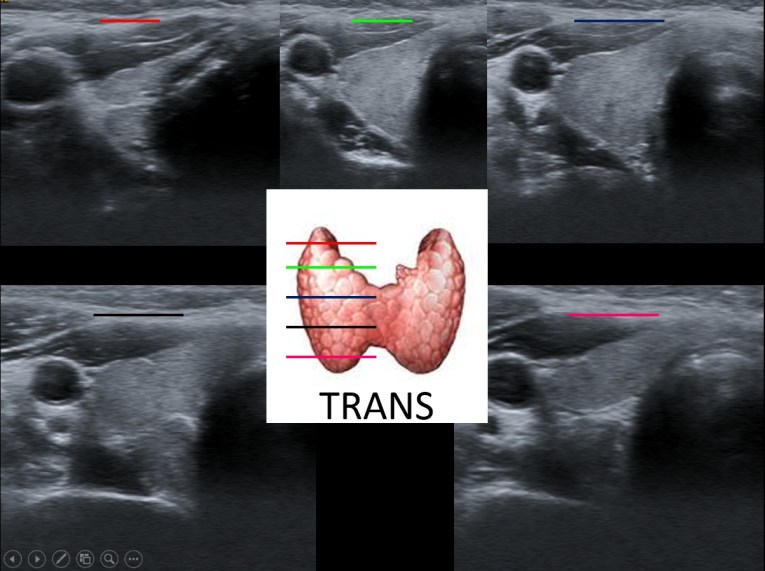
En la imagen superior ves una serie de cortes que nos sirven para realizar unas medidas:

Rojo: Medida derecha-izquierda

Verde: Medida antero-posterior

Azul: Medida antero-posterior del Istmo

Amarillo: Medida longitudinal del lóbulo

Rojo, Verde y Amarillo se repetirán en ambos lóbulos tiroideos.

Podemos realizar si lo deseamos unas fotos recorriendo de forma pormenorizada toda la estructura de la glándula tanto en transverso como en longitudinal. Así:

In the image above you see a series of cuts that help us to make some measurements: Red: Right-left measurement Green: Antero-posterior measurement Blue: Anteroposterior measurement of the Isthmus Yellow: Longitudinal measurement of the lobe Red, Green and Yellow will be repeated in both thyroid lobes. We can make some pictures if we want to go through in detail the entire structure of the gland both transverse and longitudinal. 
Cortes transversos de anterior a posterior.
Cortes Longitudinales desde externo a interno.

Los cortes están especificados en color y cada corte representado en la imagen anatómica de la estructura. No importa el sentido de los cortes, el caso es que valoremos la glándula en su totalidad.

En principio y salvo que se especifique en la petición, queda al margen del estudio las glándulas salivares, siempre que la clínica de la/el paciente no lo precise. Suelen ser estas glándulas objeto de estudio por otra clase de patologías.

En el próximo post veremos el protocolo en si, tal y como debes hacerlo para que sea valorado por un radiólogo.

The cuts are specified in color and each cut represented in the anatomical image of the structure. No matter the sense of the cuts, the case is that we value the gland in its entirety. In principle and unless specified in the request, salivary glands are excluded from the study, as long as the patient’s clinic does not require it. These glands are usually the object of study due to other types of pathologies. In the next post we will see the protocol itself, as you must do to be evaluated by a radiologist.

Como siempre te animo a compartir el Blog si lo consideras de utilidad.


34. Protocolos. Consideraciones.

Empezamos con la serie de protocolos que voy a desarrollar, siempre desde el punto de vista de mi profesión. No todos los profesionales de la Ecografía son médicos, en mi caso, mi objetivo no es diagnosticar, pero sí encontrar la mejor manera de conseguir la mejor imagen posible para poder darle al Radiólogo la oportunidad de ver lo que le pasa al/la paciente con la imagen técnicamente perfecta.

En esta serie de Post vas a poder ver cuales son las imágenes que tienes que realizar para poder tener un protocolo listo para presentar para la realización de un informe radiológico. Te voy a mostrar las imágenes de la región anatómica a estudio y como es el corte que tienes que realizar, pero desgraciadamente no puedo cogerte la mano para enseñarte a ejecutar la prueba, y es así como se aprende la Ecografía.

Te voy a enseñar los conceptos teóricos, pero la técnica de ejecución de un estudio se aprende ejecutando el estudio repetitívamente y enfrentándonos a gran cantidad de anatomías muy variopintas y vicisitudes que tienen que ver con la peculiaridad de cada paciente.

Como los protocolos son muy extensos los iré subiendo por partes y con números según la actualización que vaya realizando.

Sé que hay tutoriales que indican pormenorizadamente como colocar la sonda y donde para ver una estructura, pero desgraciadamente no vale con eso, no te frustres si no lo consigues a la primera, repite y repite teniendo clara, eso sí, la imagen que quieres conseguir.

La única manera de andar los primeros pasos en la Ecografía es como aprendí yo, como la experiencia me dice que tiene que ser, y que no es otra que dirigiéndote la mano al principio para que luego puedas caminar sola/o, eso se consigue en el centro de trabajo o taller práctico con una/un especialista.

Cuando empieces, vas a encontrarte en un mar de dudas, contacta conmigo por los canales del Blog que ya conoces en redes sociales, Facebook, Twitter, Instagram y en el mail ecografiafacil.com@gmail.com donde intentaré en la medida de lo posible contestar, incluso en los comentarios de cada Post, eso puede servir de enseñanza para otras/os que puedan tener las mismas dudas.

We start with the series of protocols that I will develop, always from the point of view of my profession. Not all professionals of the Ultrasound are doctors, in my case, my goal is not to diagnose, but to find the best way to get the best possible image to be able to give the radiologist the opportunity to see what happens to the patient. the technically perfect image. In this series of Post you will be able to see which are the images that you have to perform in order to have a protocol ready to present for the realization of a radiological report. I’m going to show you the images of the anatomical region to study and how is the cut you have to make, but unfortunately I can not take your hand to teach you how to run the test, and that is how you learn the ultrasound. I’m going to teach you the theoretical concepts, but the technique of running a study is learned by performing the study repetitively and facing a lot of very diverse anatomy and vicissitudes that have to do with the peculiarity of each patient. As the protocols are very extensive, I will upload them in parts and with numbers according to the update that I am making. I know there are tutorials that indicate in detail how to place the probe and where to see a structure, but unfortunately it is not worth it, do not get frustrated if you do not get it the first time, repeat and repeat having clear, yes, the image you want to get . The only way to walk the first steps in the Ultrasound is how I learned, as experience tells me that it has to be, and that it is nothing other than directing your hand at the beginning so that you can then walk alone, that is achieved in the work center or practical workshop with a specialist. When you start, you will find yourself in a sea of ​​doubts, contact me through the channels of the Blog that you already know in social networks, Facebook, Twitter, Instagram and in the email ecografiafacil.com@gmail.com where I will try as much as possible answer, even in the comments of each Post, that can serve as a teaching for others who may have the same doubts.

Un consejo, no empieces por el tejado, recorre todos los Post, la técnica y la física son vitales, así como los parámetros, no te olvides de esto…ah¡ super importante, la anatomía, para reconocer estructuras ecográficas debemos conocer perfectamente la antomía de dicha estructura.Esto es vital, no puede uno enfrentarse a la realización de un estudio sin conocer, así que repasa siempre la anatomía, enlazaré en cada Post con alguna página donde puedas repasar la anatomía.

Ánimo, es fácil¡¡¡…bueno, no tanto…jejej…

Empezamos¡¡¡¡

An advice, do not start on the roof, go through all the Post, technique and physics are vital, as well as the parameters, do not forget this … ah, super important, anatomy, to recognize ultrasound structures we must know perfectly the antimony of this structure. This is vital, you can not face the realization of a study without knowing, so always review the anatomy, link in each post with a page where you can review the anatomy. Courage, it’s easy … well, not so much … jejej … We started! ¡¡¡

33. La Imagen.Características y Planos de corte.

La imagen en ecografía es muy fácil de identificar si la vemos,pero ¿sabemos identificar aquello que nos cuenta la imagen de ecografía que no es el tejido que estamos estudiando?…Sí, nadie le hace mucho caso a eso, por eso voy a intentar explicarlo.

Lo primero que tenemos que saber es que una imagen de ecografía es una imagen DICOM.

Una de las características más curiosas de la imagen de ecografía es que una vez que le damos al botón destinado a hacer una foto de aquello que nos interese guardar, la captura que hace el equipo es de toda la imagen, incluido el nombre, por lo que es imposible, una vez enviado a PACS, corregir el nombre del paciente en el supuesto caso que nos hubiésemos confundido de paciente o hubiésemos puesto mal sus datos personales o de filiación. Habría que corregirlo en el equipo (si tuviésemos dicha opción) o volver a hacer el estudio con los datos correctos y volver a enviarlo.

The ultrasound image is very easy to identify if we see it, but do we know what the ultrasound image tells us is not the tissue we are studying? … Yes, nobody pays much attention to that, that’s why I’m going to try to explain it. The first thing we need to know is that an ultrasound image is a DICOM image. One of the most curious features of the ultrasound image is that once we click on the button to take a picture of what we want to save, the capture made by the team is of the whole image, including the name, so that it is impossible, once sent to PACS, to correct the name of the patient in the event that we had been confused as a patient or we had misplaced their personal or filiation data. It would have to be corrected in the team (if we had that option) or redo the study with the correct data and send it back.
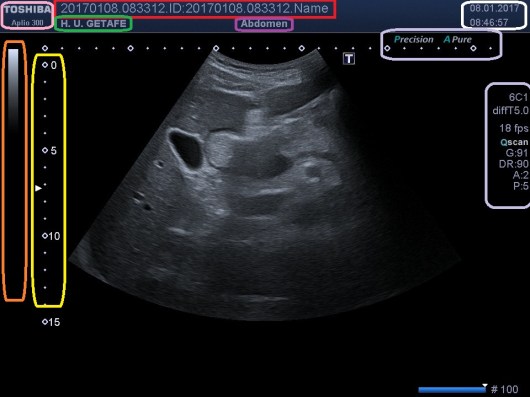
Lo que nos cuenta la imagen.

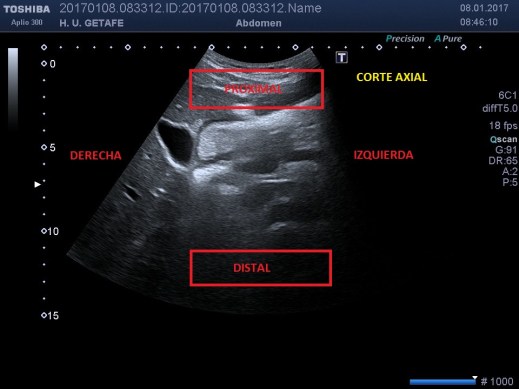
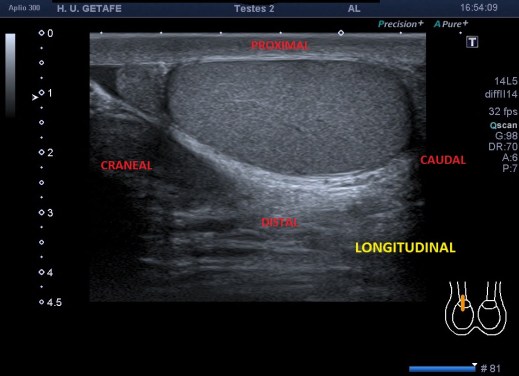
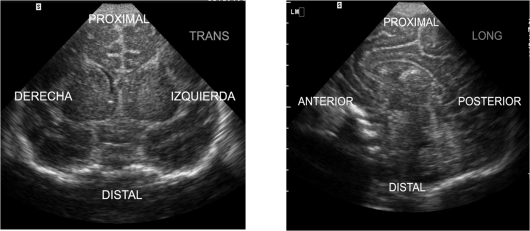
Por otro lado en la imagen de ecografía aparecen siempre con la imagen del tejido a estudiar, datos como la profundidad y posición del foco (amarillo), además una escala de grises y los datos básicos con los que hemos realizado el estudio,Ganancia General Rango Dinámico uso de armónicos o no, junto a la Frecuencia, también cuántas imágenes de Cine tenemos guardadas y otros filtros o parámetros técnicos que estemos usando, pero esto último no se da en todos los casos.

On the other hand, in the ultrasound image they always appear with the image of the tissue to be studied, data such as the depth and position of the focus (yellow), as well as a gray scale and the basic data with which we have carried out the study. General Gain Range Dynamic use of harmonics or not, along with the frequency, also how many movie images we have saved and other filters or technical parameters that we are using, but the latter does not occur in all cases.

Datos de ajustes ecográficos.

Índices Mecánicos y Térmicos siempre que fuera necesario saber su valor.

Datos de índice mecánico.

Me parece indispensable que aparezca siempre La Frecuencia.

Además del nombre del/de la paciente, debe aparecer su edad y el sexo.

Por supuesto la fecha y la hora de realización del estudio.También la marca e incluso el modelo de la marca comercial, el preseteado que hemos escogido para realizar el estudio y me parecería obligatorio que apareciese la identificación del responsable de la realización de la exploración. Además la institución donde se realiza el estudio.

Muy bien, pero ¿cómo se consigue la imagen de ecografía? Es decir, ¿cuales son los planos de corte?

La base está en la colocación del transductor. La sonda que estemos usando tiene colocarse de manera que la derecha del paciente se sitúe a la derecha de la imagen en nuestro monitor, que corresponde a nuestra mano izquierda, si estamos realizando un corte axíal, para ello, tocaremos en uno de los dos lados de la huella (la parte gris) de la sonda con un dedo con un poco de gel y con la imagen descongelada, una vez que veamos en la pantalla donde se mueve nuestro dedo comprobaremos si ese movimiento marca la derecha de la imagen, entonces si es así, pondremos ese lado de la sonda a la derecha del paciente, si no,giraremos la sonda. De este modo, la derecha del paciente será la derecha de nuestro monitor.

It seems to me indispensable that Frequency always appear. In addition to the name of the patient, your age and gender must appear. Of course the date and time of conducting the study. Also the brand and even the model of the commercial brand, the preset that we have chosen to carry out the study and it would seem mandatory that the identification of the person responsible for carrying out the exploration should appear. In addition, the institution where the study is carried out. All right, but how do you get the ultrasound image? That is, what are the cutting planes? The base is in the placement of the transducer. The probe that we are using has to be placed so that the right of the patient is placed to the right of the image on our monitor, which corresponds to our left hand, if we are performing an axial cut, for this, we will touch on one of the two sides of the footprint (the gray part) of the probe with a finger with a little gel and with the image thawed, once we see on the screen where our finger moves we will check if that movement marks the right of the image, then if that is, we will put that side of the probe to the right of the patient, if not, we will rotate the probe. In this way, the patient’s right will be the right of our monitor.
Corte axial.

En esta imagen, vemos colocado todo correctamente, la vesícula a la derecha de la imagen y el hígado también, si hubiésemos colocado mal la sonda en este corte axial, el hígado aparecería a la izquierda de la imagen.

Si el corte es longitudinal, igual, pero en este caso haremos coincidir la sonda con la parte que corresponda a la derecha de la imagen y la zona craneal del paciente, así tendremos que la derecha de la pantalla es la parte craneal del paciente y la izquierda, la zona caudal.

In this image, we see everything correctly placed, the gallbladder to the right of the image and the liver also, if we had placed the probe wrong in this axial section, the liver would appear to the left of the image. If the cut is longitudinal, equal, but in this case we will match the probe with the part that corresponds to the right of the image and the cranial area of ​​the patient, so we will have that the right of the screen is the cranial part of the patient and the left, the caudal zone.
Corte Longitudinal.

En esta imagen del testículo, el epidídimo que se ve, isoecogénico sobre el teste derecho, aparecería en la región caudal, pudiendo llevar a error si la sonda estuviese mal posicionada en el corte longitudinal (observa el pictograma).

Este método nunca os va a fallar, ya que hay sondas que tienen muescas para guiarnos, incluso en la pantalla, algún tipo de letra que nos indique la derecha, pero puede llevar a equívoco y por tanto, no lo recomiendo de base.

Una mala posición de la sonda hará que la imagen se mueva al revés y provocará un conflicto en la visualización del operador que al principio podemos no reconocer, pero que con un poco de práctica identificaremos rápidamente.

Esto no es así en todos lo casos, por ejemplo, en el estudio transfontanelar de la cabeza de un/una paciente neonato, como usamos la fontanela anterior, el corte que denominamos transverso, es un corte coronal de la cabeza de la criatura, siendo impepinable que la derecha de la pantalla sea la derecha de la cabeza del o de la paciente. En el corte longitudinal de este estudio la derecha de la pantalla corresponderá a la cara o región anterior de la cabeza y la izquierda, a la parte occipital de la cabeza o posterior.

In this image of the testicle, the epididymis that is seen, isoechogenic on the right testis, would appear in the caudal region, possibly leading to an error if the probe was incorrectly positioned in the longitudinal section (observe the pictogram). This method will never fail you, since there are probes that have notches to guide us, even on the screen, some type of letter that tells us the right, but it can lead to misunderstandings and therefore, I do not recommend it as a base. A bad position of the probe will cause the image to move backwards and will cause a conflict in the visualization of the operator that at the beginning we may not recognize, but with a little practice we will identify quickly. This is not the case in all cases, for example, in the transfontanel study of the head of a neonatal patient, as we use the anterior fontanelle, the cut we call transverse, is a coronal cut of the head of the creature, being impepinable that the right of the screen is the right of the head of the patient. In the longitudinal section of this study, the right side of the screen will correspond to the face or anterior region of the head and left, to the occipital part of the head or posterior.
Eco Transfontanelar. Distinta orientación.

Lo que es siempre fijo es que la parte donde apoya el transductor en la piel del paciente es la parte superior de la imagen y la parte más profunda es la parte más profunda del tejido que estemos estudiando.

Una cosa más, en ocasiones podemos ver u oír llamar Eje Largo al corte Longitudinal y Eje Corto al Axial, es muy típico de la ecografía muscular. En estos casos, yo prefiero hablar de axial y longitudinal en función de la colocación de la sonda, no del músculo o tendón ya que su colocación puede llevar a error.

What is always fixed is that the part where the transducer rests on the skin of the patient is the upper part of the image and the deepest part is the deepest part of the tissue that we are studying. One more thing, sometimes we can see or hear call Long Axis Longitudinal cut and Short Axial Axial, is very typical of muscle ultrasound. In these cases, I prefer to talk about axial and longitudinal depending on the placement of the probe, not the muscle or tendon since its placement can lead to error.
Otras denominaciones.

Cabe considerar que en ecografía siempre trabajamos en función del tejido a estudio y los planos de colocación de los tejidos no respetan los ejes del espacio puros. Por eso aunque hablemos de corte axiales, longitudinales, pueden ser en función del órgano o de la colocación del transductor, es importante tener la idea clara en nuestro centro de trabajo y protocolos de uso diario.

Axial, transverso o eje corto es igual, Longitudinal, eje largo y sagital, también significa lo mismo.

It should be considered that in ultrasound we always work according to the tissue under study and the planes of tissue placement do not respect the pure space axes. For that reason, although we speak of axial, longitudinal cuts, they can be in function of the organ or the placement of the transducer, it is important to have the clear idea in our center of work and protocols of daily use. Axial, transverse or short axis is equal, Longitudinal, long and sagittal axis, also means the same.