137. El Bazo errante.

A veces ves cosas con la ecografía que si no es porque las estás viendo no podrías imaginar que pasan. En el caso que te presento en este breve post te cuento el hallazgo casual de una figura patológica y muy rara que tuve la oportunidad de estudiar hace ya unos años.

Se trata de una situación anatómica anómala del Bazo. El bazo es un órgano de todxs conocemos. Aquí en el Blog hemos tratado la visualización normal de esta es estructura, en el Post 52.

No es necesario recordar la anatomía a estas alturas, ni su localización, solo quiero que veas la imagen siguiente:

Sometimes you see things with the ultrasound that if it is not because you are seeing them you could not imagine what happens. In the case that I present in this brief post I tell you the chance finding of a pathological figure and very rare that I had the opportunity to study a few years ago.

It is an anomalous anatomical situation of the spleen. The spleen is an organ of todxs we know. Here in the Blog we have treated the normal visualization of this structure, in the Post 52.

It is not necessary to remember the anatomy at this point, nor its location, I just want you to see the following image:
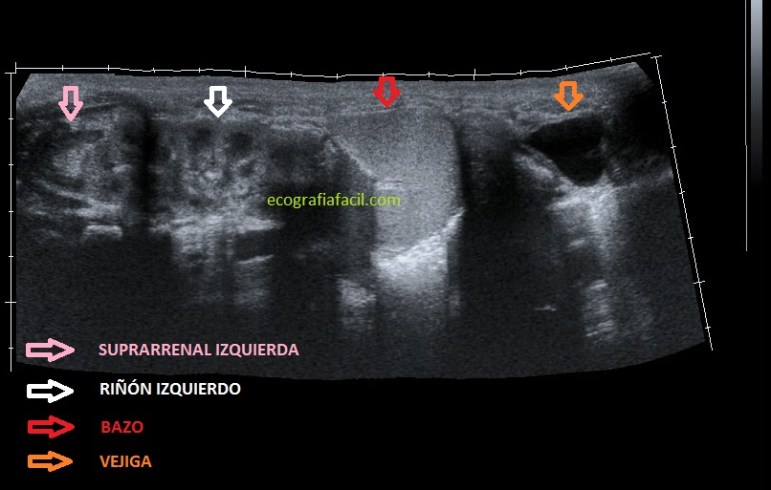
Te cuento: En una exploración ecográfica rutinaria, con sonda de alta frecuencia, de una/un paciente, era una/un neonato, empecé por la vejiga, como siempre que exploramos a lxs pacientes pediátricxs que no controlan la micción, recorrí su lado derecho estudiando Riñón derecho, Hígado y Páncreas, ya en la línea media. Al dirigirme al hipocondrio izquierdo a la búsqueda del Bazo me encontré solo su ausencia y enseguida percibí el Riñón izquierdo acompañado de su Suprarrenal, pero en el teórico lugar del Bazo, nada, continué el estudio y viendo el riñón izquierdo en su polo distal observé una imagen hiperecogénica, homogénea que recordaba al Bazo, me tuve que asegurar que tenía el transductor bien posicionado y que todo el aspecto técnico era correcto, delante de mí tenía un Bazo situado distal respecto del Riñón izquierdo, lo corroboré cuando vi la vejiga justo después del Bazo.

No tuve por más que usar el Panorama, ajuste ecográfico que me permite superponer varias imágenes mientras realizo un movimiento contínuo sobre el tejido explorado, ideal para estudiar distancias grandes, como era este caso, necesitaba estudiar todo el flanco izquierdo de la/el paciente.

De esta manera conseguí la imagen que tienes ante ti, mira y compara con la anatomía normal, observa la Suprarrenal, hipoecogénica en forma de boomerang, después el Riñón Izquierdo donde podemos ver nítidamente un  corte longitudinal con ambos polos, inmediatamente distal el Bazo, y después la forma anecoica de la Vejiga.

Este posicionamiento anómalo se conoce como Bazo errante.

I tell you: In a routine ultrasound scan of a patient, I was a / neonate, I started with the bladder, as we always explore pediatric patients who do not control urination, I traversed his right side studying right kidney, liver and pancreas , already in the middle line. When I went to the left hypochondrium to search for the spleen, I found only its absence and then I perceived the left kidney accompanied by its suprarenal, but in the theoretical place of the spleen, nothing, I continued the study and seeing the left kidney at its distal pole I observed a hyperechoic, homogenous image that reminded the spleen, I had to make sure that I had the transducer well positioned and that all the technical aspect was correct, in front of me I had a spleen located distal to the left kidney, I corroborated it when I saw the bladder just after the Spleen.

I did not have to use the Panorama, an ultrasound adjustment that allows me to superimpose several images while making a continuous movement on the scanned tissue, ideal to study large distances, as it was in this case, I needed to study the entire left flank of the patient.

In this way I got the image that you have before you, look and compare with the normal anatomy, observe the adrenal, hypoechoic in the form of a boomerang, then the left kidney where we can clearly see a longitudinal section with both poles, immediately distal the spleen, and then the anechoic form of the bladder.

This anomalous positioning is known as the wandering Spleen.

Esos día malos que te hacen retroceder años…
 

136. Los Ganglios.

Es una parte de la anatomía muy estudiable con ecografía, además son objeto de estudio citológico y histológico con guía ecográfica.

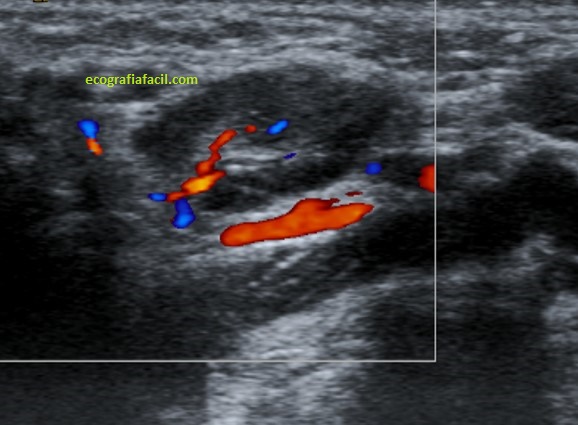
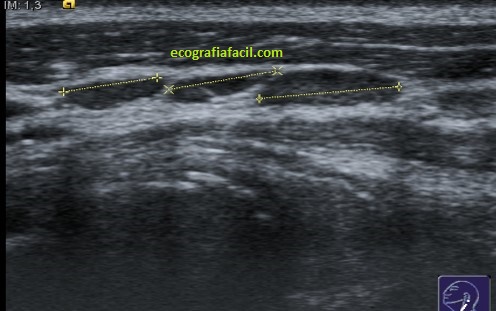
El Ganglio linfático es una estructura ecográficamente ovalada, hiperecogénica en el centro, hipoecogénica en el exterior y con vascularización mediante una arteria y una vena, doppler color mediante, en cada uno de los ganglios que estudiemos. Cuando se inflaman por el motivo que sea modifican su aspecto normal y suelen volverse hipoecogénicos y aumentan su tamaño habitual, incluso deformando su estructura.

Donde mejor vamos a ver estas estructuras en el cuello, en las axilas y en ambas ingles porque son mucho más superficiales.Por tanto las estudiaremos siempre con sondas de alta frecuencia, en ocasiones, si son muy profundas, las podemos ver con sondas de baja frecuencia, pero se perderá la resolución.

Es habitual ver estas estructuras en el abdomen cercanas a la Vena Porta en pacientes de Pediatría.

En adultos, pueden también ser visibles retroperitoneales siempre en relación con algún tipo de patología, es decir, normalmente no se deben observar.

Los ganglios tienen que ser estudiados siempre en un contexto de edad, en infantiles y adolescentes los ganglios son mucho más visibles que en adultos.

It is a very anatomical part of the anatomy with ultrasound, they are also subject of cytological and histological study with ultrasound guidance.

The lymph node is a structure oval ultrasound, hyperechoic in the center, hypoechoic in the outside and vascularized by an artery and a vein , color Doppler using, in each of the ganglia that we study.

When they are inflamed for whatever reason they change their normal appearance and tend to become hypoechoic and increase their normal size, even deforming their structure.

Where better we will see these structures in the neck, in the armpits and both groin because they are much more superficial.

Therefore we will always study them with high frequency probes, sometimes, if they are very deep, we can see them with low frequency probes, but the resolution will be lost. It is usual to see these structures in the abdomen near the portal vein in patients of Pediatrics. In adults, they can also be visible retroperitoneal always in relation to some kind of pathology, that is, normally they should not be observed.

The lymph nodes have to be studied always in an age context, in children and adolescents the lymph nodes are much more visible than in adults.


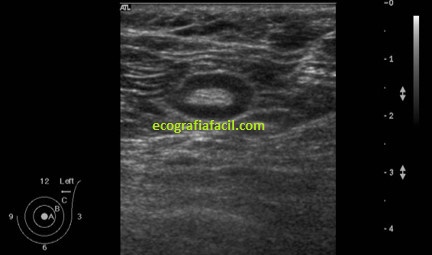
En la imagen superior vemos un ganglio normal. Centro graso hiperecogénico y la corteza hipoecogénico.


En la imagen superior vemos un ganglio normal con vascularización normal. Centro graso hiperecogénico y la corteza hipoecogénico.


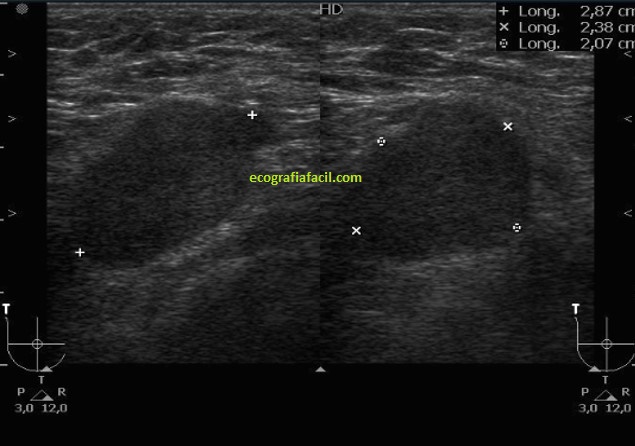
En la imagen superior vemos un ganglio patológico.Ausencia de centro graso. Aumento del tamaño de la estructura.


En la imagen superior vemos un ganglio patológico.Hiperactividad vascular.

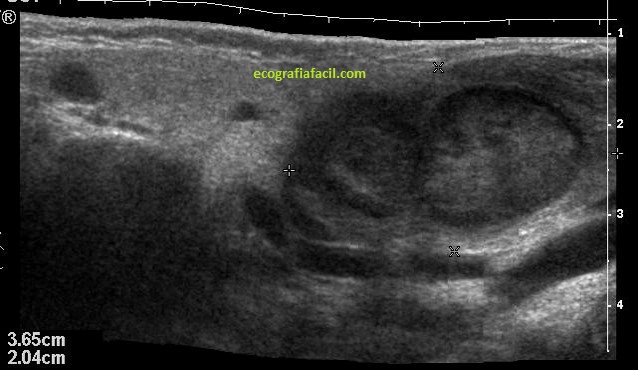
Cuando los ganglios son afectados por patología locoregional, pueden estar modificados en su ecoestructura. Suelen cambiar su estructura y se vuelven más grandes e hipoecogénicos. Pueden estar afectados por infecciones, donde los ganglios son reactivos y normalmente mantienen su forma alargada.Si están afectados por procesos oncológicos pueden ser de tipo primario o por metástasis y su aspecto varía en tamaño (aumentan), en ecogenicidad (hipoecogénica) y pierden su forma alargada adoptando un aspecto más redondo.

When the lymph nodes are affected by locoregional pathology, they can be modified in their echoestructure. They tend to change their structure and become larger and more hypoechoic. They can be affected by infections, where the lymph nodes are reactive and normally maintain their elongated shape. If they are affected by oncological processes they can be primary or metastatic and their appearance varies in size (increase), in echogenicity (hypoechoic) and lose their elongated shape adopting a rounder appearance.

Ganglios reactivos
Ganglio de aspecto metastásico.

En la imagen anterior vemos el típico ganglio centinela en la mama, es el aspecto típico de un ganglio «feo» de aquellos que en la ecografía de mama siempre levantan sospechas.

Cuestión para estudiar son los ganglios en pacientes de pediatría por las adenitis, mayoritariamente cervicales…Mira:

  • LA MAYORÍA DE LAS MASAS CERVICALES PEDIÁTRICAS SON SECUNDARIAS A LINFADENITIS AGUDA, RESPONDE BIEN A TRATAMIENTO MÉDICO
  • LA ECO ÚTIL PARA EL SEGUIMIENTO DE PROCESOS INFLAMATORIOS AGUDOS
  • EN ECO:

–MASAS HIPOECOGÉNICAS HOMOGÉNEAS DE DIFERENTE TAMAÑO, PATOLÓGICO POR ENCIMA DE 1 CM

–EL DOPPLER-COLOR MUESTRA VASOS EN EL CENTRO HILIAL

–SI SE CONVIERTEN EN ABSCESOS LA IMAGEN OFRECE UNA PARED IRREGULAR CON LUCENCIA CENTRAL

MOST OF THE PEDIATRIC CERVICAL MASSES ARE SECONDARY TO ACUTE LYMPHENENITIS, RESPONDS WELL TO ECO-USED MEDICAL TREATMENT FOR FOLLOWING ACUTE INFLAMMATORY PROCESSES:

HOMOGENEOUS HYPOOGENIC MASSES OF DIFFERENT SIZE, PATHOLOGICAL ABOVE 1 CM-THE DOPPLER-COLOR SHOWS VESSELS IN THE HILIAL CENTER-IF THEY ARE BECOMING ABSTRACTS THE IMAGE OFFERS AN IRREGULAR WALL WITH CENTRAL LUCENCY.

Adenitis cervical.

En la ecografía de mama también tenemos algunas consideraciones básicas a tener en cuenta:

1.Aumento de tamaño.

2.Forma redondeada.

3.Engrosamiento de la corteza.

4.Indentación o muescas.

5.Desplazamiento hiliar.

6.Alteracion en la señal doppler.

7.El ganglio centinela es el primer ganglio metastásico.

1. Increase in size.2.Forma rounded.3.Engrosamiento cortex.4.Indentation or notches.5.Hilitary displacement.6.Alteracion in the Doppler signal.7.The sentinel node is the first metastatic ganglion.

Nada más maravilloso que el esfuerzo por perseguir sueños, da igual lo buenx que seas en algo, pero si te sobra el tesón…todo lo bueno llega…


135. El Tórax.

Así de repente te habrá parecido raro que estudiemos el Tórax con ecografía ya que el aire que contienen los pulmones hace que el estudio de esta anatomía sea prácticamente inservible, pero hay casos en los que es muy útil esta técnica, y es en aquellos casos donde dentro de los pulmones hay agua en cualquiera de sus densidades, por ejemplo, derrame pleural, pus o sangre…

TÉCNICA ECOGRÁFICA:

–SEGÚN TAMAÑO DEL PACIENTE, GENERALMENTE SE USARÁ SONDA DE 3,5 MHZ, pero en pacientes pediátricos podemos usar otras de frecuencia mayor.

–ABORDAJE SEGÚN PATOLOGÍA, si es un proceso neumónico o derrame pleural el abordaje será muy diferente. Desde luego si se trata de algún tipo de masa la técnica se adaptará a dicha patología.

La sonda lineal será muy buena para estudiar procesos que tengan que ver con la pleura.

La sonda cónvex para aquellos procesos más profundos que requieran, por ejemplo medidas previos a Toracocentesis.

EL PACIENTE:

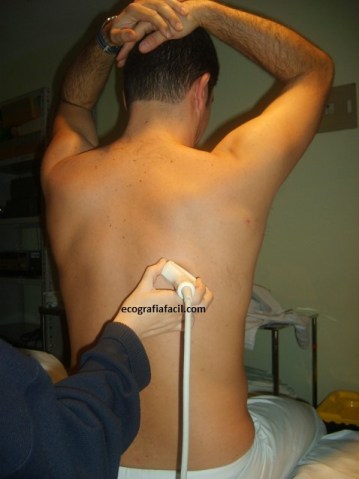
Normalmente la/el paciente debe estar sentadx dándonos la espalda, podemos subir el brazo del lado afectado y apoyarlo relajadamente en la cabeza.

Debemos buscar el espacio intercostal, las costillas serán nuestras peores enemigas, a través de los espacios que nos dejen veremos la patología.

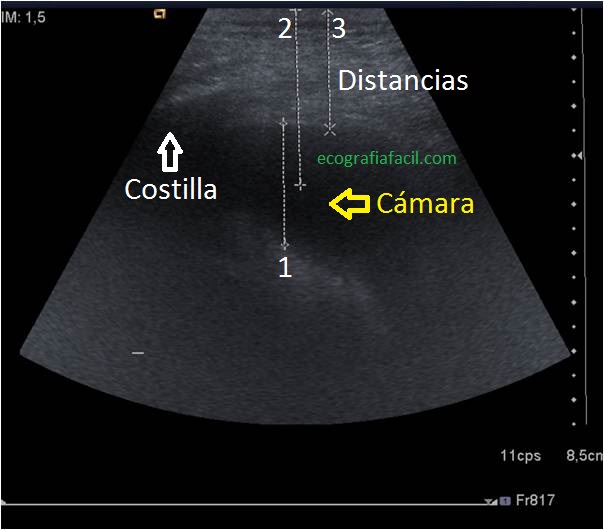
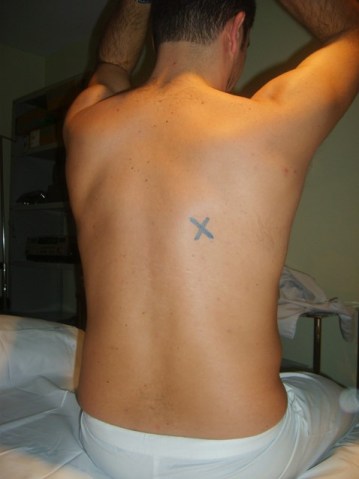
Si van a pinchar el derrame, marcaremos con una cruz la zona de punción, donde la cámara de líquido es mayor y mediremos dicha cámara y la distancia de la piel al derrame.

INDICACIONES

–MASAS QUÍSTICAS Y SÓLIDAS

–MASAS MEDIASTÍNICAS Y TIMO

–GUÍA ECOGRÁFICA PARA TORACOCENTESIS Y BIOPSIAS CON AGUJA fina o gruesa

–DERRAME PLEURAL

SIGNOS ECOGRÁFICOS:

–DETECCIÓN DE UN ESPACIO ANECOICO INMEDIATAMENTE POR DEBAJO DE LA PARED TORÁCICA

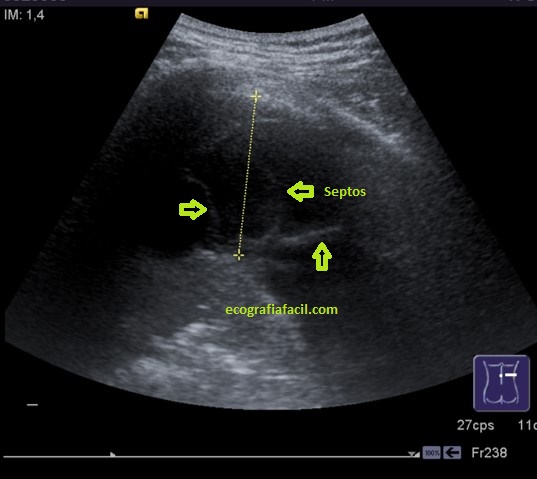
–PUEDE TENER SEPTOS

Podemos ver líquido, que se verá anecoico, normalmente derrames pleurales.

Podemos ver zona septadas, derrames «organizados», es decir, ya no son anecoicos, son heterogéneos y ecogénicos y están en relación con procesos infecciosos normalmente.

So suddenly it would have seemed strange to you to study the thorax with ultrasound since the air contained in the lungs makes the study of this anatomy practically useless, but there are cases in which this technique is very useful, and it is in those cases where within the lungs there is water in any of its densities, for example, pleural effusion, pus or blood …
ECHOGRAPHIC TECHNIQUE:
-PATIENT SIZE, USUALLY USED 3.5 MHZ PROBE, but in pediatric patients we can use other .
– APPROACH ACCORDING TO PATHOLOGY, if it is a pneumonic process or pleural effusion, the approach will be very different. Of course if it is some kind of mass the technique will adapt to this pathology. The linear probe will be very good to study processes that have to do with the pleura.The probe convex for those deeper processes that require, for example, previous measurements Toracocentesis.
THE PATIENT: Normally the patient must be seated with his back to us, we can raise the arm of the affected side and support it in the head relaxed.We must look for the intercostal space, the ribs will be our worst enemies, through the spaces Let us see the pathology.If they are going to puncture the effusion, we will mark with a cross the puncture area, where the liquid chamber is larger and we will measure said chamber and the distance of the skin to the effusion.
INDICATIONS
-CHEMISTRY AND SOLID MASSES
-MEDIASTÍNICS MASSES AND TIMO
-ECOGRAPHIC GUIDE FOR TORACOCENTESIS AND BIOPSIES WITH THICK OR LARGE NEEDLE
-ECHOGRAPHIC PLEURALSIGNAL SPILL:
-DETECTION OF AN ANECOTIC SPACE and INMEDIATELY UNDER THE THORACIC WALL
-MAY BE SEPED We can see fluid, which will look anechoic, usually pleural effusions. We can see septate area, «organized» spills, that is, they are no longer anechoic, they are heterogeneous and echogenic and are related to infectious processes normally.

En esta primera imagen vemos una cámara líquida correspondiente a un derrame pleural y las medidas estándar que realizamos como información previa a la Toracocentesis.

In this first image we see a liquid chamber corresponding to a pleural effusion and the standard measurements that we made as prior information to the Toracocentesis.

La colocación de la/el paciente, como buscamos el lugar idóneo donde la cámara líquida o lo que vaya a ser pinchado y cómo marcar el lugar correcto.

The placement of the patient, as we look for the ideal place where the liquid chamber or what is going to be punctured and how to mark the right place.

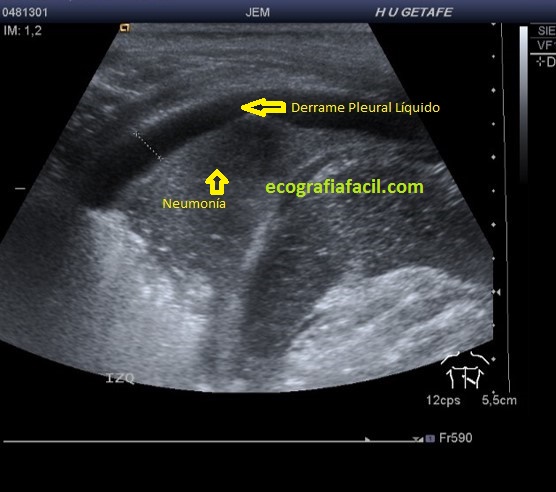
No siempre vemos una cámara líquida, también podemos ver diferentes tipos de formas de «agua», como la sangre o el moco y el pus de un proceso neumónico y como todas esas densidades se diferencia maravillosamente con ecografía.Esta imagen superior es un ejemplo perfecto.

We do not always see a liquid chamber, we can also see different types of «water» forms, like blood or mucus and pus from a pneumonic process and like all those densities it differs beautifully with ultrasound. This superior image is a perfect example.

En algunas ocasiones cuando el derrame evoluciona negativamente, podemos ver septos en su interior, como imágenes hiperecogénicas lineales dentro de la cámara.

On some occasions when the effusion evolves negatively, we can see septa inside it, as linear hyperechoic images inside the camera.

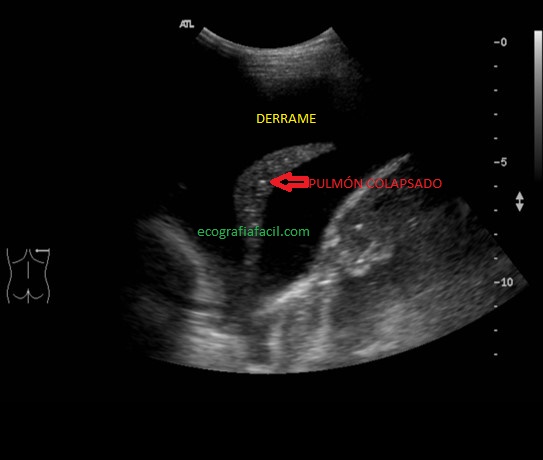
En otras ocasiones podemos ver pulmón colapsado y «flotando» literalmente en la cámara líquida, como señala la flecha roja de la imagen superior.

At other times we can see lung collapsed and «floating» literally in the liquid chamber, as indicated by the red arrow in the image above.

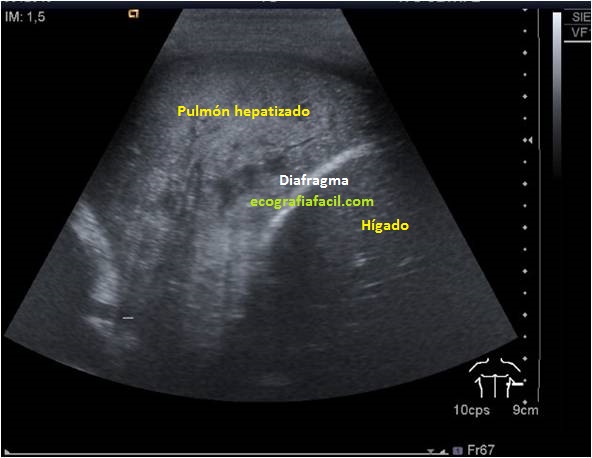
Una preciosa imagen que podemos ver habitualmente es estas patologías es el «Pulmón Hepatizado».Es una figura patológica producida por la compactación patológica del pulmón a consecuencia de un proceso infeccioso habitualmente. Tiene un aspecto muy similar al Hígado, y a veces solo podemos diferenciarlos por la separación que se produce por el Diafragma, como te enseño en la imagen superior.

A precious image that we can usually see is these pathologies is the «Hepatized Lung». It is a pathological figure produced by the pathological compaction of the lung as a result of an infectious process usually. It looks very similar to the Liver, and sometimes we can only differentiate them by the separation produced by the Diaphragm, as I show you in the image above.

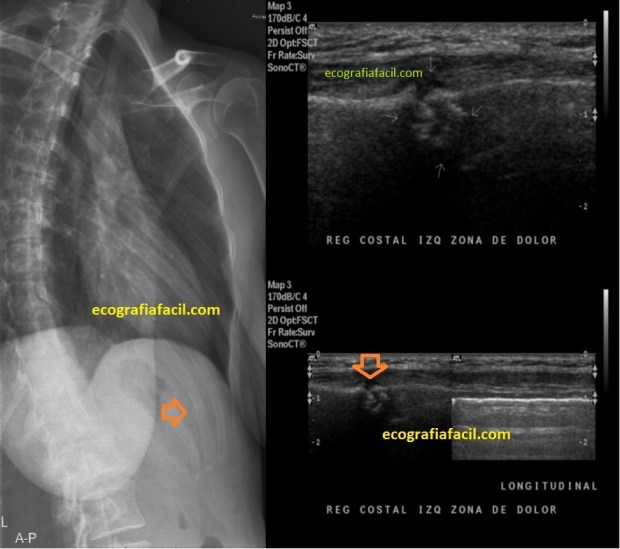
Las fracturas costales, a veces muy difíciles de ver con RX, podemos verlas en ecografía, como en esta imagen donde puedes ver costilla normal, lineal e hiperecogénica y a su lado la fractura en una costilla rota y su representación sobre la placa, prácticamente inapreciable.

The rib fractures, sometimes very difficult to see with RX, we can see them in ultrasound, as in this image where you can see normal, linear and hyperechoic rib and next to it the fracture in a broken rib and its representation on the plate, practically inappreciable.

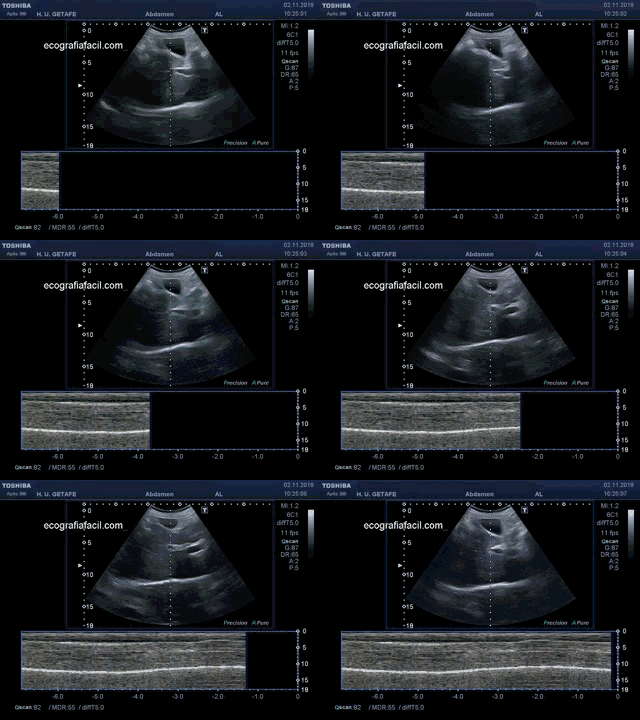
Finalmente y como método de estudio del diafragma, tenemos la representación en modo M donde vemos como colocar el roi lineal de puntos que mide la actividad del diafragma con la respiración y su representación como una línea curva en la gráfica mostrando el movimiento de dicho músculo en ese punto concreto.

Finally and as a method of studying the diaphragm, we have the M-mode representation where we see how to place the linear roi of points that measures the activity of the diaphragm with the breath and its representation as a curved line in the graph showing the movement of that muscle in that particular point.

Quiero agradecer a Paloma y a Gus por colaborar de un modo u otro a este Post…Muy afortunado de tener compis así…Muy afortunado.Muak.

A veces hay días duros, donde la creatividad y las ganas flojean, donde busco y no encuentro, donde no queda más remedio que seguir…escribiendo…


134. Fibromatosis Colli

Hoy te dejo este breve post, muy interesante, en este día duro, con muy pocas horas de sueño en el cuerpo y mucha tarde de Eco Muscular por delante…necesito mar…

En el punto 4.3.1 de este interesante enlace vas a descubrir lo que es la Fibromatosis Colli o Tortícolis congénita.

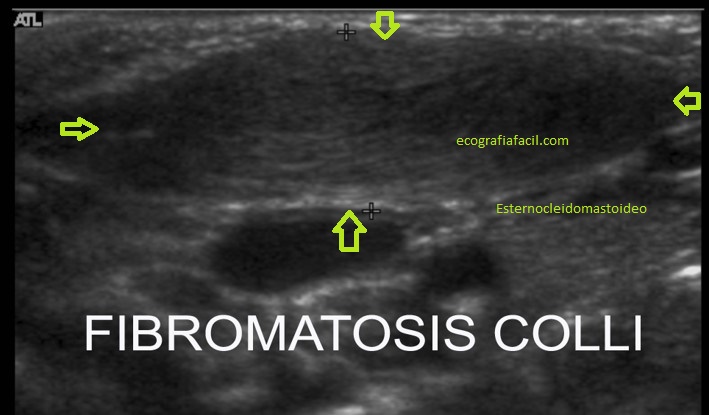
  • MASA QUE AFECTA PREDOMINANTEMENTE A LA CABEZA ESTERNAL DEL ESTERNOCLEIDOMASTOIDEO RELACIONADA CON TRAUMATISMO EN EL NACIMIENTO, entendiemdo traumatismo cualquier complicación en el parto que forzase a la criatura a nivel cervical.
  • SE PRESENTA EN EL PRIMER MES DE VIDA
  • TAMBIÉN CONOCIDA COMO TORTÍCOLIS CONGÉNITA


  • EN ECO:
  1. MASA ELÍPTICA Y LIGERAMENTE HIPOECOGÉNICA
  2. PUEDE SER BILATERAL
  3. ES CLAVE ORIENTAR EL CORTE LONGITUDINAL A LO LARGO DEL MÚSCULO ESTERNOCLEIDOMASTOIDEO

In point 4.3.1 of this interesting link you will discover what is Colli Fibromatosis or congenital Torticollis.

MASS THAT PREDOMINANTLY AFFECTS THE ESTERNAL HEAD OF ESTERNOCLEIDOMASTOIDEO RELATED WITH TRAUMATIS IN BIRTH, understandably traumatism any complication in childbirth that forced the creature at the cervical level.

IT APPEARS IN THE FIRST MONTH OF LIFE

IT IS KNOWN AS TORTÍCOLIS CONGÉNITAEN ECO: MASS elliptical AND SLIGHTLY HIPOECOGÉNICA

We must do THE LONGITUDINAL CUT ALONG THE MUSCLE STERNOCLEIDOMASTOID

Normal
Patológico

En la imagen superior ves un esternocleidomastoideo normal, fibras alargadas, grosor normal…El lado contralateral afectado lo ves más hipoecogénico y aumentado de tamaño en la imagen inferior

La/el paciente puede venir con una deformidad en el lado del cuello afectado, con la cabeza girada al lado en cuestión.

Haremos cortes longitudinales y transversales de ambos esternocleidomastoideos  desde su inserción proximal a su inserción distal comparando ambos lados.

Necesitaremos ayuda de algún familiar para mantener quieto a la/el paciente.

In the image above you see a normal sternocleidomastoid, elongated fibers, normal thickness … The affected contralateral side is more hypoechoic and enlarged. The patient may come with a deformity on the affected neck side, with the head turned to the side in question. We will make longitudinal and transverse cuts of both sternocleidomastoids from their proximal insertion to their distal insertion comparing both sides. We will need help from a relative to keep the patient quiet.


Los años han pasado…no importa lo que pase, no nos separarán…contigo hasta el final…

133. El Contraste en Ecografía. El Nódulo hepático.

Te cuento el funcionamiento práctico del contraste ecográfico con un ejemplo, quizá el más habitual,  que es el procedimiento por el cual se estudia el nódulo hepático, patología que hallamos frecuentemente en las exploraciones de ecografía abdominal.

El estudio del nódulo hepático con contraste ecográfico tiene una precisión diagnóstica del 90%.

Se estudia según el comportamiento de la lesión una vez introducido el contraste

Indicaciones:

Loes en cirrosis o hepatitis crónica
Loes en pacientes oncológicos
Loes no concluyentes en otras técnicas

Procedimiento:

Explicamos al paciente el proceso y nos aseguramos de la firma del Consentimiento Informado.

Localizamos la lesión. Son pacientes a quien se le ha detectado en una técnica de imagen anterior un nódulo cuyo aspecto requiere ampliar el estudio, por eso no repetimos la ecografía, solo localizamos la lesión para empezar el estudio.

Coger una vía al paciente para administrar mediante un bolo el contraste.

El/la radiólogx comenzará la exploración manteniendo localizada la lesión en todo momento.

Ajustes ecográficos. Software apropiado y parámetros técnicos ajustado para una correcta visualización de la lesión.

Inyección según indicaciones del radiólogx. Administraremos el contraste cómo y cuando nos indiquen

Cine y grabaciones para evaluación posterior y ejecución del informe.

Fases:

Como en todo estudio de contraste tenemos tres fases para estudiar la lesión y su comportamiento, este comportamiento se refiere a tres modos de captación de contraste muy importante:

Grado de realce, es decir, cuanto realza, si brilla mucho o brilla poco o nada.

Patrón de realce, si lo hace centrípetamente o no, si es en anillo, si su realce es global, es decir, la forma en cómo realza la lesión.

Lavado, es decir, cómo pierde el contraste la lesión

3 Fases:

– Arterial:

No hay grandes diferencias entre malignidad o benignidad
Hasta los 45 seg.

– Portal
Hasta los 2 minutos.

– Tardía
Hasta los 6 minutos.

Según su comportamiento con el contraste, tendremos un diagnóstico.

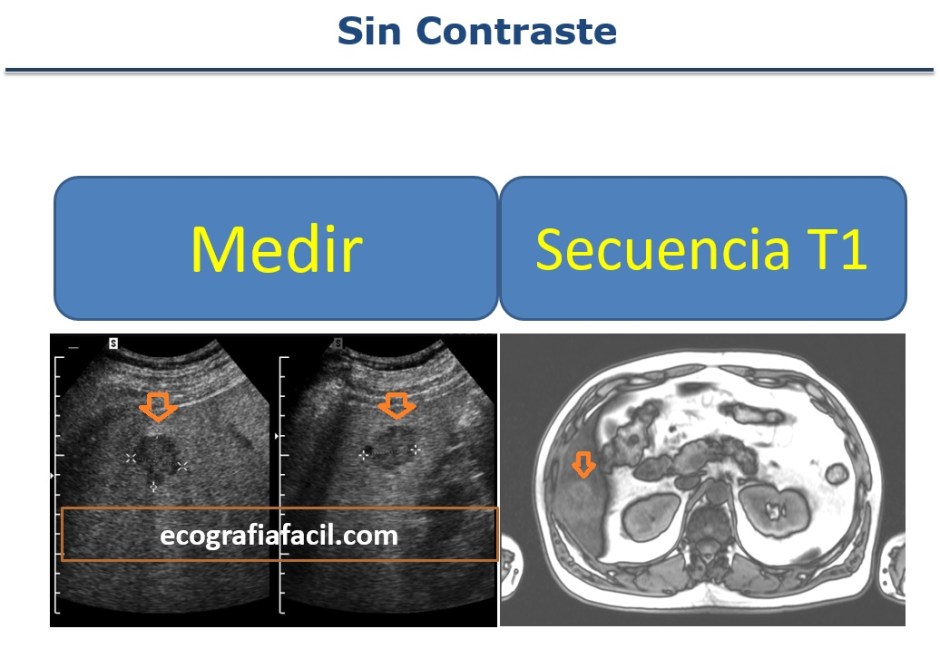
En imágenes y comparado con RMN Hepática con CIV del mismo paciente:

I tell you the practical operation of ultrasound contrast with an example, perhaps the most common, which is the procedure by which the liver nodule is studied, pathology that we frequently find in abdominal ultrasound scans.
The study of the hepatic nodule with ultrasound contrast has a diagnostic precision of 90%.
It is studied according to the behavior of the lesion once the contrast is introduced.
Indications:
Loes in cirrhosis or chronic hepatitis
Loes in oncological patients
Lois inconclusive in other techniques
Procedure:
We explain the process to the patient and we make sure the signature of the Informed Consent
We locate the injury. They are patients who have been detected in a previous imaging technique a nodule whose appearance requires further study, so we do not repeat the ultrasound, we only locate the lesion to start the study.
Choose a way to the patient to administer by bolus the contrast.
The radiologist will start the scan keeping the lesion localized at all times.
Ultrasound adjustments. Appropriate software and adjusted technical parameters for a correct visualization of the lesion.
Injection according to radiologist indications.
We will administer the contrast how and when they indicate usCine and recordings for later evaluation and execution of the report.
Phases:
As in any contrast study we have three phases to study the injury and its behavior, this behavior refers to three modes of very important
Contrast capture: Degree of enhancement, that is, how much it enhances, whether it shines a lot or shines little or nothing.
Pattern of enhancement, if it does centripetally or not, if it is in a ring, if its enhancement is global, that is, the way in which it enhances the lesion.
Lave, that is, how the contrast loses the lesion
3 Phases:
Arterial: There are no great differences between malignancy or benignityUp to 45 sec.-
Portal Up to 2 minutes.-
Late until 6 minutes.According to its behavior with contrast, we will have a diagnosis.
In images and compared with Hepatic MRI with CIV of the same patient:

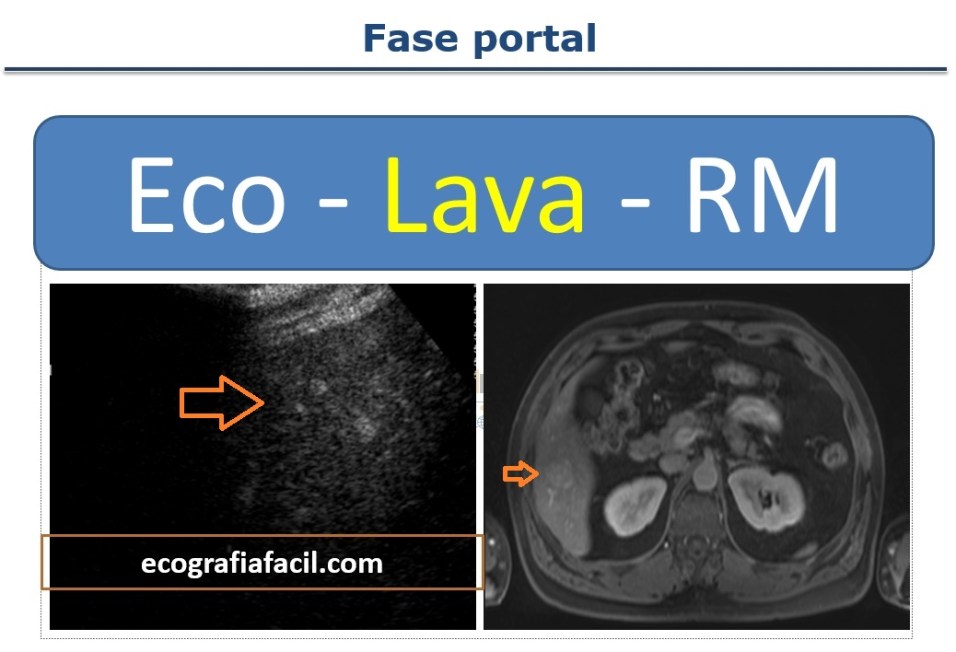
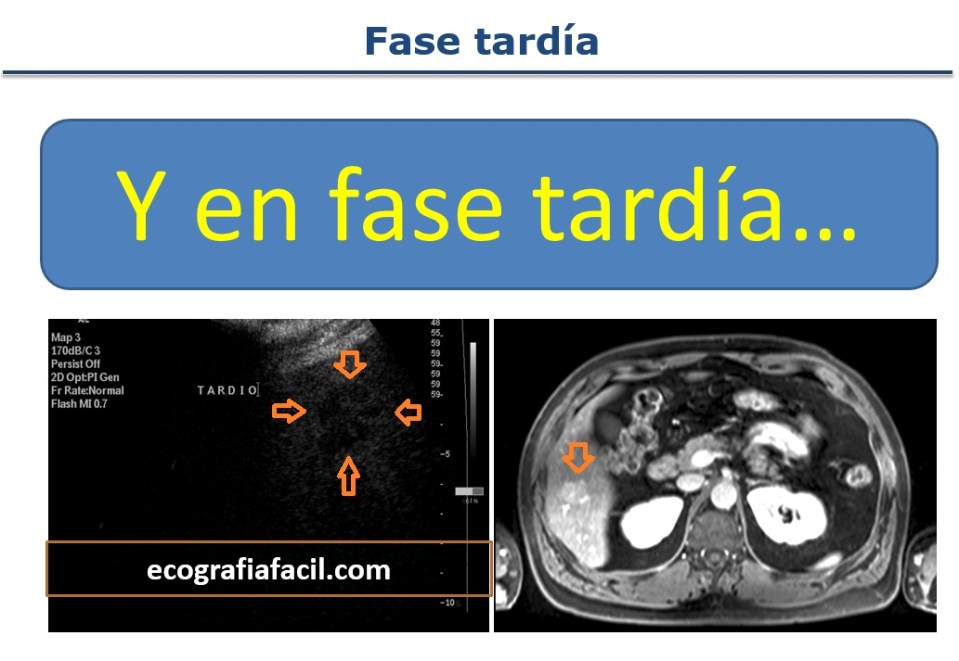
En la imágenes vemos 5 fases, las dos primeras técnicas donde la imagen sin contraste es medida y estudiada en diferentes potenciaciones en la RMN y en la Eco la estudiamos con y sin doppler.

Después viene la inyección del CIV y sus fases en las dos técnicas donde la lesión realza, se lava y en fase tardía…en fase tardía en la ecografía es donde las lesiones hepáticas nos muestran quien son en realidad.
«Se realiza ecografía abdominal visualizando en el LHD una lesión hipoecogénica de aproximadamente 3 cm. Tras inyección intravenosa de contraste  ultrasonografico se observa una captación temprana de la lesión con un realce muy importante y con una rápida pérdida de  realce siendo la lesión hipoecogénica en la fase tardía. Esto sugiere una lesión con un comportamiento que no es característico de lesión benigna por lo que recomendamos punción aspiración con aguja fina para diagnóstico citológico» Típico informe radiológico…Observa el detalle del comportamiento en fase tardía.

Bien, debemos conocer cómo se comportan las típicas lesiones hepáticas en las tres fases:

LESIÓN NODULAR FOCAL:

Hiperplásica

Hipervasvular causada por malformaciones vasculares.

REALCE COMPLETO HOMOGÉNEO (rueda de carro) + HIPER O ISO (lavado lento) + ISO O HIPER

HEMANGIOMA:

Lesión hipervascular de aporte arterial y flujo lento (habitualmente)

REALCE NODULAR PERIFÉRICO + RELLENO PROGRESIVO CENTRÍPETO + RELLENO COMPLETO

HÍGADO PRESERVADO y ESTEATOSIS

ISOCAPTACIÓN en las tres fases.

QUISTE:

AUSENCIA DE CAPTACIÓN

HEPATOCARCINOMA:

Lesiones hipervasculares de intenso flujo arterial y casi sin irrigación portal

–HIPER     +    ISO/HIPO   +   HIPO

METÁSTASIS:

Habitualmente hipovasculares en arterial.

CAPTACIÓN ANILLO + HIPO + HIPO

En resumen diremos que el contraste ecográfico es un método diagnóstico, eficaz y mínimamente invasivo donde observamos en las tres fases como se comporta la lesión, así como su grado de realce y su patrón de realce.

Podemos decir que aquellas lesiones que en la fase tardía se vuelven hipoecogénicas, y a tenor de cómo y cuanto realcen, normalmente siempre son lesiones que tienen que ver con procesos neoplásicos malignos.

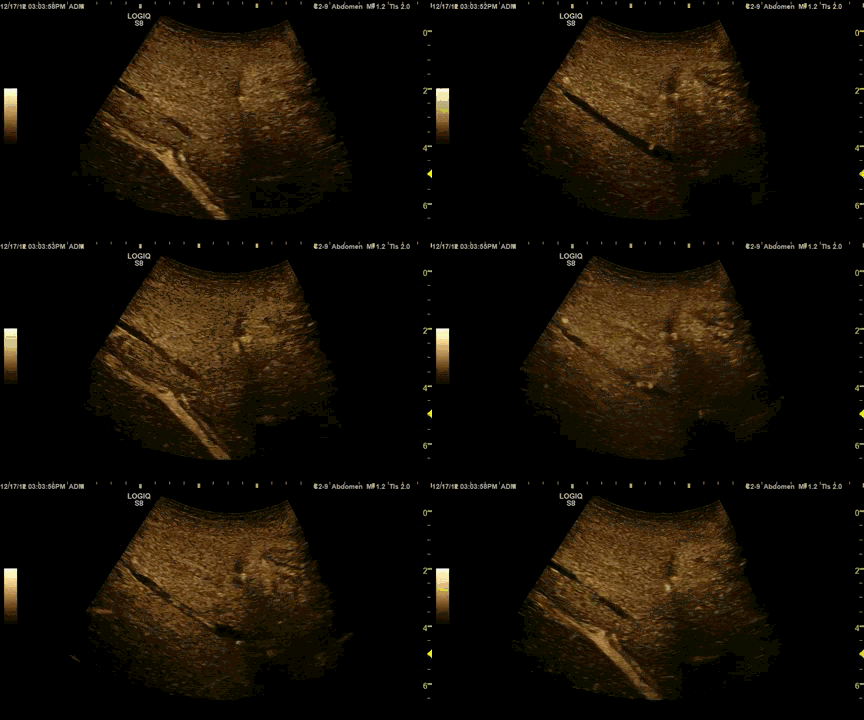
Por último te dejo unos ejemplos en vídeo de CIV Ecográfico, son típicos en el hígado, en el primero verás imágenes correspondientes al paso del contraste por los vasos hepáticos.

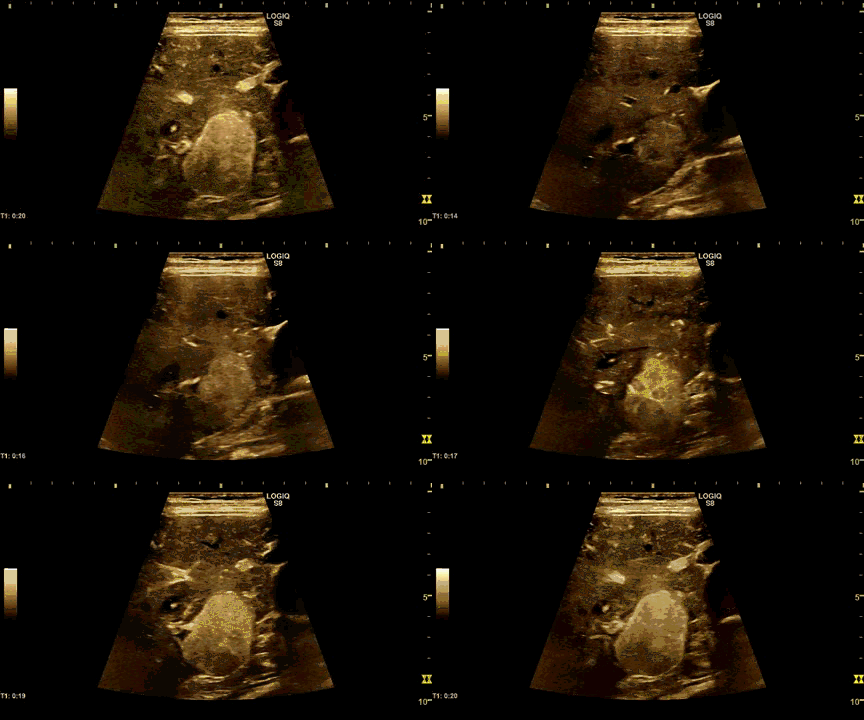
En el segundo vídeo un nódulo hepático captando contraste.

In the images we see 5 phases, the first two techniques where the image without contrast is measured and studied in different enhancements in the NMR and in the Echo we study it with and without Doppler.
Then comes the CIV injection and its phases in the two techniques where the lesion enhances, it is washed and in late stage … in late stage on ultrasound is where the liver lesions show us who they really are. «Abdominal ultrasound was performed visualizing in the LHD a hypoechoic lesion of approximately 3 cm. Intravenous injection of ultrasonographic contrast, an early uptake of the lesion with a very important enhancement and with a rapid loss of enhancement is observed, being the hypoechoic lesion in the late phase.This suggests a lesion with a behavior that is not characteristic of a benign lesion. We recommend fine needle aspiration for cytological diagnosis «Typical radiological report …
Observe the detail of the behavior late stage. Well, we must know how the typical liver lesions behave in the three phases:
FOCAL NODULAR INJURY: HyperplasticHypervasvular caused by vascular malformations.
FULL HOMOGENEOUS REACTION (cartwheel) + HIPER OR ISO (slow wash) + ISO O HYPER
HEMANGIOMA: Hypervascular injury of arterial supply and slow flow (usually)
PERIPHERAL NODULAR PERFORMANCE + CENTRIPPET PROGRESSIVE FILLING + PRESERVED COMPLETE
HILLET FILLING and ESTEATOSISISOCAPTATION in the three phases.QUALITY: ABSENCE OF CAPTATION
HEPATOCARCINOMA:
Hypervascular injuries of intense arterial flow and almost without portal irrigation
-HIPER + ISO / HIPO + HYPO
METASTASIS:
Usually hypovascular in arterial.
RIPPING RATE + HYPO + HYPO
In summary we will say that the ultrasound contrast is a diagnostic, effective and minimally invasive method where we observe in the three phases how the injury behaves, as well as its degree of enhancement and its pattern of enhancement.
We can that those lesions that in the late phase become hypoechoic, and how and how much they enhance, are usually always lesions that have to do with malignant neoplastic processes.
Finally I leave you some video examples of CIV Ecographic, are typical in the liver, in the first you will see images corresponding to the passage of the contrast by the hepatic vessels.
In the second video a liver nodule capturing contrast.


A Ellas…En toda mi vida profesional, nunca me encontré con una compañera que no me tratase como una persona en vez de como un hombre…Ninguna de ellas puede decir lo mismo del sexo masculino con casi toda seguridad.Gracias.


132. Contraste Ecográfico. Consideraciones básicas.

¿Qué es el Contraste ecográfico?

  • Agentes que aumentan intensidad en la imagen ecográfica y proporcionando así información precisa sobre la vascularización de las lesiones a estudiar.
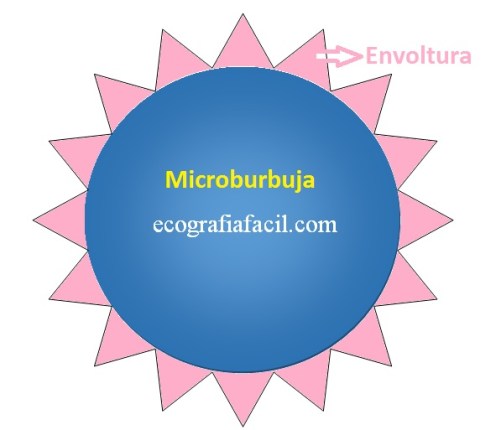
  • Microburbujas de gas estabilizadas, es decir, envueltas en alguna sustancia que hagan que duren un poco más en el torrente sanguíneo antes de «evaporarse».
    • Burbuja libre en sangre no dura mas de 20msg.
    • Se envuelven en galactosa o fosfolípidos.
  • Es inerte y por tanto no interactúa químicamente, por tanto no da reacciones adversas. Si hay reacciones, suele ser debido al excipiente del fármaco.

What is the ultrasound contrast?

Agents that increase intensity in the ultrasound image and thus providing accurate information on the vascularization of the lesions to be studied.

Stabilized gas micro bubbles, that is, wrapped in some substance that makes them last a little longer in the bloodstream before «evaporate». Free bubble in blood does not last more than 20msg. They are wrapped in galactose or phospholipids.

It is inert and therefore does not interact chemically, therefore it does not give adverse reactions. If there are reactions, it is usually due to the excipient of the drug.

Las Microburbujas:

  • Esta microburbujas tienen un diámetro menor al de un hematíe.
  • Las microburbujas se mantienen siempre en el espacio intravascular.
  • No son eliminadas por el sistema excretor renal.
  • Se disuelven en el plasma y se eliminan a través de los pulmones.

This microbubbles have a smaller diameter than a red blood cell.The microbubbles are always kept in the intravascular space.They are not eliminated by the renal excretory system.They dissolve in the plasma and are eliminated through the lungs.

Las microburbujas son aire, gas o compuesto químico gaseoso, dependiendo de las marcas comerciales que las distribuyan. Se las envuelve en alguna sustancia que las haga más duraderas en el torrente sanguíneo.

The microbubbles are air, gas or gaseous chemical compound, depending on the commercial brands that distribute them. They are wrapped in some substance that makes them more durable in the bloodstream.

Comportamiento de una microburbuja:

  • La microburbuja cuando se le somete a un pulso de eco responde así:
  1. –Reflejo en la superficie de la microburbuja por interfase ecográfica.
  2. –Compresión y descompresión de la burbuja = Movimiento oscilatorio = Sonido.

El pulso de ecografía dependerá de la La Potencia de Transmisión. Esta potencia de transmisión está en estrecha relación con amplitud de onda y por tanto con la calidad de la imagen. Vamos a apreciar que la calidad de imagen en la ecografía de contraste es de menor calidad que la imagen 2D, eso es porque necesitamos potencias de transmisión bajas y por tanto Indice Mecánico bajo que está en relación con los Efectos biomecánicos del ultrasonido, pero no siendo esta potencia, tan baja, que no ocasione ningún efecto sobre la microburbuja.

Si el IM es demasiado bajo no habrá movimiento en la microburbuja, si el IM es demasiado alto, se romperá, debe ser bajo para que el pulso de eco para excitar a la microburbuja haciéndola oscilar (compresión y relajación) y ese efecto provocará un onda sónica…esta es la base del comportamiento de las microburbujas de gas estabilizadas.

Behavior of a microbubble:

The microbubble when subjected to an echo pulse responds thus:

-Reflection on the surface of the microbubble by ultrasound interface.

-Compression and decompression of the bubble = Oscillatory movement = Sound.

The pulse of ultrasound will depend on The Power of Transmission. This transmission power is closely related to wave amplitude and therefore to the quality of the image. We are going to appreciate that the image quality in the contrast ultrasound is of lower quality than the 2D image, that is because we need low transmission powers and therefore a low Mechanical Index that is related to the biomechanical effects of ultrasound, but it is not this power, so low, that does not cause any effect on the microbubble.

If the IM is too low there will be no movement in the microbubble, if the IM is too high, it will break, it must be low for the echo pulse to excite the microbubble making it oscillate (compression and relaxation) and that effect will cause a sonic wave … this is the basis of the behavior of the stabilized gas microbubbles.

Presentación:

Hay varios preparados en función de las marcas comerciales.

  • Disolvente.
  • Compuesto preparado
  • Preparación:
  1. –Unir ambas partes
  2. –Agitar enérgicamente 15-20 sg.
  • Admisitrar según prospecto y siguiendo indicaciones de la/el radiólogx, normalmente vía endovenosa.

Presentation:

There are several preparations depending on the commercial brands.

Solvent.Composed prepared

Preparation: -Unit both parties-Agitate vigorously 15-20 sg.

Admisitrate according to the leaflet and following indications of the radiologist, usually via intravenous.

Contraindicaciones:

  • Enfermedad cardiopulmonar grave. Algunas marcas usan compuestos químicos que pueden alterar negativamente patologías cardiacas como síndrome coronarios agudos y otra patologías cardiacas. También en pacientes con galactosemia, ya que una de las marcas tiene como envoltura de la microburbuja, la galactosa.
  • Pacientes menores de 18 años.
  • Embarazo y lactancia

Estas contraindicaciones siempre deben ser valoradas por lx radiologx que ejecuta la prueba habiendo sido revisado el historial clínico de cada paciente.

Contraindications:

Severe cardiopulmonary disease. Some brands use chemical compounds that can adversely alter cardiac pathologies such as acute coronary syndrome and other cardiac pathologies. Also in patients with galactosemia, since one of the brands has as a wrapper of the microbubble, galactose.

Patients under 18 years old.

Pregnancy and lactation

These contraindications should always be assessed by the radiologist who performs the test having reviewed the clinical history of each patient.

Limitaciones de la técnica:

-Ecografía convencional. Es decir, los equipos necesitan un Software apropiado para realizar este tipo de estudios, no todos los equipos, por muy caros que sean, pueden ejecutar este tipo de estudios.

-Tipo de lesión
* Tamaño
* Localización

Algunas lesiones son muy pequeñas o su localización es de acceso ecográfico complicado, por ejemplo, LOES Hepáticas subdiafragmáticas cuyo localización es muy compleja.

-Órganos de difícil visualización debidido a sus patologías.

-Lesiones múltiples, aquellas patologías hepáticas cuyas lesiones comporten gran número de ellas, por ejemplo, un hígado globalmente metastásico.

Limitations of the technique:

-Conventional art. That is, the teams need an appropriate software to perform this type of studies, not all equipment, however expensive, can perform this type of studies.

-Type of injury

* Size

* LocationSome

lesions are very small or their location is of complicated ultrasound access, for example, subdiaphragmatic liver LOES whose location is very complex.

-Organs difficult to visualize due to their pathologies.

-Multiple lesions, those liver pathologies whose lesions involve a large number of them, for example, a globally metastatic liver.

Quieres ver un ejemplo de cómo actual el contraste ecográfico en tiempo real:

En la imagen ves una lesión hepática que se vuelve brillante en su totalidad debido al contraste ecográfico.

In the image you see a liver injury that becomes bright in its entirety due to ultrasound contrast.

Hoy he leído esto y aunque ya lo había leído hace tiempo, cada vez me gusta más:

«Sí, eres lo que piensas, lo que comes, lo que lees, sueñas,haces o temes.Pero antes y después de todo,eres lo que amas» (Andrea Boniforti)…Buenas noches…


131. MMSS II

Al lío:

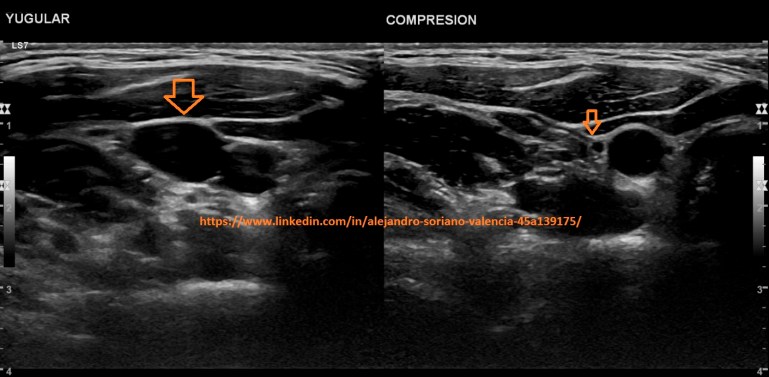
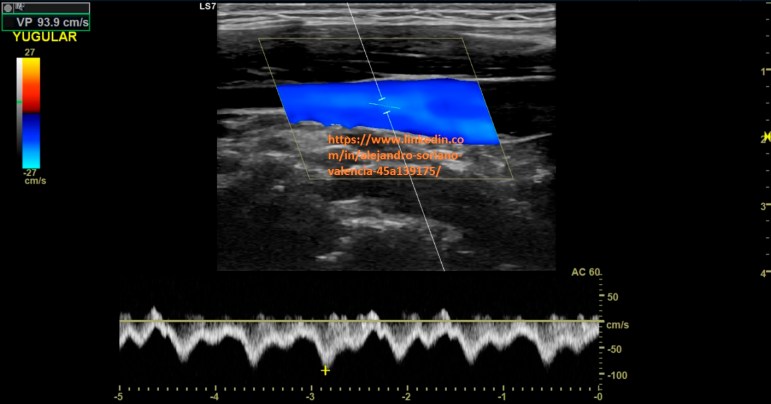
o Yugular interna.

Le pediremos al paciente que coloque el cuello en
hiperextensión para tener un buen acceso. La estudiaremos en su máximo
trayecto posible.

We will ask the patient to place the neck in hyperextension to have good access. We will study it in its maximum possible project.

1. Yugular interna transversal.


2. Yugular interna longitudinal. Estudio triplex.

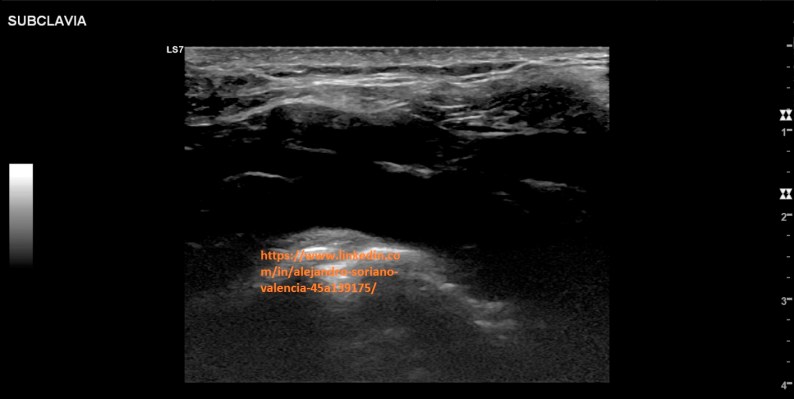
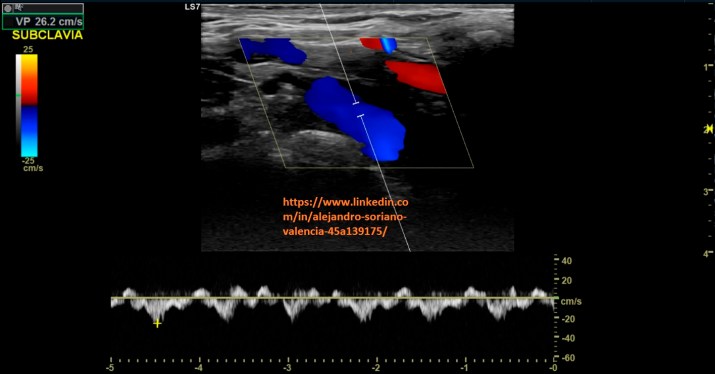
o Subclavia.

Generalmente su porción más proximal podremos estudiarla
de manera supraclavicular mientras que por su tercio medio y más distal,

Generally, its most proximal portion can be studied supraclavicularly, while its middle third and more distal

se hará infraclavicular. Es un vaso de muy difícil acceso, por lo no
seremos capaces de hacer cortes transversales y no podremos comprimir
adecuadamente.

Como vimos en el post nº 105 las venas tienen un patrón monofásico. Pues
bien, aquí tenemos dos excepciones, y es que, nos encontraremos con un
flujo pulsátil en las venas yugular interna y subclavia.

will become infraclavicular. It is a vessel with very difficult access, so we are not able to make transversal cuts and we will not be able to compress properly. As we saw in post no. 105, the veins have a monophasic pattern. Well, here we have two exceptions, and that is that, we will find a pulsating flow in the internal jugular and subclavian veins.

3. Subclavia longitudinal.


o Axilar.

Para esta vena el paciente tendrá que elevar y doblar el brazo para
colocar su mano detrás de la cabeza.

For this vein the patient will have to raise and bend the arm to place his hand behind the head.

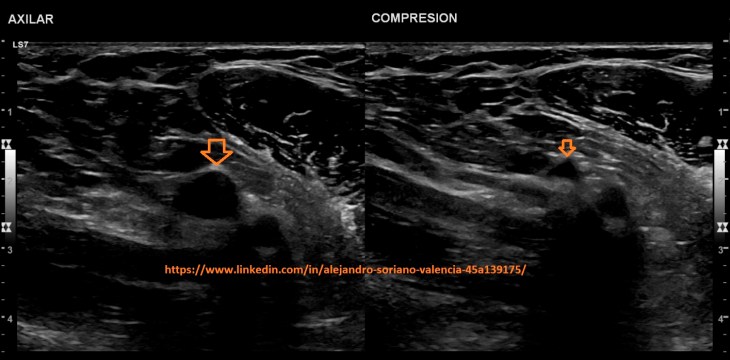
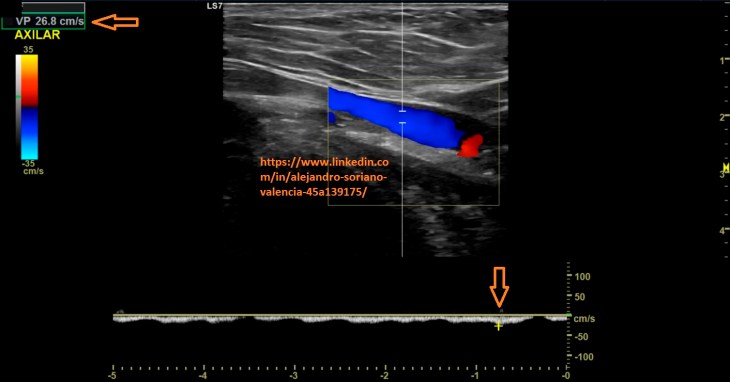
5. Axilar transversal.

6. Axilar longitudinal. Estudio triplex.

o Braquiales.

Brazo extendido en posición anterior. Nos servirá de guía la
arteria braquial para identificar las dos venas adyacentes a ella.

Arm extended in anterior position. The brachial artery will guide us to identify the two veins adjacent to it.

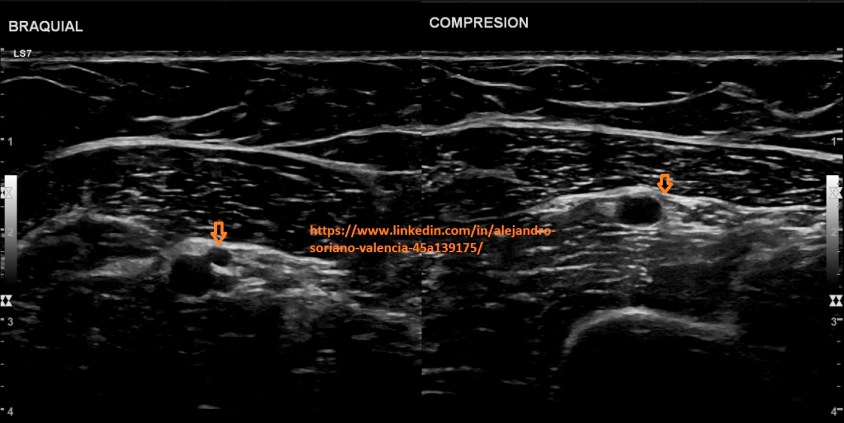
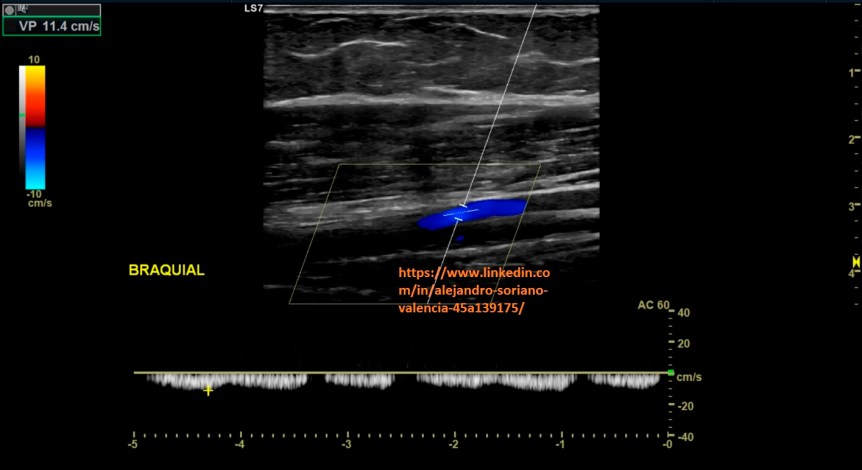
7. Braquiales transversal.

8. Braquial longitudinal. Estudio triplex.

o Radiales.

Antebrazo extendido en posición anterior.

o Cubitales.

Antebrazo extendido en posición anterior.

Radials. Forearm extended in anterior position.

Cubitals. Forearm extended in anterior position

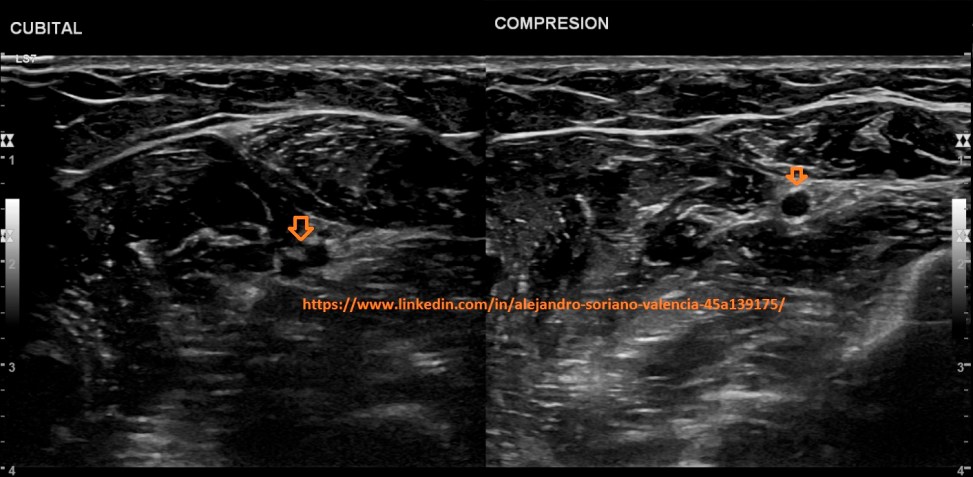
Tendremos gran dificultad en ver y estudiar las venas radiales y cubitales si no son
patológicas debido a su pequeño tamaño y que con la más mínima presión las
colapsaremos.

El truco está en seguir las correspondientes arterias. Junto a ellas encontraremos dichas
venas (un par por arteria).

Sigo buscando unas buenas gafas de aumento para facilitar la búsqueda de los vasos.
¿Alguien sabe de algún sitio donde estén a buen precio?

We will have great difficulty in seeing and studying the radial and ulnar veins if they are not pathological due to their small size and that with the slightest pressure we will beat them. The trick is to follow the corresponding arteries. Next to them we will find said arteries (one pair per artery). I am looking for good magnifying glasses to facilitate the search of the glasses. Does anyone know of any place where they are at a good price?


130. Doppler Venoso Profundo MMSS. Consideraciones Generales.

Seguimos en esta segunda parte del Blog hoy dedicado al Doppler…
Alejandro nos va a contar en esta ocasión un protocolo de estudio muy solicitado.

Lo primero es conocer unas consideraciones generales, después el protocolo de estudio.

Seguimos con el estudio Doppler venoso profundo, en este caso de miembros
superiores.

El estudio es muy similar al estudio Doppler del sistema venoso profundo de los
miembros inferiores:

1. Transductores de alta frecuencia. Usaremos una frecuencia entre 7 y 9 Mh.

2. Paciente en decúbito supino. Iniciaremos la exploración con el paciente en
decúbito supino con el cuello en hiperextensión. Brazo del paciente extendido
para explorar su cara anterior o en sobreextendido sobre su cabeza según sea
necesario.

3. Exploración:

Igual que en el post 105, la exploración consistirá en seguir el trayecto
venoso profundo mediante barridos transversales para identificar la existencia de
trombos, para ello iremos comprimiendo los vasos según nos desplazamos.
Como ya vimos nos apoyaremos en la imagen “dual” para mostrar en una
pantalla el paquete vascular sin compresión y en la otra mostrar cómo se
comprime, o no…

Recordad que únicamente se comprimen las venas debido a su histología.
Haremos cortes longitudinales de la vena trombosada para su estudio Doppler y
comprobar que no tiene flujo y así reafirmar la trombosis. Si nuestro protocolo
lo requiere tendremos que estudiar la dirección del flujo y la velocidad de cada
vena del sistema venoso profundo.

Finalizaremos el estudio en el momento en que identifiquemos un trombo,
excepto, cuando nos exijan por protocolo hacer el barrido completo hasta las
venas más distales del antebrazo.

Como en el estudio de miembros inferiores, el estudio también se hará unilateral
en caso de sospecha de trombosis venosa o bilateral en caso de TEP.

Respondiendo a una de vuestras dudas, en el post de miembros inferiores, el
estudio no es recomendable hacerlo en bipedestación, ya que tendremos peor
ventana para acceder a muchos de los vasos a estudiar, además de que
tendremos pacientes que por su clínica no soportarán estar tanto tiempo de pie.
Los vasculares lo hacen así, porque buscan la existencia de varices, es decir,
malfuncionamiento del sistema venoso superficial (safena mayor y safena
menor).

Alejandro is going to tell us on this occasion a very requested study protocol. The first thing is to know some general considerations, then the study protocol. We continue with the deep venous Doppler study, in this case of superior members. The study is very similar to the study Doppler of the deep venous system of the lower members:
1. High frequency transducers. We will use a frequency between 7 and 9 Mh.
2. Patient in the supine position. We will begin the exploration with the patient in supine position with the neck in hyperextension. Patient’s arm extended to explore its anterior or over-extended face on its head as needed.
3. Exploration: As in post 105, the exploration will consist of following the deep trajectory through transversal sweeps to identify the existence of debrombs, for this we will compress the vessels as we move. As we saw we will rely on the «dual» image to show in one screen the vascular package without compression and in the other show how it is compressed, or not …
Remember that only the veins are compressed due to their histology. We will make longitudinal cuts of the thrombosed vein for its Doppler study and check that it has no flow and thus reaffirm the thrombosis . If our protocol requires it, we will have to study the flow direction and velocity of the vein in the deep venous system. We will finish the study at the moment in which we identify a thrombus, except when we are required by protocol to do the complete sweep until the most distal veins of the forearm As in the study of lower limbs, the study will also be done unilaterally in case of suspicion of venous thrombosis or bilateral in case of PTS. Answering one of your doubts, in the post of lower limbs, the study is not advisable to do it in standing, since we will have the worst window to access many of the glasses to study, in addition to that we will have patients who because of their clinic will not stand to be so long standing. The vascular ones do so, because they look for the existence of varicose veins, that is, malfunction of the venous system superficial (saphenous greater and safenamenor).


129. Punto y aparte.

Quería haber hecho esto hace unos días, pero la verdad es que no me había sentado tranquilamente a escribir.Este es el 129…qué cosas…

Con el Post 128 dí por finalizado el Blog tal como lo ideé. Esto no es un punto y final, sólo es un punto y aparte, tengo más cosas que contar, será de una forma algo distinta, no tan organizado todo, no tan pensado…pero aún tengo muchas cosas por contarte, muchos Post para escribir…

Desde que el Blog comenzó allá por mediados de Noviembre de 2017, 14 meses, madre mía…el Blog ha crecido mucho y yo he crecido también muchísimo junto a él, muchas horas robadas al sueño, muchas horas de estudio, horas robadas a EL y a sus juegos, hoy puedo decir que he terminado «el libro de mi vida»…y más allá de que aún quedan retoques que hacer, estoy orgulloso, sobre todo de su esencia, y ésta es que es conocimiento libre y gratuito…y por eso, nada más de lo que, eventualmente, pueda realizar algún día, me hará sentir mejor que este blog.

Quiero dar las gracias a quienes me leéis cada vez que publico un post…a quien lo sigue desde hace tanto, os debo tantas cosas…a quien me ha ayudado de una u otra manera a llegar hasta aquí…este Blog también es un poco vuestro, como ya he dicho otras veces.

Hace tiempo que dejé de mirar cifras, pero el jueves pasado el Blog superó las 1.500 visitas en un solo día, cuenta ya, con casi un cuarto de millón de visitas en estos 14 meses…Quería compartirlo y yo solo puedo decir, gracias…de verdad, gracias de todo corazón.

Perdón por ponerme un poco ñoño, pero es que necesitaba contarlo…lo dicho:

Punto y Aparte…


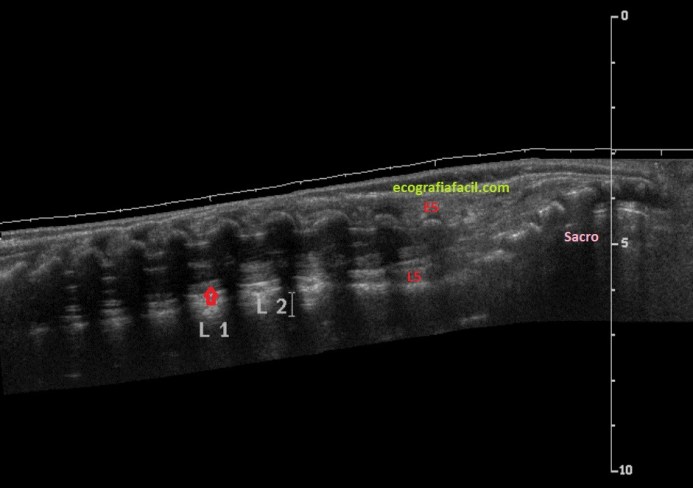
128.SNC.Canal Medular.Patología básica.

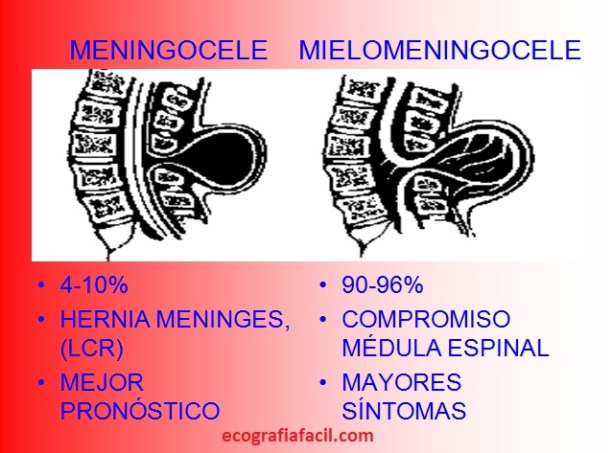
El objetivo de esta bonita técnica es descartar patologías como la Médula Anclada. Esta médula anclada puede estar asociada a patología como el Meningocele y el Mielomeningocele a nivel de la médula, patologías que están muy bien explicadas en este link.

Una vez estudiado en el link de la Sociedad Española de Pediatría, pasamos a ver conceptos que tienen que ver más bien con la imagen:

The objective of this beautiful technique is to rule out diseases such as the Anchored Marrow. This anchored marrow may be associated with pathologies such as meningocele and myelomeningocele at the marrow level, pathologies that are very well explained in this link. Once studied in the link of the Spanish Society of Pediatrics, we went to see concepts that have more to do with the image:

La diferencia de estas dos patologías está en la estructura anatómica que está herniada, meninges o médula, lo cual varía el diagnóstico.

En la imagen siguiente vas a ver un ejemplo del segundo caso, la imagen es difícil de interpretar, pero vas a ver un tipo de Mielomeningocele con médula anclada.
The difference of these two pathologies lies in the anatomical structure that is herniated, meninges or marrow, which varies the diagnosis.
In the following image you will see an example of the second case, the image is difficult to interpret, but you will see a type of Myelomeningocele with anchor bone.

Para entender la imagen superior, compara con la normalidad:

En la imagen patológica observamos médula con dilatación de canal medular central en relación con hidrosiringomielia. Cono medular desciende hasta nivel de vértebras sacras, en porción posterior de canal espinal, anclada por un lipoma, que se extiende desde tejido graso subcutáneo a través de un defecto vertebral posterior en L5-S1, asociando también parte de meningocele a través de defecto.

In the pathological image we observed marrow with dilation of the central medullary canal in relation to hydrosyringomyelia. The medullar cone descends to the level of the sacral vertebrae, in the posterior portion of the spinal canal, anchored by a lipoma, which extends from the subcutaneous fat tissue through a posterior vertebral defect in L5-S1, also associating part of the meningocele through the defect.

El milagro no es haber llegado al final, el milagro es haber tenido el valor de haber empezado…