130. Doppler Venoso Profundo MMSS. Consideraciones Generales.

Seguimos en esta segunda parte del Blog hoy dedicado al Doppler…

Alejandro nos va a contar en esta ocasión un protocolo de estudio muy solicitado.

Lo primero es conocer unas consideraciones generales, después el protocolo de estudio.

Seguimos con el estudio Doppler venoso profundo, en este caso de miembros
superiores.

El estudio es muy similar al estudio Doppler del sistema venoso profundo de los
miembros inferiores:

1. Transductores de alta frecuencia. Usaremos una frecuencia entre 7 y 9 Mh.

2. Paciente en decúbito supino. Iniciaremos la exploración con el paciente en
decúbito supino con el cuello en hiperextensión. Brazo del paciente extendido
para explorar su cara anterior o en sobreextendido sobre su cabeza según sea
necesario.

3. Exploración:

Igual que en el post 105, la exploración consistirá en seguir el trayecto
venoso profundo mediante barridos transversales para identificar la existencia de
trombos, para ello iremos comprimiendo los vasos según nos desplazamos.
Como ya vimos nos apoyaremos en la imagen “dual” para mostrar en una
pantalla el paquete vascular sin compresión y en la otra mostrar cómo se
comprime, o no…

Recordad que únicamente se comprimen las venas debido a su histología.
Haremos cortes longitudinales de la vena trombosada para su estudio Doppler y
comprobar que no tiene flujo y así reafirmar la trombosis. Si nuestro protocolo
lo requiere tendremos que estudiar la dirección del flujo y la velocidad de cada
vena del sistema venoso profundo.

Finalizaremos el estudio en el momento en que identifiquemos un trombo,
excepto, cuando nos exijan por protocolo hacer el barrido completo hasta las
venas más distales del antebrazo.

Como en el estudio de miembros inferiores, el estudio también se hará unilateral
en caso de sospecha de trombosis venosa o bilateral en caso de TEP.

Respondiendo a una de vuestras dudas, en el post de miembros inferiores, el
estudio no es recomendable hacerlo en bipedestación, ya que tendremos peor
ventana para acceder a muchos de los vasos a estudiar, además de que
tendremos pacientes que por su clínica no soportarán estar tanto tiempo de pie.
Los vasculares lo hacen así, porque buscan la existencia de varices, es decir,
malfuncionamiento del sistema venoso superficial (safena mayor y safena
menor).

Alejandro is going to tell us on this occasion a very requested study protocol. The first thing is to know some general considerations, then the study protocol. We continue with the deep venous Doppler study, in this case of superior members. The study is very similar to the study Doppler of the deep venous system of the lower members:
1. High frequency transducers. We will use a frequency between 7 and 9 Mh.
2. Patient in the supine position. We will begin the exploration with the patient in supine position with the neck in hyperextension. Patient’s arm extended to explore its anterior or over-extended face on its head as needed.
3. Exploration: As in post 105, the exploration will consist of following the deep trajectory through transversal sweeps to identify the existence of debrombs, for this we will compress the vessels as we move. As we saw we will rely on the «dual» image to show in one screen the vascular package without compression and in the other show how it is compressed, or not …
Remember that only the veins are compressed due to their histology. We will make longitudinal cuts of the thrombosed vein for its Doppler study and check that it has no flow and thus reaffirm the thrombosis . If our protocol requires it, we will have to study the flow direction and velocity of the vein in the deep venous system. We will finish the study at the moment in which we identify a thrombus, except when we are required by protocol to do the complete sweep until the most distal veins of the forearm As in the study of lower limbs, the study will also be done unilaterally in case of suspicion of venous thrombosis or bilateral in case of PTS. Answering one of your doubts, in the post of lower limbs, the study is not advisable to do it in standing, since we will have the worst window to access many of the glasses to study, in addition to that we will have patients who because of their clinic will not stand to be so long standing. The vascular ones do so, because they look for the existence of varicose veins, that is, malfunction of the venous system superficial (saphenous greater and safenamenor).
 

129. Punto y aparte.

Quería haber hecho esto hace unos días, pero la verdad es que no me había sentado tranquilamente a escribir.Este es el 129…qué cosas…

Con el Post 128 dí por finalizado el Blog tal como lo ideé. Esto no es un punto y final, sólo es un punto y aparte, tengo más cosas que contar, será de una forma algo distinta, no tan organizado todo, no tan pensado…pero aún tengo muchas cosas por contarte, muchos Post para escribir…

Desde que el Blog comenzó allá por mediados de Noviembre de 2017, 14 meses, madre mía…el Blog ha crecido mucho y yo he crecido también muchísimo junto a él, muchas horas robadas al sueño, muchas horas de estudio, horas robadas a EL y a sus juegos, hoy puedo decir que he terminado «el libro de mi vida»…y más allá de que aún quedan retoques que hacer, estoy orgulloso, sobre todo de su esencia, y ésta es que es conocimiento libre y gratuito…y por eso, nada más de lo que, eventualmente, pueda realizar algún día, me hará sentir mejor que este blog.

Quiero dar las gracias a quienes me leéis cada vez que publico un post…a quien lo sigue desde hace tanto, os debo tantas cosas…a quien me ha ayudado de una u otra manera a llegar hasta aquí…este Blog también es un poco vuestro, como ya he dicho otras veces.

Hace tiempo que dejé de mirar cifras, pero el jueves pasado el Blog superó las 1.500 visitas en un solo día, cuenta ya, con casi un cuarto de millón de visitas en estos 14 meses…Quería compartirlo y yo solo puedo decir, gracias…de verdad, gracias de todo corazón.

Perdón por ponerme un poco ñoño, pero es que necesitaba contarlo…lo dicho:

Punto y Aparte…


128.SNC.Canal Medular.Patología básica.

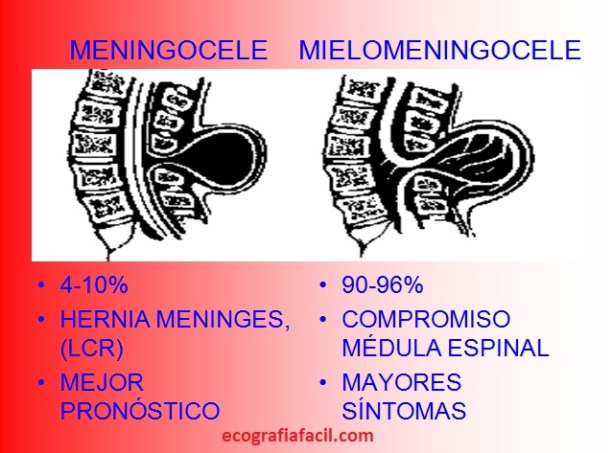
El objetivo de esta bonita técnica es descartar patologías como la Médula Anclada. Esta médula anclada puede estar asociada a patología como el Meningocele y el Mielomeningocele a nivel de la médula, patologías que están muy bien explicadas en este link.

Una vez estudiado en el link de la Sociedad Española de Pediatría, pasamos a ver conceptos que tienen que ver más bien con la imagen:

The objective of this beautiful technique is to rule out diseases such as the Anchored Marrow. This anchored marrow may be associated with pathologies such as meningocele and myelomeningocele at the marrow level, pathologies that are very well explained in this link. Once studied in the link of the Spanish Society of Pediatrics, we went to see concepts that have more to do with the image:

La diferencia de estas dos patologías está en la estructura anatómica que está herniada, meninges o médula, lo cual varía el diagnóstico.

En la imagen siguiente vas a ver un ejemplo del segundo caso, la imagen es difícil de interpretar, pero vas a ver un tipo de Mielomeningocele con médula anclada.
The difference of these two pathologies lies in the anatomical structure that is herniated, meninges or marrow, which varies the diagnosis.
In the following image you will see an example of the second case, the image is difficult to interpret, but you will see a type of Myelomeningocele with anchor bone.

Para entender la imagen superior, compara con la normalidad:

En la imagen patológica observamos médula con dilatación de canal medular central en relación con hidrosiringomielia. Cono medular desciende hasta nivel de vértebras sacras, en porción posterior de canal espinal, anclada por un lipoma, que se extiende desde tejido graso subcutáneo a través de un defecto vertebral posterior en L5-S1, asociando también parte de meningocele a través de defecto.

In the pathological image we observed marrow with dilation of the central medullary canal in relation to hydrosyringomyelia. The medullar cone descends to the level of the sacral vertebrae, in the posterior portion of the spinal canal, anchored by a lipoma, which extends from the subcutaneous fat tissue through a posterior vertebral defect in L5-S1, also associating part of the meningocele through the defect.

El milagro no es haber llegado al final, el milagro es haber tenido el valor de haber empezado…


127. SNC. Canal Medular.

En el estudio del SNC del lactante o el neonato estudiamos de forma habitual el Canal Medular con el objetivo principal de descartar la Médula anclada u otras patologías a ese nivel.

Este estudio está dirigido a menores de 6 meses dado que las apófisis espinosas aún no tienen la densidad ósea suficiente de impedir el paso de los ultrasonidos y podemos ver claramente el canal medular situando la sonda sobre dichas apófisis.

Es normal que nos lleguen peticiones para pacientes que tienen algún defecto en la piel justo antes de empezar la línea anatómica que separa ambos glúteos, es decir, en la parte final de la espalda. Estos son conocidos como Hoyuelos Sacros.

Generalidades:

  • PACIENTE EN DECÚBITO PRONO y desnudx, si está recién comidx, mejor, estará más calmadx.
  • ESTUDIO DE LA MÉDULA, CONO MEDULAR Y MASAS INTRACANICULARES
  • DETERMINAR EL NIVEL DEL CONO MEDULAR Y DESCARTAR MÉDULA ANCLADA
  • ENTRE L2 Y L3 NORMAL
  • MÉDULA ANCLADA:
  1. –HOYUELOS SACROS, MECHONES DE PELO
  2. –CONO MEDULAR POR DEBAJO DE L3
  • MALFORMACIONES FÍSICAS Y DÉFICIT NEUROLÓGICOS

Técnica Ecográfica:

  • SONDA de alta frecuencia
  • SOBRE LA LÍNEA MEDIA ENTRE LAS ESPINOSAS
  • VISTA PANORÁMICA
  • CONDUCTO RAQUÍDEO NORMAL:
    • –CONO MEDULAR
      • AFILADO EN LONGITUDINAL
      • –SACO TECAL
      • –COLA DE CABALLO
        • BANDAS ECOGÉNICAS EN LONGITUDINAL
  • –CUERPOS VERTEBRALES

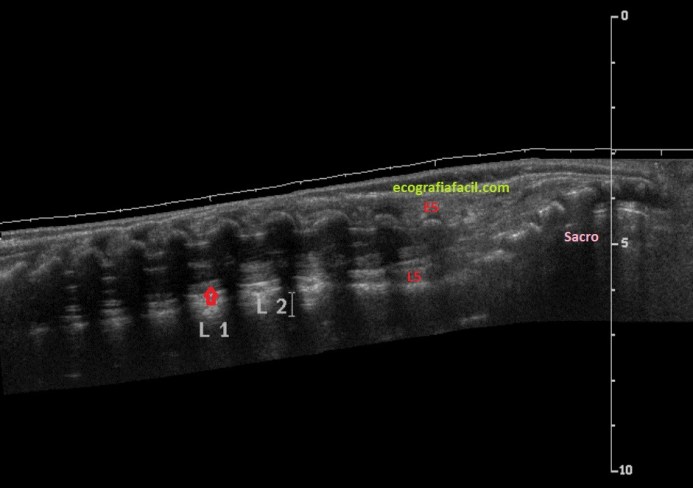
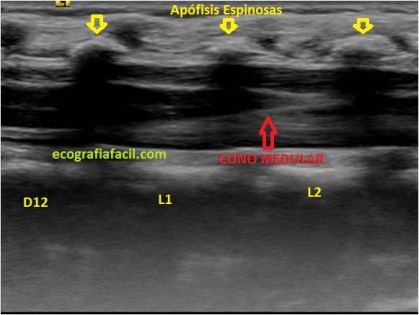
Colocaremos la sonda, para localizar en longitudinal el canal medular, debemos concretar a qué nivel termina el canal medular, para ello debemos saber cual es el nivel y las vértebras, para ello contaremos desde L5 hacia arriba.

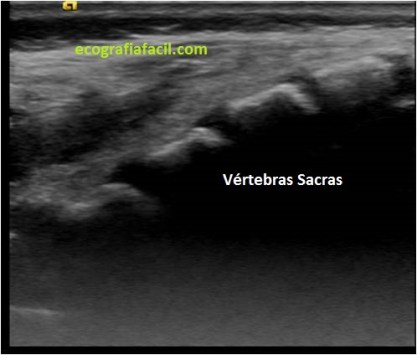
Localizamos L5 estudiando el Sacro y contando desde la última espinosa lumbar y contando cuando identifiquemos L5, de ahí hacia craneal.

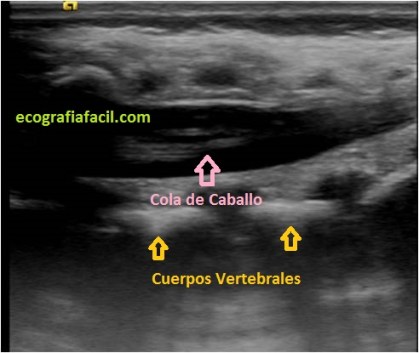
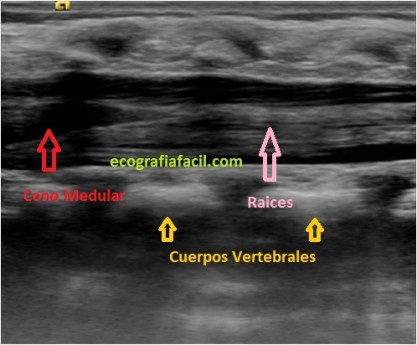
Imágenes desde distal hacia craneal, corte longitudinal.

In the study of the CNS of the infant or the newborn, we studied the usual form in the Medullary Canal with the main objective of ruling out the anchored marrow or other pathologies at that level.
This study is aimed at children under 6 months since the apophysis does not yet have sufficient density in the passage of ultrasound and we can clearly see the medullary canal by placing the probe on said process.
It is normal that it has arrived to us. Applications for patients have a skin defect. Before starting. The anatomical line separates both buttocks, that is, in the final part of the back. These are known as Sacred Dimples.
Generalities:
PATIENT IN DECUMITURE PROOF AND NUDE.
STUDY OF THE MEDULA, THE MEDULAR CONE AND INTRACANICULAR MASSES
DETERMINE THE LEVEL OF THE MEDULAR CONE AND DISCARD ANCHORED MELDLE
BETWEEN L2 AND L3 NORMAL
ANCHORED MÉDULA:
-HOYUELOS SACROS, MECONOS DE PELO
– MEDULAR CONCRETE BELOW L3
PHYSICAL MALFORMATIONS AND NEUROLOGICAL DEFICIT
Ultrasound technique:
HIGH FREQUENCY PROBE
ABOUT THE MIDDLE LINE BETWEEN THORNS
PANORAMIC VIEW
NORMAL RAQUIDAL CONDUCT:
– MEDULAR CONNECTION
SHARPENING IN LONGITUDINAL
-SACO TECAL
-HORSE TAIL
ECOGENIC BANDS IN LONGITUDINAL
– VERTEBRAL BODIES
We will place the probe, to locate in the medullary canal, we must specify at the median level, channel the medullary canal, so that we can know what is the level and the vertebrae, for this we will count from L5 upwards.
We locate L5 by studying the sacrum and counting from the last lumbar and counting when we identify L5, from there to cranial.
Images from distal to cranial, longitudinal section.

Si hay hoyuelo sacro debemos ver si tiene conexión o está «cerrado».

Haremos cortes longitudinales y transversos e identificaremos D12, L1,L2 y L3 en Longitudinal.

Comprobaremos normalidad de raíces nerviosas, y saco tecal.

If there is a sacral dimple, we must see if it has a connection or it is «closed».
We will make longitudinal and transverse cuts and we will identify D12, L1, L2 and L3 in Longitudinal.
We will check normality of nerve roots, and thecal sac.

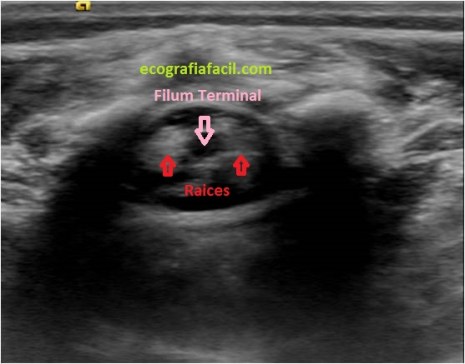
Debemos ver y comprobar que el Filum Terminal no esté engrosado, para esto necesitamos un corte axial.

We must see and verify that the Terminal Filum is not thickened, for this we need an axial cut.


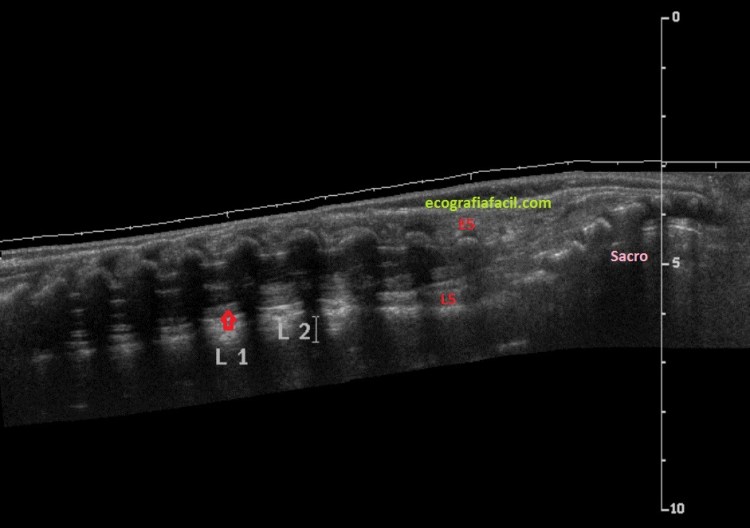
Finalmente realizaremos una vista panorámica como esta donde poder ver toda la anatomía, resulta esclarecedora:

Finally we will perform a panoramic view like this where you can see the entire anatomy, it is enlightening:

Le tengo tanto cariño a esta imagen…En ella ves lo punto claves, sacro, última espinosa y por tanto localización del cuerpo de L5…final del cono medular…preciosa…

I am so fond of this image … In it you see the key point, sacral, last thorny and therefore location of the body of L5 … end of the spinal cone … beautiful …

Esa playa, arena fina y caliente, el mar, te necesito tanto ahora…


126. Ecografía Transfontanelar. Patología básica.

Como te conté anteriormente, la ecografía transfontanelar se realiza en multitud de ocasiones ante sospechas clínicas de sangrado, podemos encontrarnos otras patologías, que os enlazo en este magnífico documento, pero descartar procesos hemorrágicos es clave, sobre todo en las Unidades de cuidados intensivos de Neonatología.

Este es un resumen de aquellas patologías que podemos encontrarnos:

  • MALFORMACIONES CONGÉNITAS
  • HIDROCEFALIA
  • ACCIDENTES HIPÓXICO-ISQUÉMICOS
  • HEMORRAGIAS
  • LESIONES POSTRAUMÁTICAS
  • INFECCIONES
  • TUMORES (RM)
As I told you before, transfontanel ultrasound is performed on many occasions before clinical suspicions of bleeding, we can find other pathologies, which I link in this magnificent document, but rule out bleeding processes is key, especially in Neonatal intensive care units
This is a summary of those pathologies that we can find:
CONGENITAL MALFORMATIONS
HIDROCEPHALIA
HIPOXIC-ISQUEMIC ACCIDENTS
HEMORRHAGES
POSTHUMATIC INJURIES
INFECTIONS
TUMORS (RM)

En imágenes vamos a ver algunas de estas, empezamos:

Hemorragias:

  • RIESGO AUMENTADO en pacientes con:
    • –MENOS 30S GESTACIÓN
    • –MENOS 1500 grs.
  • EXISTEN 4 GRADOS, según su tamaño.
  • HIPERECOGENICIDAD y ASIMETRÍA como signo ecográfico más importante.
  • LEUCOMALACIA PERIVENTRICULAR es su diagnóstico diferencial
    • –INFARTO Y NECROSIS DE LA SUSTANCIA BLANCA
INCREASED RISK in patients with:
-MENOS 30S GESTATION
-MENOS 1500 grs.
THERE ARE 4 DEGREES, according to their size.
HYPERECOGENICITY and ASYMMETRY as the most important sonographic sign.
PERIVENTRICULAR LEUKOMALACIA is your differential diagnosis
-INFARTH AND NECROSIS OF THE WHITE SUBSTANCE

Quistes de Plexo Coroideo:

  • 1% DE LOS NACIDOS
  • HALLAZGO AISLADO RARAMENTE ASOCIADO A OTRAS PATOLOGÍAS DEL SNC
  • MASA QUÍSTICA DE PAREDES FINAS DENTRO DEL PLEXO ANECOICAS
  • DIFERENTES TAMAÑOS y NÚMERO
  • USUALMENTE UNILATERALES
1% OF THE BORN
ISOLATED FINDING RARELY ASSOCIATED WITH OTHER PATHOLOGIES OF THE SNC
CYSTIC MASS OF FINE WALLS WITHIN THE ANECOIC PLEXUS
DIFFERENT SIZES and NUMBER
USUALLY UNILATERAL

Hidrocefalia:

  • 5 AL 25% DE CADA 10.000 NACIMIENTOS
  • DESEQUILIBRIO ENTRE LA PRODUCCIÓN DE LCR Y SU DRENAJE
  • LCR ES ANECOICO
  • CAUSAS:
    • –OBSTRUCCIÓN DE VACIAMIENTO
    • –ABSORCIÓN DISMINUIDA
    • –EXCESO DE PRODUCCIÓN de LCR
5 TO 25% OF EVERY 10,000 BIRTHS
UNBALANCE BETWEEN THE PRODUCTION OF CSF AND ITS DRAINAGE
LCR IS ANECOIC
CAUSES:
-OFF EMPLOYMENT
-ADMINATED DECORATION
– LCR PRODUCTION EXCESS

A continuación te dejo un video de un corte Sagital en la Línea Media donde observamos una imagen que muy pocas veces vamos a poder presenciar, espero que te guste…en Instagram resolveremos la duda de lo que es, te animo a que sigas mi perfil favorito del Blog.

Then I leave a video of a Sagittal section in the Media Line where we see an image that we will rarely be able to witness, I hope you like it … on Instagram we will solve the doubt of what it is, I encourage you to follow my favorite profile of the Blog.


La superación está en ti, en tu esfuerzo, en tu día a día…(@Patri_Psicologa)


125. Ecografía Transfontanelar,otros accesos.

Hemos repasado el estudio básico de la ecografía transfontanelar, pero quiero dedicar este breve post antes de ir a dormir a dos accesos auxiliares por dos fontanelas diferentes y que nos van a ofrecer dos vistas diferentes de la Coronal y la Sagital, detalladas con anterioridad.

Estos accesos nos van a ofrecer una imagen pseudo axial con un objetivo claro cada una de las dos…¿me acompañas?

FONTANELA TEMPORAL

  • VER PLANO TRANSVERSO (AXIAL)
  • SONDA SITUADA 1CM POR ENCIMA DEL CAE
  • MARCA DE LA SONDA HACIA ANTERIOR
  • Objetivo: POLÍGONO DE WILLIS Y PATOLOGÍA CEREBELO

FONTANELA MASTOIDEA

  • UNIÓN DE PARIETAL POSTERIOR,OCCIPITAL Y TEMPORAL
  • SONDA DETRÁS DE LA OREJA
  • Objetivo: ESTUDIO DE TERCER Y CUARTO VENTRÍCULO
  • BÚSQUEDA DE HEMORRAGIAS
  • FUSIÓN A LOS DOS AÑOS

No tengo imágenes de estos accesos, pero os enlazo aquí una magnífica presentación que explica y resume fenomenal estos post que os he contado con anterioridad, antes de dar paso a la patología habitual.

We have reviewed the basic study of transfontanelar ultrasound, but I would like to dedicate this brief post before going to sleep to two auxiliary accesses by two different fontanels and that will offer us two different views of the Coronal and the Sagittal, detailed previously.

These accesses will offer us a pseudo-axial image with a clear objective each of the two … will you accompany me?

TEMPORARY FONTANELA

SEE TRANSVERSE PLANE (AXIAL)
PROBE LOCATED 1CM ABOVE THE CAE
MARK OF THE PROBE TO PREVIOUS
Objective: WILLIS POLYGON AND CEREBELLO PATHOLOGY

FONTANELA MASTOIDEA

UNION OF PARTIETAL POSTERIOR, OCCIPITAL AND TEMPORARY
PROBE BEHIND THE EAR
Objective: STUDY OF THIRD AND FOURTH VENTRICLE
SEARCH FOR HEMORRHAGE
FUSION AT TWO YEARS

I do not have images of these accesses, but I link you here a magnificent presentation that explains and summarizes these post that I have told you before, before giving way to the usual pathology.

Echando de menos mi Verano, aquí…Siguiendo el rastro de un amanecer…

124 Ecografía Transfontanelar. Estudio Vascular básico.

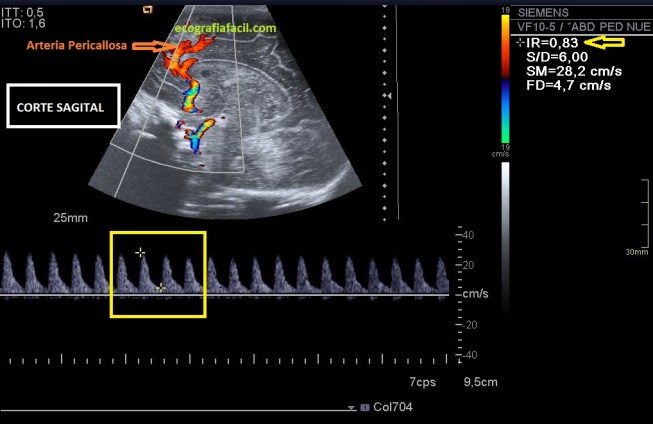
En el estudio con el Doppler del cerebro neonatal y lactante perseguimos la consecución de un valor que nos dará el IR o Índice de Resistencia. En este enlace os dejo un trabajo de la Universidad de Zaragoza donde vais a comprender perfectamente los pormenores de la importancia de este IR, valor que calcularemos mediante el Doppler Pulsado de dos arterias, la Arteria Pericallosa (Corte Sagital) y algunas de las Arterias Cerebrales, te recomiendo estudiarla en corte Coronal. Ambos cortes se realizan a través de la fontanela anterior.

Este registro dará un valor, que según la edad de la/el paciente tendrá unos valores de normalidad en unas tablas. Si este valor está alterado puede deberse a varios motivos de índole patológico, por ejemplo:

–HEMORRAGIA INTRAVENTRICULAR, Valor IR Aumentado.

–HIDROCEFALIA, Valor IR Aumentado.

–ASFIXIA, Valor  IR Disminuido.

–DUCTUS: Valor IR alterado por:

  • La persistencia, después de nacer, de la comunicación que normalmente existe entre el sistema arterial pulmonar y la aorta durante la vida fetal
In the study with the Doppler of the neonatal and infant brain we pursue the achievement of a value that will give us the IR or Resistance Index. In this link I leave a summary of the University of Zaragoza where you will understand perfectly the details of the importance of this IR, a value that we calculate using the Doppler Pulsed of two arteries, the Pericallosa Artery (Sagittal Cut) and some of the cerebral arteries , I recommend studying it in Corte Coronal. Both cuts are made through the anterior fontanelle.
This record will give a value, which according to the age of the patient will have normal values ​​in some tables. If this value is altered it can be due to several reasons of pathological nature, for example:
-INTRAVENTRICULAR HEMORRHAGE, Increased IR Value.
-HIDROCEPHALY, Increased IR Value.
-ASIXIX, IR Value Decreased.
-DUCTUS: IR value altered by:
The persistence, after birth, of the communication that normally exists between the pulmonary arterial system and the aorta during fetal life

Mira las imágenes:

Observa la flecha amarilla de las imágenes, en un valor conseguido por la medida en el espectro arterial de cada arteria.

Observe the yellow arrow of the images, in a value obtained by the measurement in the arterial spectrum of each artery.

Mi cuerpo es mi diario y mis tatuajes son mi historia…


123. Ecografía Transfontanelar. Cortes Sagitales.

Afrontamos este breve, pero precioso Post para hablar de los cortes sagitales en el estudio transfontanelar de pacientes neonatos y lactantes.

Una vez terminados los cortes coronales vamos a girar nuestra sonda sobre la fontanela anterior de modo que tenemos que ver en la pantalla de nuestro ecógrafo la cabeza en su corte sagital…

Para explicarte estos cortes necesito una imagen coronal con las angulaciones necesaria para ver la anatomía ecográfica de los sagitales, mira.

Partiendo de un corte sagital central donde a un lado de la pantalla veremos la región frontal y al otro la región occipital, nos angularemos de derecha a izquierda de la cabeza recorriendo toda la cabeza en sagital y si el estudio resulta normal, realizaremos esto resumidamente:

  • TRANSDUCTOR LONGITUDINALMENTE COLOCADO A LA FONTANELA ANTERIOR
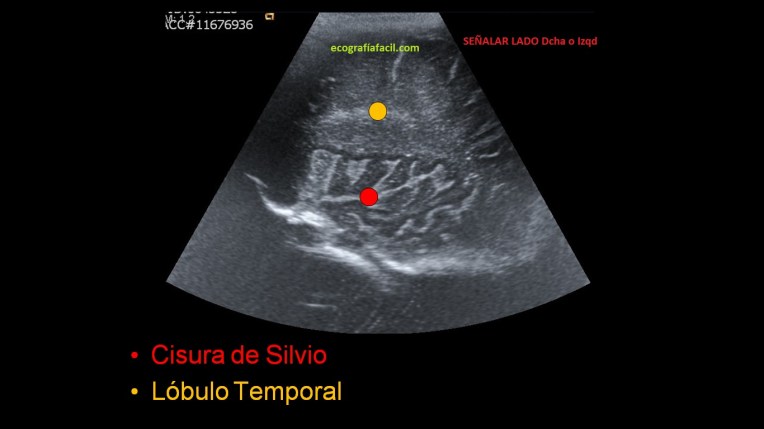
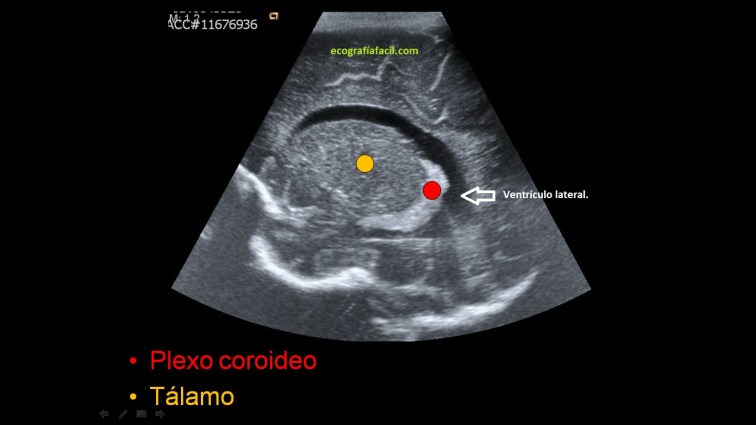
  • VER LADO DERECHO, LÍNEA MEDIA Y LADO IZQUIERDO, señalar en pantalla el lado estudiado…
  • LADOS DERECHO E IZQUIERDO
    • LÓBULO FRONTAL, LÓBULO PARIETAL, TÁLAMO, PLEXO COROIDEO
  • LÍNEA MEDIA
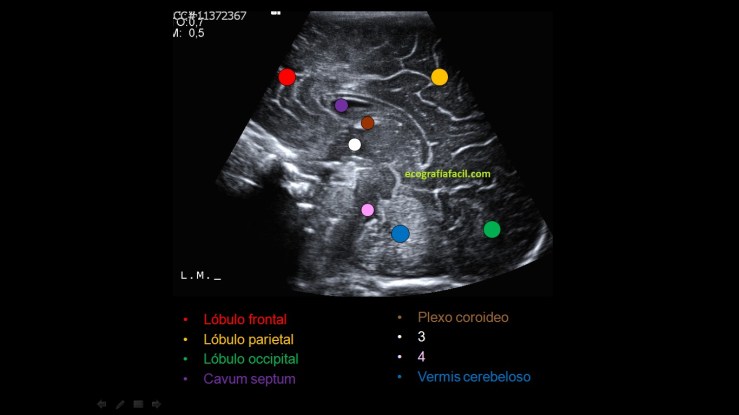
    • LÓBULO FRONTAL, LÓBULO PARIETAL, LÓBULO OCCIPITAL, CUERPO CALLOSO, CAVUM SEPTI, PLEXO COROIDEO, TERCER Y CUARTO VENTRÍCULO, SURCO DEL CÍNGULO

Good evening, we face this beatiful Post to talk about sagittal cuts in the transfontanel study of neonatal and nursing patients.

Once the coronal sections are finished, we will rotate our probe over the anterior fontanelle so that we have to see the head in its sagittal slice on the screen of our ultrasound machine …

To explain these cuts I need a coronal image with the necessary angulations to see the ultrasound anatomy of the sagittals, look.

Starting from a central sagittal section where on one side of the screen we will see the frontal region and on the other the occipital region, we will angle from right to left of the head through the whole head in sagittal and if the study is normal, we will do this briefly:

TRANSDUCER LONGITUDINALLY PLACED TO THE PREVIOUS window
SEE RIGHT SIDE, LINE AVERAGE AND LEFT SIDE, indicate on the screen the side studied …
SIDES RIGHT AND LEFT
FRONTAL LOBE, PARIETAL LOBE, TALAM, CHOROID PLEXUS
MIDDLE LINE
FRONTAL LOBE, PARIETAL LOBE, OCCIPITAL LOBE, CALLY BODY, CAVUM SEPTI, CHOROID PLEXUS, THIRD AND FOURTH VENTRICLE, SURFACE OF THE CELL

Es muy importante que los cortes sagitales sean puros para no desvirtuar la anatomía ecográfica, por eso la técnica y la experiencia son claves en este estudio.

It is very important that the sagittal cuts are pure so as not to detract from the ultrasound anatomy, that is why technique and experience are vital in this study.

Corte 1:

Corte 2:

Corte 3:

El corte 1 es el más lateral, luego angulamos buscando la línea media y paramos en el corte 2 y finalmente vamos a al corte que más anatomía nos demuestra, el corte de la Línea Media, repetimos corte 1 y 2 en el otro lado de la cabeza…

Cut 1 is the most lateral, then angulate looking for the middle line and stop at cut 2 and finally we go to the cut that shows more anatomy, the cut of the Midline, we repeat cut 1 and 2 on the other side of the head…

Cuando tienes un compromiso contigo misma/o, buscas fuerza y disciplina para anteponer tu sueño por encima de tu pereza…@patri_psicologa

When you have a commitment to yourself, you seek strength and discipline to put your dream above your laziness

Buenas noches…


122. Ecografía Transfontanelar. Cortes Coronales.

Empezamos la exploración del SNC en Lactantes/Neonatos. Voy a dividirlo en varias partes, según los accesos que tendremos con la sonda ecográfica a través de las fontanelas y sus cortes además el estudio vascular habitual, después la patología habitual. Es largo, pero es muy bonito.

La ecografía transfontanelar tendrá un acceso principal, que será la Fontanela Anterior. Desde ella podremos realizar los cortes básicos que toda exploración ecográfica transfontanelar o transcraneal debe tener.Luego tiene otros accesos, secundarios, por otras fontanelas.

Realizaremos, finalmente cortes Coronales, Sagitales y Axiales, estas últimas, como he dicho en el párrafo anterior desde otras Fontanelas.

Para realizar la exploración necesitamos un/a paciente Neonato o Lactante, da igual en el las salas de la ecografía o en las unidades de Neonatos ya que podemos ir con nuestro ecógrafo a realizar la exploración allí con la misma efectividad.

En caso de pacientes lactantes es necesario que no sean muy mayores, a medida que crecen las fontanelas se cierran y el acceso es peor, obviamente, empeorando la sensibilidad del estudio.

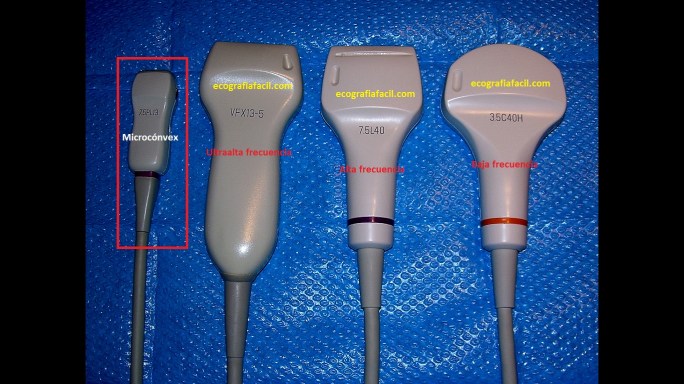
Necesitamos sondas de alta frecuencia, microcónvex, por elección (como la de la imagen) y si no disponemos de ellas, una lineal de alta frecuencia puede valer.

We begin the exploration of the CNS in Infants / Neonates. I am going to divide it into several parts, according to the accesses we will have with the sonographic probe through the fontanelles and its cuts, in addition to the usual vascular study, after the usual pathology. It’s long, but it’s very beautiful.
The transfontanelar ultrasound will have a main access, which will be the Anterior Fontanelle. From it we can make the basic cuts that any trans-cellular or transcranial ultrasound scan should have. Then it has other accesses, secondary, by other fontanels.
We will finally make Coronal, Sagittal and Axial cuts, the latter, as I said in the previous paragraph from other Fontanelles.
To perform the examination we need a Neonatal or Infant patient, it does not matter in the ultrasound rooms or in the Neonatal units since we can go with our ultrasound to perform the exploration there with the same effectiveness.
In case of nursing patients it is necessary that they are not very old, as the fontanelles grow they close and the access is worse, obviously, worsening the sensitivity of the study.
We need high frequency probes, microconvex, by choice (like the image) and if we do not have them, a linear high frequency can be worth.

La posición de la/el bebé debe ser decúbito supino para nuestra comodidad, en los casos de ecografías portátiles realizadas en las unidades de neonatos encontraremos dificultades de posicionamiento y de acceso, muchos de estxs pacientes se recuperan en incubadoras y pueden estar colocadxs en diferentes posiciones como decúbito prono y cabeza lateral y tendremos que adaptarnos a su colocación.

Siempre que introduzcamos dentro de una incubadora nuestras sondas debemos haberlas limpiado convenientemente, incluido el cable, para no introducir elementos bacteriológicos nocivos dentro de la incubadora, igualmente debemos hacer con nuestras manos, siempre limpias y con guantes.

The position of the baby should be supine for our comfort, in the cases of portable ultrasound performed in the units of neonates we will find positioning and access difficulties, many of these patients recover in incubators and may be placed in different positions as prone and lateral head decubitus and we will have to adapt to its placement. Whenever we introduce our probes into an incubator, we must have cleaned them properly, including the cable, so as not to introduce harmful bacteriological elements into the incubator, we must also do it with our hands, always clean and with gloves.

Cortes Coronales

Bien, después de estas consideraciones, vamos a entrar de lleno en el protocolo estudiando los Cortes Coronales. Para ello localizamos la fontanela anterior, ponemos nuestra sonda en transversal en ella, para realizar cortes coronales de la cabeza y sin moverla nos tenemos que angular de anterior a posterior de la cabeza para realizar los cortes…Es vital asegurarnos de la lateralidad correcta en el estudio de cada uno de los hemisferios laterales.

Well, after these considerations, we will enter fully into the protocol studying the Coronal Courts. For this we locate the anterior fontanelle, we put our probe in transversal in it, to make coronal cuts of the head and without moving it we have to angular, without moving from the fontanelle, from anterior to posterior of the head to make the cuts … It is vital to ensure correct laterality in the study of each of the lateral hemispheres.

Resumo:

  • TRANSDUCTOR EN FONTANELA ANTERIOR TRANSVERSALMENTE (MARCA A LA DERECHA DEL PACIENTE)
  • BARRIDOS DE ANTERIOR A POSTERIOR
  • SEIS IMÁGENES ESTÁNDAR:
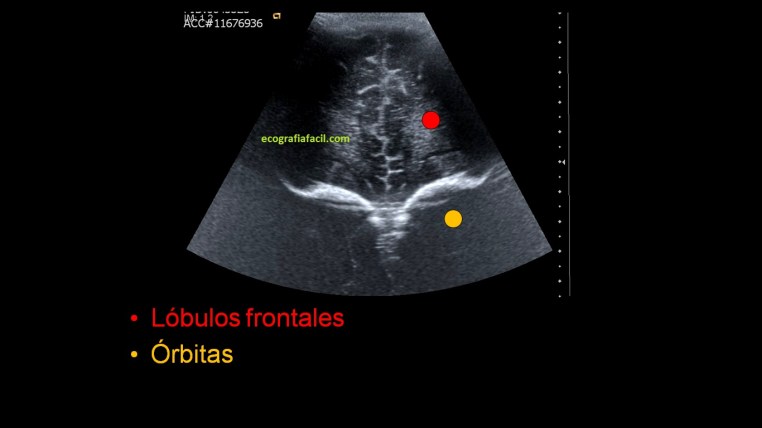
  1. LÓBULOS FRONTALES, ÓRBITAS EN BASE DE CRÁNEO
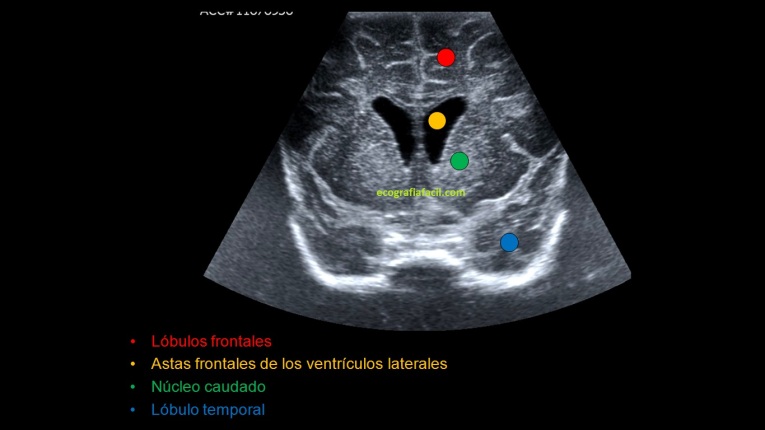
  2. ASTAS FRONTALES DE VENTRÍCULOS LATERALES, LÓBULOS TEMPORALES, LÓBULOS FRONTALES, CISURA INTERHEMISFÉRICA
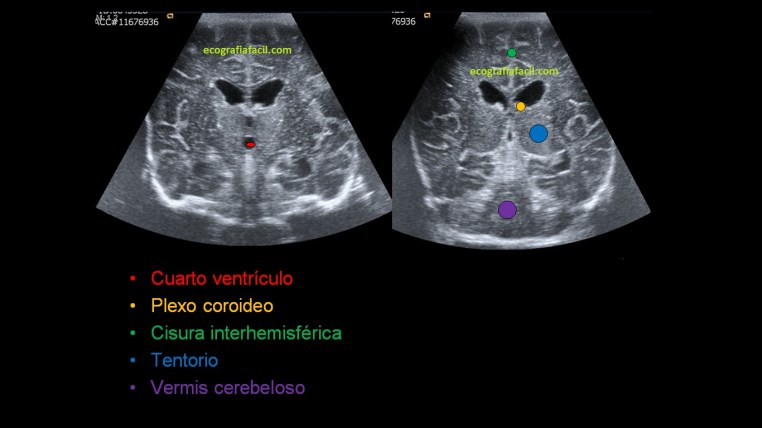
  3. LÓBULOS FRONTALES, TRONCO CEREBRAL
  4. CUERPO VENTRÍCULO LATERAL, PLEXO COROIDEO, TÁLAMO
  5. LÓBULO PARIETAL, GLOMUS DEL PLEXO, CEREBELO
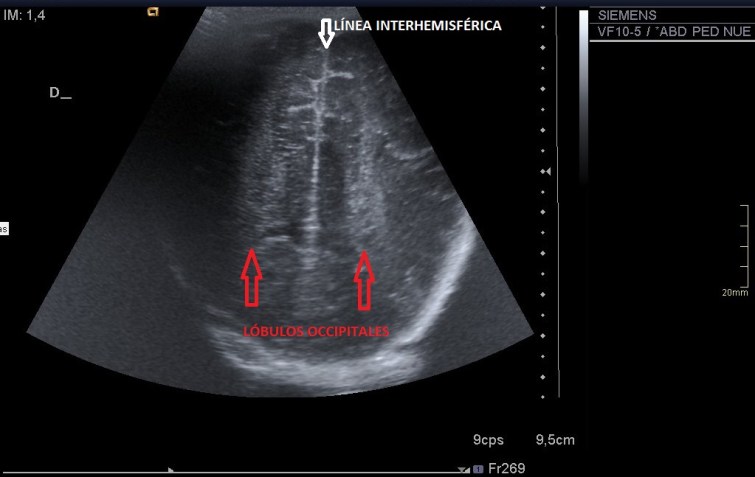
  6. LÓBULO OCCIPITAL
Summary:

TRANSDUCER IN FONTANELA ANTERIOR TRANSVERSALLY (MARK ON THE RIGHT OF THE PATIENT)
BARRIDES FROM PREVIOUS TO POSTERIOR
SIX STANDARD IMAGES:
-FRONTAL LOBE, ORBITS IN SKULL BASE
-FRONTAL STICKS OF SIDE VENTRICLES, TEMPORAL LOBES, FRONTAL LOBE, INTERHEMISPHERIC CISURE
-FRONTAL LOBE, CEREBRAL TRUNK
-LATERAL VENTRICLE, PLEXUS COROIDEO, TALAMO
PARIETAL LOBE, GLOMUS OF THE PLEXUS, CEREBELLUM
-OCCIPITAL LOBE

Es absolutamente vital la correcta realización de esta técnica, de alto nivel, en la que es inexcusable conseguir la simetría entre ambos hemisferios laterales con el fin de localizar asimetrías que puedan indicar patología cerebral. Siempre que realizando la técnica correctamente veamos asimetrías es obligatorio consultar con la/el radiólolx.

Para empezar es necesario ver desde un Plano Sagital los cortes que tenemos que realizar para la visualización de los cortes coronales, pincha en el enlace y ahora mira los cortes coronales estándar que tienes que realizar:

The correct realization of this high-level technique is absolutely vital, in which it is inexcusable to achieve symmetry between both lateral hemispheres in order to locate asymmetries that may indicate brain pathology. Whenever performing the technique correctly we see asymmetries it is mandatory to consult with the radiololx.
To begin it is necessary to see from a Sagittal Plane the cuts that we have to make for the visualization of the coronal cuts, click on the link and now look at the standard coronal cuts that you have to make:

Corte 1.Coronal.Anterior:

Corte 2:

Corte 3:

Corte 4:

Corte 5:

Corte 6:

Has visto que en algunos cortes he puesto alguna imagen más, para que comprendas mejor y puedas buscar mejor la anatomía ecográfica y obviamente, yo lo hago, siempre saco más imágenes que los 6 estándar mínimos que hay que realizar.

You have seen that in some cuts I have put some more images, so that you understand better and you can look better for the ultrasound anatomy and obviously, I do it, I always get more images than the 6 minimum standards that have to be done.

Sé tú mismo/a, Piensa Positivo, Vive el Presente, Sueña, actúa con Pasión, No te rindas jamás,Trabaja duro…y Sonríe…

Be yourself, Think Positive, Live the Present, Dream, act with Passion, Never give up, Work hard … and Smile


121. SNC en Pediatría.Consideraciones.

El sistema nervioso central de un/a lactante puede ser estudiado con ecografía y comprende dos regiones anatómicas, la cabeza, que se estudia con la técnica conocida como ecografía transfontanelar y la ultima porción de la Columna con la técnica ecográfica que explora el Canal Vertebral.

El problema es el crecimiento de la/el lactante, la ecografía transfontanelar aprovechará las fontanelas cerebrales, cuanto más mayores son, las fontanelas estarán más cerradas y por tanto la dificultad del estudio aumentará.Algo similar pasa con el canal vertebral, que a medida que la osificación de la columna sea más importante, tanto más imposible será realizar esta técnica.

A nivel de importancia, la ecografía transfontanelar es sin duda la más impotante, por la cantidad de patologías que pueden estudiarse y porque es una de las más demandadas en las unidades de neonatología intensiva de los hospitales.

Ventajas:

  • PORTÁTIL
  • NO RADIA
  • NO NECESITA SEDACIÓN
  • ESTUDIO EN TIEMPO REAL
  • BARATA

Desventajas:

  • HASTA LOS 12-14 MESES
  • Técnica operador dependiente

Como siempre, pero más en esta técnica que empezamos hoy, conocer la anatomía del cerebro y el canal vertebral es vital. La anatomía cerebral es compleja, desgranaremos en siguientes posts todo, muy desmenuzado para que quede claro.


The central nervous system of an infant can be studied with ultrasound and includes two anatomical regions, the head, which is studied with the technique known as transfontanelar ultrasound and the last portion of the spine with the ultrasound technique that explores the Vertebral Canal.
The problem is the growth of the infant, the transfontanel ultrasound will take advantage of the cerebral fontanelles, the older they are, the fontanelles will be more closed and therefore the difficulty of the study will increase.
Something similar happens with the vertebral canal, which as the ossification of the spine is more important, the more impossible it will be to perform this technique. Importantly, transfontanelar ultrasound is undoubtedly the most important, due to the number of pathologies that can be studied and because it is one of the most demanded in intensive neonatology units of hospitals.
Advantage: Portable, no radiation, IT DOES NOT NEED SEDATION REAL-TIME STUDY CHEAP
Disadvantages: UNTIL 12-14 MONTHS Dependent operator technique
As always, but more in this technique that we started today, knowing the anatomy of the brain and spinal canal is vital. The cerebral anatomy is complex, we will break down in next posts everything, very crumbled so that it is clear.