117. Estenosis hipertrófica de píloro.

Este tipo de patología es habitual en los servicios de urgencia pediátrica de los hospitales. Lxs pediatras encuentran pacientes con unos signos que pueden hacerles pensar en esta patología y hacen peticiones para descartar la Estenosis Hipertrófica de Píloro.

  • VÓMITOS Y LLANTO INCONSOLABLE, es típico de estxs lactantes.
  • PRECISIÓN DIAGNOSTICA DEL 100% EN TÉCNICA RELATIVAMENTE FÁCIL, SONDA DE + DE 7,5 MHZ
  • LOCALIZAR PÍLORO EN con el/la paciente en OPD
    • Posicionamos en OPD, localizamos estómago y seguimos su recorrido buscando el bulbo gástrico, finalizando el estómago vamos a empezar a ver región pilórica. Tenemos que estudiar esta región en axial y en longitudinal.
  • HALLAZGOS:
  1. –MASA MUSCULAR ENGROSADA HIPOECOGÉNICA INMEDIATAMENTE SUPERFICIAL A LA MÁS ECOGÉNICA CAPA MUCOSA DEL CONDUCTO PILÓRICO
  2. –MASA MUSCULAR DE MÁS DE 2 MM ES PATOLÓGICA, MAyor de 3mms 100% seguridad  en el diagnóstico.
  3. –LONGITUD CANAL PILÓRICO DE 15 MM MÁXIMO
  4. –DIÁMETRO DEL PÍLORO MAYOR DE 11 MM
  • OTROS HALLAZGOS:

–PERISTALTISMO DE LUCHA EN ANTRO

–NO APERTURA DE PÍLORO

This type of pathology is common in the pediatric emergency services of hospitals. Pediatricians find patients with signs that can make them think about this pathology and make requests to rule out Pyloric Hypertrophic Stenosis. VOMITING AND UNCOMFORTABLE CRYING, is typical of these infants. DIAGNOSTIC PRECISION OF 100% IN RELATIVELY EASY TECHNIQUE, PROBE + 7.5 MHZ LOCALIZE PILLS IN with the patient in OPD,
We position in OPD, locate stomach and continue its journey looking for the gastric bulb, ending the stomach we will begin to see pyloric region. We have to study this region in axial and longitudinal.
 FINDINGS: MUSCULAR MASSIVE HYPOECHOGENIC IMMEDIATELY SUPERFICIAL TO THE MOST ECOGENIC MUCOUS LAYER OF THE PILORETIC DUCT -MUSCULAR MASS OF MORE THAN 2 MM IS PATHOLOGICAL -PILORIC CHANNEL LENGTH OF 15 MM MAXIMUM – DIAMETER OF THE PILLAR GREATER THAN 11 MM OTHER FINDINGS: -THE CONTROL OF ANTRO FIGHT -NO PILLOW OPENING

En la imagen vemos un corte axial de una tripa. el píloro, está engrosada, hipoecogénica lo marca la flecha roja, y se mide con una medida que indica la flecha amarilla, en azul la luz del píloro…

In the image we see an axial cut of a gut. the pylorus, is thickened, hypoechoic marked by the red arrow, and is measured with a measure that indicates the yellow arrow, in blue the light of the pylorus

Para esta técnica es necesario una gran dosis de paciencia.

A great deal of patience is necessary for this technique.

No puedo con este frío…me consume…
 

116. Riñón en Herradura

Gracias, antes de nada, por hacer que este Blog siga creciendo, en Insta, más de 500 seguidores y me encanta porque es mi red favorita…os espero para que visites el perfil y sigas el Blog…

Thanks, first of all, for making this Blog keep growing, in Insta, more than 500 followers and I love it because it’s my favorite network … I’m waiting for you to visit the profile and follow the Blog …

Tenemos, dentro de las malformaciones habituales a nivel renal que podemos encontrar por «casualidad» en la edad infantil, los Riñones en Herradura.

Es una figura que en ecografía suele ser un hallazgo, a veces en la edad adulta si nunca se exploró el abdomen, casi siempre en la edad pediátrica…

Te enlazo aquí para que conozcas en imágenes esta figura malformativa y te presento la imagen ecográfica, que es a veces difícil de explorar, puesto que vamos a ver unos riñones malrotados o situados de forma anómala y tenemos que ver siempre la independencia morfológica de ambos polos renales…

We have, in the usual malformations at the renal level that we can find by «chance» in childhood are the Kidneys in Horseshoe. It is a figure that in ultrasound is usually a finding, sometimes in adulthood if the abdomen was never explored, almost always in the pediatric age … I link you here so that you know in images this malformative figure and I present the sonographic image, which is sometimes difficult to explore, since we are going to see some malformed or abnormally located kidneys and we must always see the morphological independence of both poles kidney …

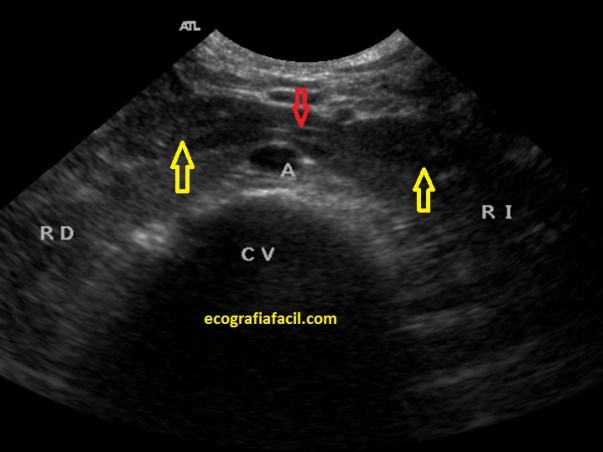
El aspecto del riñón en herradura en cuanto a su semiología es de lo más normal, pero cuando hacemos la exploración vamos a poder comprobar que el polo inferior del riñón, normalmente el derecho, porque es el que primero se explora, se orienta  y continua buscando la línea media y comprobaremos como pasa por encima de Aorta, es decir, anterior a ésta y a la Cava Inferior, lógicamente.

Las flechas amarillas marcan ambos riñones y la flecha roja su unión.

Casi siempre se unen los polo inferiores de los riñones.

The aspect of the horseshoe kidney in terms of its semiology is the most normal, but when we do the exploration we will be able to verify that the lower pole of the kidney, usually the right one, because it is the one that is first explored, is oriented and continues to search the middle line and we will check how it passes over Aorta, that is, prior to this and to the Lower Cava, logically. The yellow arrows mark both kidneys and the red arrow their union. The lower poles of the kidneys are almost always joined.

El esfuerzo por aprender es costoso, pero más lo es el de desaprender, y es igual de necesario…


115. Nefrocalcinosis.

Seguimos en este año 2019 en el que te deseo mucha Salud, y que la vida te sea muy favorable, no es perfecta, no es todo color de rosa, pero que sea lo más amable posible.

Otro MicroPost para hablar de una patología poco habitual en pediatría, pero que como figura patológica muy llamativa ecográficamente podemos ver es la Nefrocalcinosis, te lo enlazo para que conozcas más de esta patología. rara en pediatría como he dicho antes, pero es tan llamativo el caso que quería presentarlo aquí.

Datos básicos:

-Es la calcificación del parénquima renal. Puede se distrófica o metastásica.

-La calcificación distrófica se debe al depósito de calcio como consecuencia de una isquemia o necrosis.

-La nefrocalcinosis metastásica suele deberse a estados hipercalcémicos. (Insuficiencia renal, hipoparatiroidismo y neoplasias malignas.)

Vamos a ver unos riñones así en la ecografía:

We continue in this year 2019 in which I wish you much Health, and that life is very favorable, is not perfect, it is not all rosy, but that is as friendly as possible. Another MicroPost to talk about an unusual pathology in pediatrics, but that as a very striking pathological figure we can see ultrasound is Nephrocalcinosis, I link it to you to know more about this pathology. rare in pediatrics as I said before, but the case is so striking that I wanted to present it here. Basic data: – It is the calcification of the renal parenchyma. It can be dystrophic or metastatic. -Dystrophic calcification is due to the deposit of calcium as a result of ischemia or necrosis. -The metastatic nephrocalcinosis is usually due to hypercalcemic states. (Renal insufficiency, hypoparathyroidism and malignant neoplasms.) We are going to see some kidneys like this in the ultrasound:

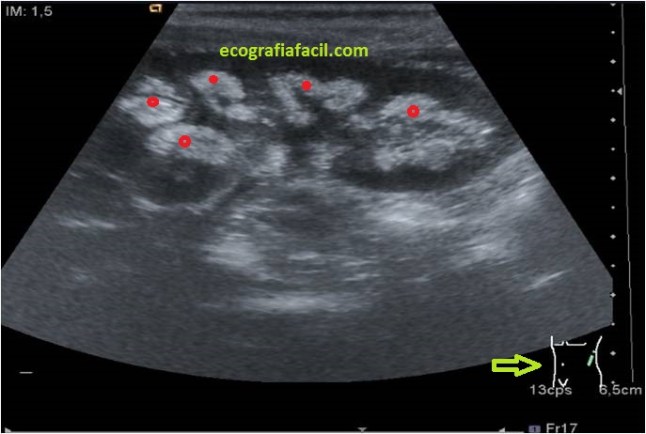
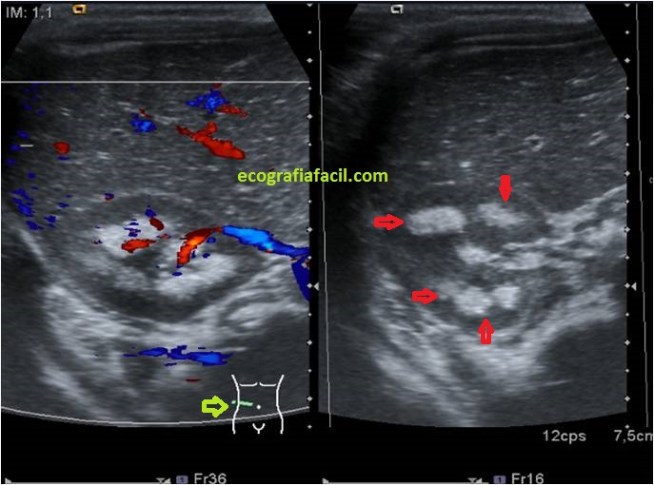
En las imágenes superiores ves un corte longitudinal y otro axial del riñón.Marcado con círculos o flechas rojas, los pielones caliciales hiperecogénicos, muy llamativamente, indican patología a dicho nivel, la corteza renal, hipoecogénica y normal.

In the upper images you see a longitudinal and axial cut of the kidney. Marked with red circles or arrows, the hyperechoic calyceal skin, very strikingly, indicates pathology at this level, the renal cortex, hypoechoic and normal.

Vértigo…Soñar, Esfuerzo y Saber Esperar.